US president Donald Trump’s administration imposed sanctions on the International Criminal Court on Friday, hours after one of its former judges won the Nobel Peace Prize, putting Washington on a diplomatic collision course with European allies.
The Nobel Peace Prize was awarded to Navi Pillay, a South African human rights lawyer and jurist, in an endorsement of the importance of international law as it comes under “tremendous pressure”.
The Nobel committee said on Friday that Pillay (85), who has served on International Criminal Tribunal for Rwanda and the International Criminal Court, was a “lawyer and legal pioneer”.
It added the 2026 award came as “the system of international law is under tremendous pressure, and its institutions are under attack”.
RM Block


The prize is likely to be seen as a shot across the bows of many autocrats and even democratically elected leaders such as US president Donald Trump and Israeli prime minister Binyamin Netanyahu.
Within hours of the announcement, the US issued sanctions against the entire International Criminal Court in an attempt to hobble its ability to function, stepping up Trump’s campaign to dismantle what he says is an “anti-American tribunal”.
Under the sanctions order published on Friday, companies have 180 days to stop trading with The Hague-based war tribunal. US secretary of state Marco Rubio said that the US was still hoping for “a diplomatic solution” that addresses US “concerns”, without specifying what that would involve.
Last year, Pillay chaired a UN commission that determined that Israel had committed genocide in Gaza, an accusation Israel has vehemently denied.
The Nobel committee said that from her early work as a lawyer, including defending Nelson Mandela, Pillay has become “one of the most respected international jurists of our time”.
“Her distinguished career reminds us of the need to support, fortify and expand the global rule of law,” it added.
In a video shared on social media shortly after the announcement, a visibly surprised Pillay quipped: “If you clap a little bit more, I may share this prize with Trump.”
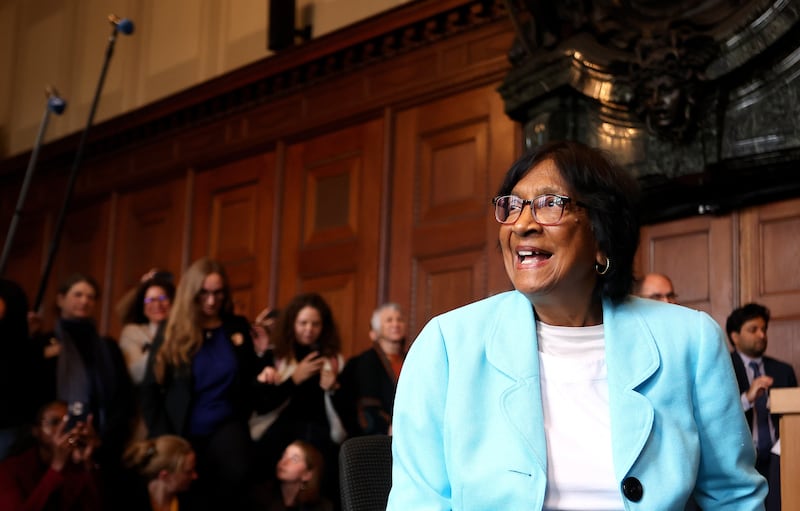
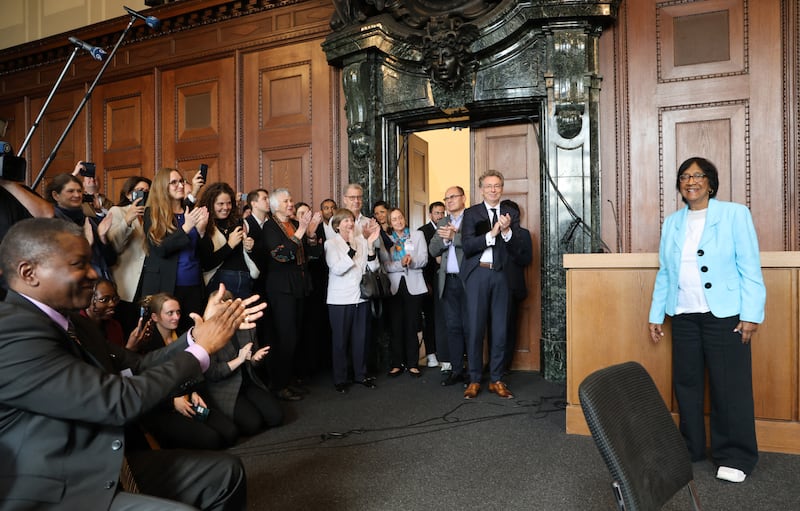
Speaking later in Nuremberg, where she was attending a gathering of international lawyers, she described the news as “so totally unexpected that I’m still reeling with surprise”.
She said that while she had received many honours in her life, “this is the highest and best”. She dedicated the award to “survivors of international crimes”.
Pillay was born in 1941 in Durban, South Africa, to a family of Indian Tamil origin. Her father was a bus driver, while her mother was denied education under apartheid.
“I was treated like dirt just because of my skin colour,” she told South Africa’s The Citizen newspaper in 2023, recalling how even her later legal qualifications could not shield her from discrimination. But she said that she “learned not to succumb to that”.
Pillay opened her own legal practice in 1967 because no white law firm in South Africa would hire a woman of Indian descent, and went on to defend anti-apartheid activists on Robben Island.
But it was her subsequent work in Rwanda that would reshape international criminal law. As president of the International Criminal Tribunal for Rwanda, Pillay co-authored a groundbreaking 1998 judgment that established that mass rape and sexual violence constitute acts of genocide.
The Nobel committee said Pillay’s work confronted “deep structural discrimination, segregation and exclusion”.
It said that in “historic” international court cases, Pillay has shown that “legal measures can help prevent acts of war and violence” and contributed to strengthening the institutions of international law.
Israel reacted angrily to the choice of Pillay. Its foreign ministry called her prize “the grotesque weaponisation of an award to legitimise anti-Israel hatred and prejudice”.
“Now that the Nobel commission has rewarded the biggest lie of the 21st century, Joseph Goebbels is certainly applauding from hell,” it added.
The award signalled the Nobel committee’s intent to underscore the importance of the rule of law in an increasingly volatile geopolitical environment.
“The institutions that uphold the international law are under tremendous pressure, sanctions and attack,” said Jorgen Watne Frydnes, chair of the Norwegian Nobel Committee.
“In the world we are living in, with more conflicts [than] in a long time, supporting, strengthening and also expanding the work of these institutions are key to a more peaceful world,” he added.
– Copyright The Financial Times Limited 2026