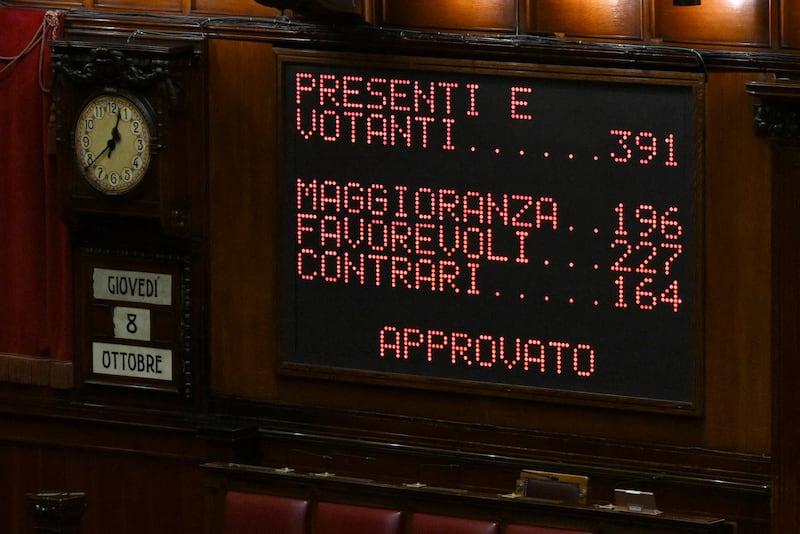
The Italian parliament passed a contentious electoral reform on Thursday that prime minister Giorgia Meloni says will increase political stability but opponents criticise as self-serving in advance of an election due by the end of next year.
The new law awards parties that win more than 42 per cent of votes with extra seats in both houses of parliament, cementing their majority while toughening requirements for new parties to contest elections.
Meloni said the law was “giving citizens back the power to directly choose who represents them” as it introduces an element of preferential choice among candidates.
It will also incentivise the formation of large coalitions of parties to contest elections, which will have to set out a programme and a prime ministerial candidate in advance of the vote rather than leaving these for post-vote government formation talks.
RM Block


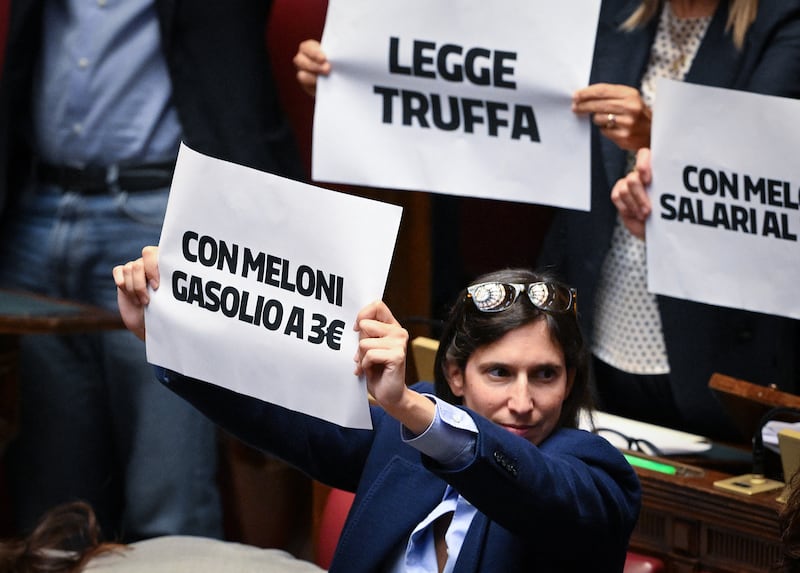
But opposition parties have accused the prime minister of changing the rules to favour her own party and have promised to challenge the Bill in Italy’s constitutional court.
[ Meloni electoral plan ‘authoritarian’ Italy’s opposition saysOpens in new window ]
“Meloni, just months before the election, is changing the rules of the game,” said centre-left leader Elly Schlein, accusing Meloni of fearing the electorate.
Lawmaker with the More Europe party Riccardo Magi has been on hunger strike for a week in protest against a large increase in the number of signatures that parties would need to collect under the law in order to stand in any multiseat constituency, from 1,500 to 6,000.
“We will continue to fight, including outside of parliament, because this isn’t about us but about democracy, which can’t be locked away with a key by those who are temporarily in power,” Magi said.
He estimated that parties would have to collect 450,000 signatures, all in person, in order to run nationwide, calling this “blatantly unconstitutional”.
The Meloni government is reportedly already preparing potential tweaks to the law in case the court rules against it, including adjustments to the seat bonus that would be awarded in the Senate to reflect a constitutional requirement that Italy’s upper house is elected regionally.

Why is the government changing the law?
Successive Italian governments have sought to change the country’s electoral system, promising to increase stability and move away from a tendency for short-lived governments that defined much of its postwar history.
Each law is given a mock-Latin nickname with the suffix “ellum”.
The “Matarellum” in 1993 ended a proportional electoral system that had been in place since 1946, introducing a mix of proportional and first-past-the-post elements.
This was replaced by the 2005 Porcellum, a derogatory nickname that stuck after the law’s author publicly described it as a “porcata”, a piece of crap.
The Porcellum was found to be unconstitutional and was replaced in 2013 by the Italicum, which was also found to be unconstitutional, and was repealed before it was ever used.
The current Rosatellum system was introduced in 2017. Meloni’s government was elected under it and won a significant majority in parliament, helping it to become Italy’s longest-ruling administration since the second World War.
However, Meloni and her party have long sought a reform that would make Italian parliamentary elections more “presidential”, with a prime ministerial candidate named on the ballot.
This idea has troubling associations for some due to the cult of personality that surrounded its former fascist leader Benito Mussolini, who is part of the political heritage of Meloni’s party.
Due to internal opposition within their governing coalition, this idea did not make it into the current proposed law, though parties will have to name a prime ministerial candidate during their election campaign.
The Meloni government has given its law the flattering name “Stabilicum”, but opponents refuse to use it and call it the “Melonellum” after Meloni herself, which sounds like “melon-law”.