The success of Irish firms on international markets over the past 12 years has been little short of remarkable. Despite the challenges faced - including Brexit, the Covid pandemic, US tariffs, wars in the Middle East and Ukraine - exports from Irish companies increased by 89 per cent over the period and reached a record high of €38.8 billion last year, up 8 per cent on the previous year.
That success is rightly celebrated, but what receives less attention is its impact on communities here at home. That’s the main focus of Enterprise Ireland’s Growing Home campaign.
“We want to highlight the contribution these companies make to towns and villages across the country,” says Enterprise Ireland chief executive Jenny Melia. “Enterprise Ireland’s mandate is to help home-grown Irish companies to start, scale and grow on international markets. It’s also about building sustainable communities by investing in Irish exporting businesses.”
Those companies might be growing overseas, but they are investing back home, she explains. “Enterprise Ireland supported companies now employ over 232,000 people across the country, an increase of 40,000 since 2014. They are spending on salaries, local supply chains, materials and so on. In 2025, Enterprise Ireland client companies spent €43.7 billion in the Irish economy.
RM Block


“When that money is spent in local towns and villages, it lifts all boats. It supports the next tier of enterprises in those areas. That includes coffee shops, restaurants, hotels and other local businesses. It brings vibrancy and energy into towns and villages which become magnets for tourism, both domestic and international. That flywheel effect is very powerful.”
The impact on regional Ireland is plain to see. “Our regional development mandate is very important,” says Melia. “Of the 12,609 new jobs created by client companies in 2025, 69 per cent of them were outside Dublin. It’s very much about balanced regional development. Dublin is very important, but it is equally important to focus our efforts on the regions outside of the capital.”
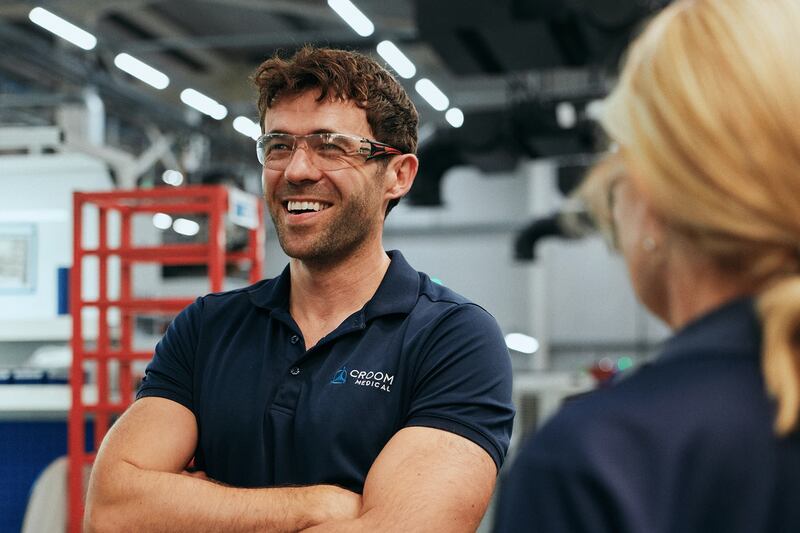
The Growing Home campaign features the contribution made by a number of companies in a variety of sectors across the country. These companies include Croom Medical in Limerick, Merenda in Manorhamilton, Co Leitrim, Fenergo in Dublin, Revive Active in Galway and Westmeath, and Mullan Lighting in Co Monaghan.
“The campaign really speaks to the positive impact of growing Irish indigenous exports on local communities,” says Melia. “The companies featured in the campaign all have in common the ambition to be leaders in their space, to grow the exporting side of the business and a commitment to give back to their local communities. For example, Mullan Lighting now employs over 100 people in what was an old boot factory and 90 per cent of its output is exported. The team there spoke to us about how as the business found its feet, it brought the village of Mullan back to life and allowed a community to grow around it.”
Emphasising the critical importance of export success, Melia says Enterprise Ireland’s ambition is for Irish exporters to become the primary driver of the economy in the years ahead.
“In a small country like Ireland with a population of 5.5 million, startups need to be export-focused from the get-go,” she says. “When we look at last year’s export results, we saw growth in all major markets and in all sectors. And when you look at how that growth breaks down across markets and sectors it speaks to the importance of a well-diversified industry base.
“For example, food and drinks exports to the UK grew by more than 10 per cent last year but fell back in the US due to the imposition of tariffs. However, technology and services exports to the US exceeded €3 billion and brought overall exports to that market into positive territory. A regionally balanced and diversified indigenous enterprise base working alongside the FDI community will be a key driver of the Irish economy.”
That feeds into the Growing Home campaign, she adds. “When Irish companies scale and succeed in overseas markets the impact is felt in new jobs, higher salaries, an increased spending in local supply chains, higher quality of life, increased spending power and more domestic economy spend.”
That provides a launchpad for the next wave of startups. “These companies show the next generation what can be achieved if you choose to become an entrepreneur,” she says. “I meet entrepreneurs who have chosen to start businesses because they have seen what other entrepreneurs have achieved and delivered for their communities. They want to do that as well and they want to go further and see what’s possible.”
Those entrepreneurs are innovating and embracing new technologies, she notes. “Just over half of startups supported by Enterprise Ireland last year had artificial intelligence (AI) at the centre of their propositions. Enterprise Ireland client companies spent €1.68 billion on R&D last year. That’s a very significant figure. There is a very high level of connectivity between the enterprise and the research communities. Researchers in the third-level system are working in partnership with indigenous companies to create new knowledge and intellectual property. Small and medium sized companies often don’t have dedicated in-house R&D resources and can begin their innovation journey by working with a third level institution close by.”
Enterprise Ireland supports 26 Technology Centres and Gateways around the country which give companies access to expertise and skills to help them innovate, she points out.
“A good starting point for companies is an Enterprise Ireland Innovation Voucher that they can use to work with a Technology Centre. They can move on from there to a larger Innovation Partnership support and avail of other Enterprise Ireland R&D supports as well as the R&D Tax Credit, as their R&D grows.”
Looking ahead, she points to the existence of a vibrant startup environment in Ireland. “We want to build on that and our five-year strategy to 2029 will see us support more than 1,000 startups. Some are already scaling and growing quickly in international markets. These companies represent the next wave of industry leaders coming through the system.”
Enterprise Ireland’s recently launched Startup Ireland initiative is aimed at making it easier for entrepreneurs to start, build and scale globally successful companies from Ireland, she adds. “It’s about building a coherent and founder-friendly national startup support system, by accelerating startup and scale up creation through stronger pathways from startup to scale across regions and sectors, and by positioning Ireland as a connected, globally relevant startup hub.”
The initiative has been tailored to meet the specific needs of Irish startup founders. “My colleagues at Enterprise Ireland spent time on the road last year speaking to over 500 entrepreneurs to find out what’s important to them and what the initiative should deliver to have maximum impact.”
The overall aim is to help entrepreneurs and founders to achieve their global ambitions for their businesses and to have a positive impact on their local communities, she points out.
“We are very proud of the Growing Home campaign,” Melia concludes. “When you look at the videos and stories on the website you can see the impact home-grown businesses are having in towns and communities across Ireland, from supporting local sports clubs and schools to creating employment opportunities close to their home. Their success means people working for them have the option to work local, to live local, and to enjoy a better quality of life.
“Indigenous Irish companies are a vital driver of Ireland’s economy, and Enterprise Ireland’s ambition is to help them become the primary engine of economic growth across every region. The stories featured in Growing Home show the real and lasting impact they have on communities throughout the country, and it is very uplifting to see.”