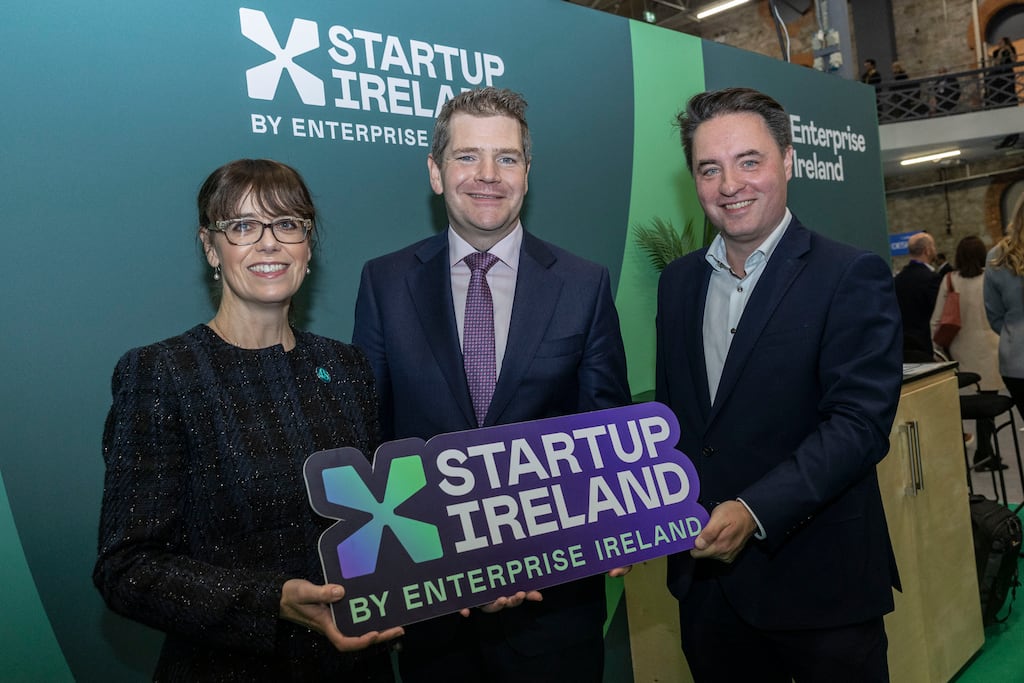

Led by Enterprise Ireland, the newly launched Startup Ireland initiative aims to strengthen the State’s future economy by building a world-class start-up ecosystem.
Among its key goals up to 2030 are to back 10,000 new entrepreneurs nationwide, support 1,000 new start-ups through equity investment, invest €150 million in direct early-stage funding, increase the number of start-ups reaching €1 million in turnover by 20 per cent, grow the proportion of women-led start-ups supported by Enterprise Ireland to 35 per cent and significantly increase the number of university spin-outs and start-ups emerging from Ireland’s research ecosystem.
“There has never probably been a better time to be an entrepreneur, with AI and other technology advances making it possible to develop minimum viable products and prototypes very inexpensively and to bring ideation to early-stage products and solutions,” says Conor O’Donovan, head of Startup Ireland. “It is now possible to achieve customer traction very early on in a way that wasn’t possible even five years ago.”
The question is how to support and encourage more entrepreneurs and founders to set out on the start-up and scale-up journey.
RM Block


“Ireland has a dynamic base of innovative, export-focused Irish companies, but we need to increase the number of ambitious companies with the finance, talent, research capability and market access required to grow into global leaders,” says O’Donovan.
Enter Startup Ireland. “It’s designed to make it easier for the next generation of founders to start, scale and succeed from Ireland.”
The initiative was designed on the basis of extensive research. “The OECD did a report on the challenges facing the Irish start-up ecosystem,” says O’Donovan. “It also highlighted opportunities to strengthen it. We carried out our own research and benchmarked Ireland against other European member states in terms of their start-up ecosystems.”
A critical component of that research was a founders’ listening tour conducted by Enterprise Ireland staff last year. “We went to all parts of Ireland, met well over 500 founders from different companies, in different sectors, at different stages of development, across all regions, to understand their needs and what they’d like more support on into the future.
“The core principle underpinning the entire initiative is to ensure that it’s founder-centric and that founders’ needs are at the heart of what we’re doing.”
Startup Ireland is built on three central pillars. The development of a high-performing ecosystem will unite founders, Government, industry, academia and investors through the Startup Ireland brand, supported by a digital platform that makes the ecosystem faster and easier to navigate.
“In addition, the Government is establishing a Strategic Advisory Forum for start-ups which will ensure that founders have a voice in terms of shaping decisions around policy on start-ups and innovation,” says O’Donovan.
The accelerating start-up and scale-up creation pillar will expand founders’ access to finance, talent and markets through new national accelerator programmes, a refreshed Enterprise Ireland New Frontiers Programme, and a range of inclusive and sector-specific supports aimed at translating world-class research into new companies and creating faster pathways to market.
The first of those accelerator programmes was launched last month at the International AI Summit in Dublin. “The Startup Ireland AI Accelerator gives founders hands-on access to the tools, engineering expertise and capital needed to build an AI company that can compete internationally,” says O’Donovan.
The accelerator programme also includes a funded National Company Accelerator with a €100,000 investment for participants to accelerate their growth and international scaling.
A dedicated Talent Accelerator will support experienced individuals at pre-company and pre-idea stage to validate opportunities, form companies and progress towards pre-seed investment.
“It’s about bringing people with deep scientific and technical knowledge together with people with commercial expertise in a very supportive environment,” says O’Donovan. “We will help them build globally scalable, venture-backable start-ups from pre-idea and pre-company stage.”
The third pillar, connecting Irish and international ecosystems, will see the establishment of a flagship National Startup Hub which will provide founders with a single front door to the start-up ecosystem.
The National Startup Hub will connect Ireland’s start-up and innovation ecosystem both nationally and internationally by providing a convening point for founders, investors, multinational companies, researchers and other partners.
These are just a few of the programmes and supports which will be rolled out as part of the initiative, O’Donovan notes.
“Startup Ireland is about building the support structure to help the next wave of founders access the capital, talent, expertise and networks they need to grow their companies. It will be an evolving roadmap. It’s designed to be agile and flexible to respond to founder needs as they change over time. We’ve already launched the AI Accelerator and over the next 12 to 18 months we will release a number of other programmes and supports, including the National Startup Hub in 2028.”