

Finding the right energy solutions for your home or business can feel difficult. But it doesn’t have to be.
Electric Ireland helps you take control of your energy use and costs, supporting you to make informed decisions. The result is greater energy-independence and peace of mind. Solar installations start at under €5,300 including a Sustainable Energy Authority of Ireland (SEAI) grant, but mid-to-large installations are becoming more common. For instance, a solar system of 14 panels on a south-facing roof in the east of the country may generate approximately 5,450kWh per year, which could mean over €1,400 in savings annually depending on your electricity plan.
As product manager at Electric Ireland, Anne Marie McArdle knows exactly how easy finding the right solutions can actually be.
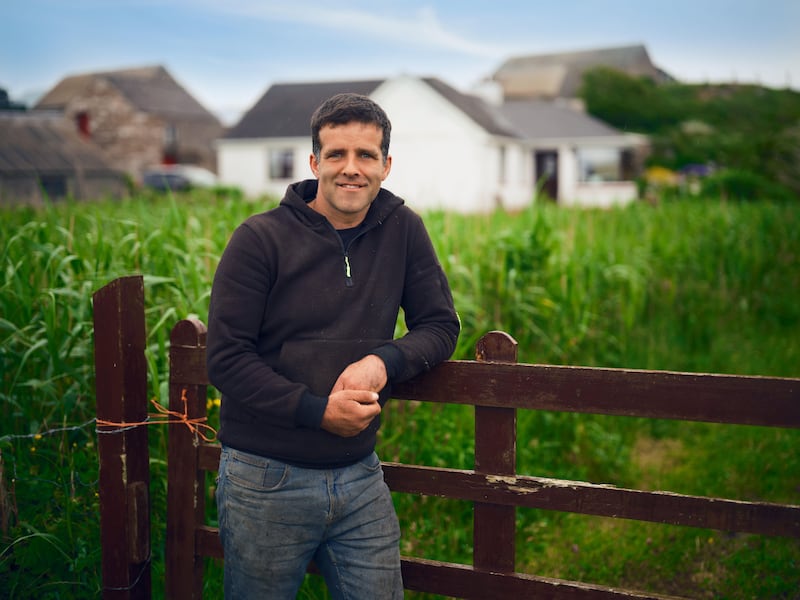
For example, she recently worked with Tom, a sheep farmer in Carrickfinn, a beautiful and remote part of northwest Donegal.
RM Block


“Tom’s is a working sheep farm in quite an isolated part of the country – the next parish over is the USA,” says McArdle. “But his family has farmed here for generations and he has a lot of relatives nearby, so he has deep roots in what is a very close-knit community.”
In many respects, Tom’s farm is a traditional one. Depending on the season, he will ferry his sheep out to a nearby island to graze – a scene to behold.
But farmers are forward looking too, with an entrepreneurial spirit, and Tom is no different, diversifying in recent years to raise cattle and pigs.
The whole enterprise is very much a family affair. Both his wife, a local teacher, and his young children, who attend the local Gaelscoil, pitch in to help.
“The family has a flock of chickens that roam freely and the children know all the secret places they lay, so they go around collecting their eggs,” says McArdle. “These are sold at the gate from an honesty box.
“As well as being a teacher, Tom’s wife has won many awards with her baking, which she sells through the honesty box at Lakeside farm. They also make soap from their jersey cows’ milk. They are a really industrious family.”
That matters because, while the farm is an idyllic family home, it is also a business. Like so many business-owners, Tom has had to cope with rising costs. Fertiliser, fodder and fuel for his tractor are among the rising expenses.
‘For some it’s because they want to live more sustainably and to know that they are doing their part. Others want to know that they are investing their money in something that they can see a payback for within a certain number of years’
— Anne Marie McArdle, Electric Ireland
While he can’t control every expense, he can make some more predictable, such as the cost of electricity, which is what first brought him to Electric Ireland’s online Net Zero Hub. It’s the place to find out everything you need to know about smart meter plans, solar energy, electric vehicle chargers and home retrofits.
In short, it guides you through all the steps you can take towards a low-carbon, net-zero emissions future.
The next step is to fill in the callback form on the solar landing page and request a callback from an Electric Ireland solar consultant.
Within a day or so, you run through high-level checks about your home and book a 30-minute consultation at a time that suits you. These can take place over the phone or online by video call.
This allows the experts at Electric Ireland to use an online platform to assess factors such as roof space, your home’s aspect and orientation, or shading from trees or other buildings, to find the best option for you.
Tom’s farmhouse has a south-facing roof, making it ideal for generating electricity all through the day.
You don’t have to be an Electric Ireland customer to avail of its solar installation services.
“Of course, we love it when people switch over to us, but it isn’t necessary. Hopefully they will consider us for their electricity plan and strong Microgen export rate based on their solar experience,” says McArdle. “One of the reasons for getting solar PV is typically to protect against price volatility, as well as the financial savings. Tom was finding that some of his costs were becoming a bit unpredictable, and was looking for ways to have more control.
“He knew that by getting solar in he could start to predict his costs a bit more accurately, as well as reduce his usage from the grid.”
The company also offers two payment options for Solar PV for homeowners. You can either pay the full amount upfront, or you can pay half after the survey, with the remaining balance due on the day of installation. The panels come with a 25-year warranty, for even greater peace of mind, and prices have come down too.
“Solar technology has improved over the years, improving the overall value for customers thinking of investing in solar,” she says. “It’s the same for the storage batteries. Their price has come down over the last couple of years, making it much more affordable.”
Generous grants are still available from the SEAI towards the cost. But in this case, cost wasn’t the only factor. “Tom’s farm and home are in an exposed part of the country that can experience weather-related power outages. As a result, he was keen to make his home as energy-resilient as possible,” McArdle says.
‘Most people opt for solar PV because of the savings but for others, it could be that they want to futureproof their house for the next generation, or increase its Building Energy Rating and resale value’
— Anne Marie McArdle
That’s because, depending on the solution you opt for, it is possible to use some of the energy generated by your solar panels to power key appliances, such as a freezer or wifi.
“Pharmacies use it for example to keep a fridge containing vaccines going,” she says.
A key part of Electric Ireland’s assessment process is to find out about each applicant’s needs and goals. That includes looking at their usage patterns, whether they wish to export excess energy to the grid or store it in a battery, and whether they are thinking of installing a heat pump too at a later stage.
At the end of the process, Tom opted to have 22 solar PV panels installed on his roof, and a weatherproof battery.

Electric Ireland’s expert team looked after his SEAI grant and deducted it from the price, saving him both time and money.
Depending on the time of year, the period from initial inquiry to installation can be just a few weeks. The installation itself normally takes less than a day.
The team took care of the NC6 paperwork, the residential microgeneration form, allowing Tom to earn export credits from day one.
In McArdle’s experience, the drivers of decisions on renewable energy are as varied as the people who make them.
“Most people opt for solar PV because of the savings, but for others, it could be that they want to futureproof their house for the next generation, or increase its Building Energy Rating and resale value,” she explains.
“For some it’s because they want to live more sustainably and to know that they are doing their part. Others want to know that they are investing their money in something that they can see a payback for within a certain number of years which, in the case of solar PV, is on average five to six years.”
And, just as he has innovated and diversified on the farm with great results, Tom is now keen to take more steps on the journey to net zero.
McArdle says, “He’s asking, what else can we do?”
For more information on the steps you can take in your journey to Net Zero, visit the Electric Ireland Net Zero hub.


