

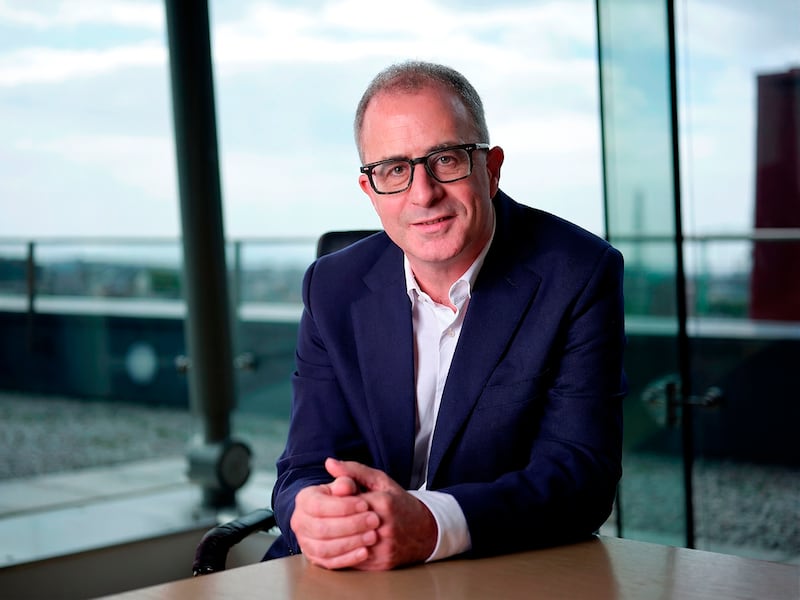
If anything, Jim Breslin has been busier than ever since stepping down from the secretary general role at the Department of Further and Higher Education, Research, Innovation and Science (DFHERIS). He has advised Ukraine’s health ministry on EU accession talks, chaired the Local Democracy Task Force, holds a range of directorships and advisory roles across the private, not-for-profit and public sectors including chair of Renewable Energy Ireland and a board member of St Vincent’s Healthcare Group.
Alongside that work he is now bringing his experience to bear as a faculty member of the Institute of Directors (IoD) Ireland’s chartered director programme, the institute’s flagship professional qualification for directors, leading to the certificate and diploma in company direction and, for eligible candidates, the internationally recognised chartered director (CDir) designation.
It is little surprise that he is in such high demand given his vast experience in the public sector at times of extreme challenge and disruption. “I always seem to be somewhere where the clampdown was happening,” he says.
That includes establishing the Department of Children in the middle of the last recession as its first secretary general. “We were starting a new department in the financial crash, working within diminishing resources, but trying to do something quite distinct and new and developmental,” he recalls. “I remember in those days there was a three-year spending review, and we were cutting 15 per cent out here, 30 per cent out there. The idea was to fundamentally try to protect things in order to rebuild programmes that were going to be effective over the medium term.”
RM Block


He subsequently moved on to lead the Department of Health, where budgetary challenges are a perennial feature, and later to being the first secretary general of DFHERIS.
Governance has been a recurring theme. “I happened across departments that were redoing governance on a number of occasions,” he says. Setting up Tusla required “first principles thinking” about the governance design of an organisation. “It became a template for what I did with some other organisations and my approach to state bodies.”
Subsequently, he played a key role in the reform of HSE governance at the Department of Health, which at that time had no independent oversight. “We changed that and brought in a non-executive board led by a chair.”
Lessons learned from these experiences were reinforced when he completed the IoD Ireland chartered director programme himself, which focuses on four key areas of strategy, leadership, company finance, and corporate governance. The insights he gleaned proved invaluable on the last big governance reform he worked on, reshaping university governance from stakeholder-based “mini-parliaments” towards more focused boards with a majority of independent members “all selected on the basis of competency.”
He doesn’t see governance in the public, private and not-for-profit sectors as completely separate things. “I think there are principles that cut across all of those sectors,” he says. “It is often about the nature of the decision or the nature of the project rather than which sector the organisation is in. If you’re managing a very significant, irreversible decision where once you commit you can’t pull back, or if you do pull back, there is a huge cost, you will see a very deliberate approach to governance in the private sector. In the energy sector for example, where the upfront costs are really, really significant at the start and the payback is over 25 or 30 years there’s a very thoughtful and deliberate process before making that decision.”
In regulated sectors organisations are not only deliberate in their decisions but also deliberate in documenting the decisions, he notes. “In much the same way as the public sector, because they are exposed to scrutiny, they have to take that approach. And then of course, there are other occasions where it’s a much more agile decision-making process. I like the approach they use in Amazon. They have a saying about two-way doors and one-way doors. A one-way door is once you do it, there’s no coming back from it. They are really slow in making those decisions.”
It is the context of the decision or the project that should inform the type of governance overlay put on it, he explains. “There is something to learn from everybody’s experience in that. And I’m certainly learning now in the private sector, in the not-for-profit sector, and that is great. I am a very curious person; getting into a sector and trying to understand it from start to finish is something that motivates me.”
Part of what he does is to take that learning and use it to translate different sectors for each other, he explains. “People look at government and see it as very hard to understand and very complex and I can help them with that. But equally now that I have a perspective on commerciality and the private sector and what is needed – how you structure opportunity that the private sector will be willing to take on – I can have that conversation in a government context.”
He is keen to emphasise the value of a blend of experience. “When I engage with people on behalf of the IoD Ireland, I’m not trying to sell them my experience in the public sector as the answer,” he says. “I am trying to interpret with them what their situations are. Sometimes my experience is relevant, and I can give an insight into that, but I am not trying to dictate to them because I want to learn from their experience as well.”
That peer-to-peer learning is a very important part of the IoD Ireland chartered director programme; the classes provide a forum for it while allowing participants to expand their director network. “What is really good in the IoD Ireland classroom is the diversity of experience. Part of my job is to facilitate that. It is a class that is learning from each other as much as from me, as the content includes real work case studies, while also having regard for the theory and the core set of principles that are firmly embedded in everything the IoD Ireland does. I have immersed myself in those codes of governance to ensure that when people ask questions we’re not improvising, that we are going back to first principles all the time.”
Breslin advises others to consider the opportunities presented by non-executive directorships and advisory roles. “I would highly recommend it. But do it with intentionality and due diligence. Don’t just find yourself doing something because somebody asked you. You need to have thought about it well ahead of time.”
He also recommends serving on State boards. “People might criticise the public sector, but it is a fantastic place to make an impact for the public and for your community. And I think it is still a respected thing to do. If you are playing that role, you’re doing the State some service and you are doing your fellow citizens some service.”
A sense of civic responsibility and an acknowledgment of the value of learning from different perspectives are threads that run through Breslin’s career and his approach to governance, threads he now weaves into his contribution to the IoD Ireland chartered director programme, where participants learn alongside other experienced directors and senior leaders from across the private, public and not-for-profit sectors.
Enrolment for the next intake of the Institute of Directors Ireland chartered director programme is now open for January 2027. Learn more about the programme on the IoD Ireland website


