
BYD may claim its Dolphin G has been developed for Europe, but if that’s the case, they need to spend more time on the roads of Sligo and Stockholm.
True, the Dolphin G is a compact hatchback with a decent boot and an intriguing powertrain that offers plug-in hybrid power, which is a first for European buyers in the supermini category.
BYD is the giant of Chinese car brands. Since its first self-developed car in 2005, it has risen with astonishing speed to become one of the biggest car brands in the world, vying with Tesla for top spot in the EV market. And it’s not shy about its ambitions, name-dropping Toyota as a target it wants to overtake. Here in Ireland, where it has overtaken the likes of Renault and Dacia, the brand is set to fall under direct control by the parent company instead of via a local distributor, a decision driven by a desire to wring out ever more sales volume.
When you hear warnings from European car executives about the threat of Chinese competition, it’s BYD that’s at the forefront of their minds. So, they are right to be concerned when it expands its offering in a favourite category of car for European buyers.
RM Block


So, let’s assess the positives of this new car. Certainly, the addition of a plug-in hybrid option in the supermini market is to be welcomed.
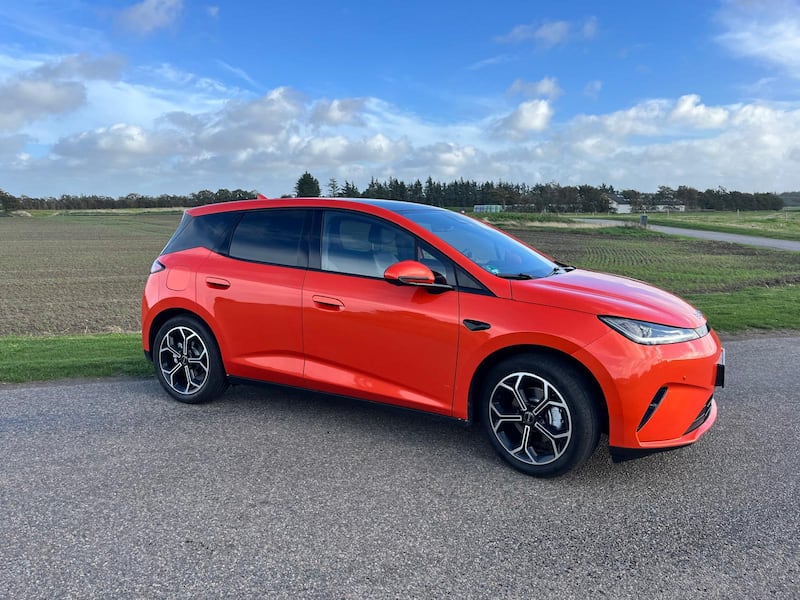
The front-wheel drive hatch comes with a total output of either 129kW or 156kW depending on the specification you choose. The lower output version has a 7.4 kWh battery pack delivering electric-only range of 40km, while the more powerful version has an 18.3kWh battery pack and boasts an electric range of 105km. Add in the power of the 1.5-litre petrol engine to the mix and it claims a combined range of up to 1,040km from a full battery and petrol tank. BYD claims a combined fuel consumption of 4.5l/100km.
Those are impressive statistics to trot out when considering a supermini. And the new car sales figures show that a sizeable cohort of buyers like the reassurance of an EV driving with a petrol engine backup when the battery runs out.
But there is a reason why rivals in this category have opted to forgo the tech. Partly, that’s down to costs, where the Chinese clearly have advantages in low-cost production these days. But it’s also down to market demand.
Tax changes may change that. The Dolphin G was gifted an edge over non-EV rivals in the recent budget, with CO₂ emissions of 60g/km for the smaller battery version and 32g/km for the larger battery. That means it evades the rise in Vehicle Registration Tax by 1 per cent, which is being applied to new cars with emissions over 80g/km, and which hits non-electric rivals and even regular hybrids like the Toyota Yaris.
Many in this category don’t have off-street parking or else live in apartment accommodation where private charging simply isn’t available. For them, the smaller 7.4kWh battery, which can only take AC charging, is hard to justify without convenient regular charging access.
The larger 18.3kWh battery does support CCS DC rapid charging, but only to a 39kW limit – regardless of whether the charger capacity is 150kW or 360kW. That said, given its relatively small size, BYD claims it will charge from 10 per cent to 80 per cent in 26 minutes.
If the charging options for the smaller battery version are slightly negative, there are more to come. For a car intended specifically with European motorists in mind, the ride and handling are well behind its French and German peers.
We tested the bigger battery Dolphin G in both the mid-range Boost and higher Comfort specification on a wide variety of roads in northern Denmark. In pure EV mode, the car is as quiet as you’d expect, with the odd intrusion of wind noise in the cabin at times.
However, once the engine kicks in, it proves itself tuned for fuel efficiency over performance, with a delayed response under acceleration that’s compounded by a strained engine note.
That could be forgiven in the same way we accept the set-up for other fuel-conscious hybrids like the Prius. However, it’s compounded by a ride quality on the Comfort’s 18in wheels that struggles to cope with the speed bumps that litter Europe’s urban streets and the potholes of rural roads. We forgave it the initially unsettled drive over country roads, but even in towns at slow speeds, the Dolphin G felt ill at ease.
Then there is the steering, which is both heavy and vague, making driving a chore. All this is topped off with the usual concerto of beeps and bongs from the over-anxious safety systems.
On the open motorway, you find yourself regularly correcting the steering line, while on the rutted back roads or broken urban streets the suspension gets out of sorts quite quickly. Some of that is down to the wheel choice, and the ride does improve slightly if you opt for the Boost specification’s 16in wheels. But it’s just enough to soften out the rough edges, certainly not enough to give the car itself any competitive edge.

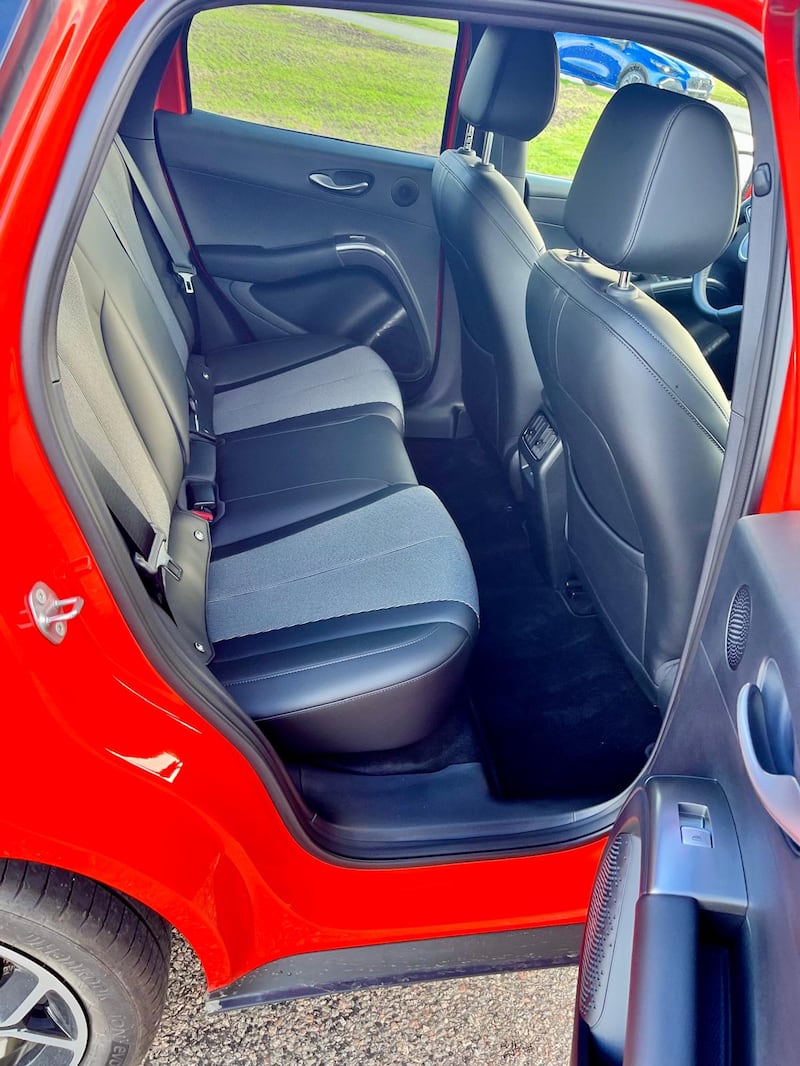
Then there is the practicality. The boot space is deep and decent, though it has a big lip that can impede loading, but the rear seat headroom and legroom are just average, and the cabin’s hard plastics contrast with the much-improved cabins on offer by rivals these days. The touchscreen controls are quick to respond, but it suffers from the same muddle of menus that curses many modern cars.

Amid a wave of exciting new arrivals in this category, the Dolphin G’s shortcomings are even more apparent.
Due for introduction at the Nevo Electric car show at the RDS in early November, the Dolphin G is targeting 271 registrations. BYD says it will confirm prices closer to launch but “it will be a competitive price for a model kitted out with all the specifications”.
Given the ultra-competitive landscape into which it arrives, pricing will be critical.
Just to recap on what’s coming in this class, at the same time as Dolphin G lands, there will be the new – and really impressive – Volkswagen ID.Polo, delivering Golf-like interior space and the sharp handling and well-honed ride qualities that epitomise the best of the German’s traits. And its starting price is just below €20,000 after grants.
Alongside this comes a fleet of its siblings like the Cupra Raval with its sportier and more engaging handling, and the practically minded VW ID.Cross and Skoda Epiq. And that’s just the new arrivals from the VW Group stable.
Aside from these are the likes of the new Renault 5, Nissan Micra, and the impressive Yaris hybrid, whose Yaris Cross variant is Ireland’s bestselling new car. There are too many more to list.
The Yaris represents a useful contrast to the Dolphin G, and a potential lesson for BYD. This original Yaris supermini was designed in Europe primarily for European tastes, while drawing on its Japanese engineering expertise. They got the mix right. BYD needs to more closely take note of that recipe.
European motor executives are right to be frightened of BYD. Its progress to date is simply astounding when compared to the gradual growth of its European counterparts. Even when it stumbles, it quickly recovers.
And it has some impressive models in its line-up, like the big Seal-U plug-in hybrid, the all-electric Seal and Sealion 7. But it has shown that its mammoth spending on research and development doesn’t always deliver a win. This Dolphin G brings a new powertrain format for buyers in this class, but its road manners need more work. While aggressive pricing will help, on first impressions this seems to be a swing and a miss.


