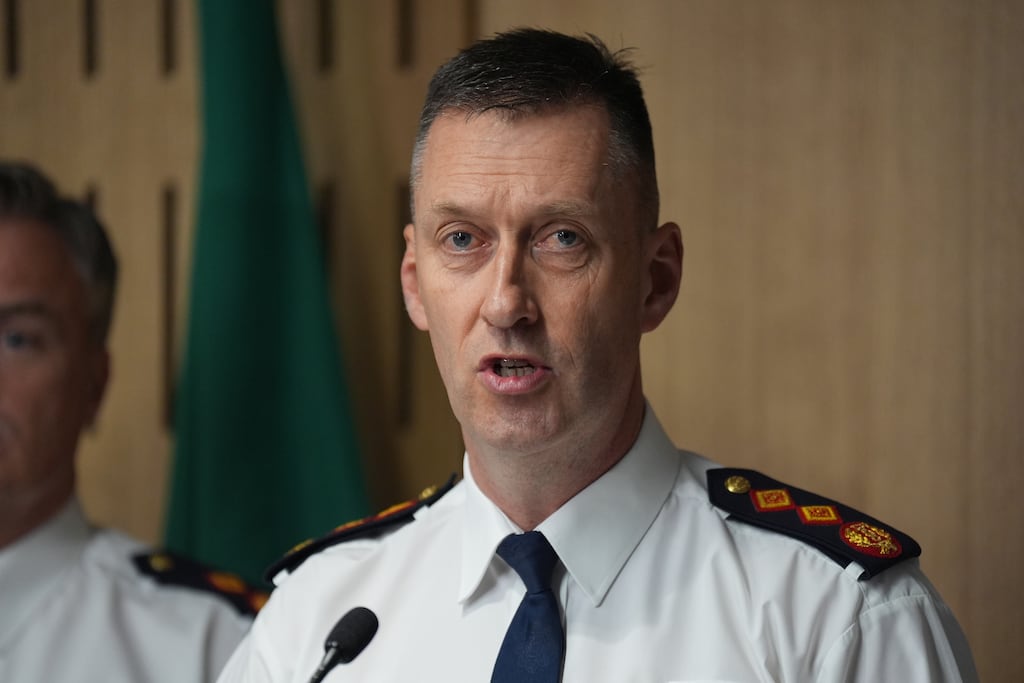
There will be “absolutely no toleration” for anyone trying to engage in robust protests and roadblocks in Dublin or other parts of the country during key events of Ireland’s EU presidency this week, Garda Commissioner Justin Kelly has warned.
While acknowledging there is “significant risk” to safety and security in Dublin in the coming days as up to 50 heads of state and other international leaders gather, he insisted the Garda was prepared for “all eventualities”.
The senior officer in charge of policing in Dublin, Assistant Commissioner Jonathan Roberts, said any “obstruction” on the roads, like that seen during the fuel-related protests in April, “will be dealt with swiftly and robustly”.
Over 500 public order unit gardaí, along with two water cannons and heavy-duty towing vehicles, are on standby, along with specialist barriers to halt very large vehicles. But Roberts added there was no evidence that an anti-Government protest planned for Dublin on Friday would be “anything but peaceful”.
RM Block



Heavy vehicle mitigation barriers will be visible on Dublin streets, aimed at preventing large vehicles from being weaponised as part of any terror attack, but they can also frustrate efforts to obstruct roads as a form of protest. Security scanning equipment to check for weapons or explosives as people enter security-cordoned areas will also be in use.
Police officers from Latvia, Portugal and Northern Ireland with specialist skills will be on the ground in Dublin, though not on the front lines, for the unprecedented policing operation. These officers are augmenting the Garda’s and Defence Forces’ anti-drone operation and also providing and handling sniffer dogs trained to find bombs.
The main focus of the security operation, the biggest in the history of the State, will be the Convention Centre and surrounding cordon, at the IFSC on Dublin’s north quays. The European Political Community meeting of heads of state and government from across Europe takes place there on Thursday. It will involve up to 50 European leaders and heads of European organisations and is the biggest event of Ireland’s six-month presidency of the Council of the EU.
The following day, Friday, an informal meeting of the heads of state or government will take place, also at the Convention Centre. The presidents of the European Council and European Commission will be in attendance.
Furthermore, the presence of British prime minister Andy Burnham and Ukrainian president Volodymyr Zelenskiy will add an additional layer of security, especially as large drones were seen near the flight path Zelenskiy’s plane had taken on its descent into Dublin during a visit last December.
Kelly said there had been bomb hoaxes in Ireland last week, as well as bomb threats, all found to be false alarms, against airlines across Europe, and the Garda had expected an increase in such activity in the build-up to this week’s security operation, which will cost tens of millions.
However, he also said the hybrid threats, including hoaxes and cyber, were expected because of the continued war between Russia and Ukraine, as well as Russia’s history in this area of grey zone attacks and disruption. But Kelly added that none of the threats on airlines or media organisations last week focused on Ireland alone and instead were European in nature.
The major policing operation this week will be aimed at securing the Convention Centre in Dublin; safeguarding airport perimeters with drone incursions in mind; escorting heads of state in convoys with armed gardaí; ensuring heads of state are secured when they stay overnight; and limiting the risks posed by any robust street protest.
The EU presidency events security operation will involve an unprecedented policing surge with over 5,000 Garda members, while other gardaí across the State will engage in regular policing duties.
The EU presidency operation will involve over 15,000 tours of duty, each lasting 12 hours, with more than 100 advanced escort training Garda motorcyclists and 200 motorcycle security escorts.
More than 200 members of the Garda’s trained search teams, supported by the Garda water and dog units, have already carried out days of searching and patrols on the river Liffey to secure the Convention Centre and other key locations. Defence Forces personnel have also been assisting in that work.
[ Dublin traffic disruption for EU summit is unacceptableOpens in new window ]
More than 500 members of the public order unit are also on standby, as well as two water cannons, in the event of street disturbances, either related to the EU presidency or perhaps due to trigger events, as has been the case with rioting in Dublin several times in recent years.
The armed Garda response will include more than 500 members from the emergency response unit, armed support unit, special detective unit, or antiterrorist squad and close protection officers, or bodyguards, drawn from national Garda bureaus and some Garda divisions.
More to come.


