
As part of his architecture degree at Waterford IT (now SETU), Carlow-born Alexander Buckeridge spent his fourth year studying in Brussels where he worked part-time in a bar to pay his way. He remembers a patron there encouraging him to “give New York a go once”. It was advice he is glad he took, even though it was a circuitous route that brought him to the Big Apple.
After qualifying in 2012, Buckeridge was selected for an internship in the Paris firm, Scau, a company that specialises in large urban projects and which is known for designing the Stade de France stadium. He arrived with little French, slept on a couch and figured things out as he went.
He moved on to work with the internationally-renowned architect, Jean Nouvel.
“I worked on cultural buildings, things that were very creative and a poetic approach to architecture. There were around 100 people in the office, a mix of all sorts of nationalities. I met some incredibly talented people and had a great time there.”
RM Block


By 2016, he was hankering for new experiences and, with a number of friends based in New York, he decided to give it a go. His work with Nouvel opened doors but Buckeridge encountered a culture shock on arrival that took a while to get used to.
“I found the US had a very different way of practising architecture. It was much more financially driven, much more data-driven, and very different to how the French were practising it.
“When I was in France, it was about pushing the boundaries of the architectural capabilities, how people use space, how people circulate through and how materials come together, a lot of experimenting. In the US, it was much more corporate and focused on the bottom line.”
The stricter financial constraints and fast-paced approach involved learning new ways to do things and Buckeridge admits he had “a rough first year”. He adapted, working on projects such as One Times Square, converting portions of the building into a museum and restaurant.
By 2020, he was working with Snarkitecture, a 10-person practice cofounded by an artist and an architect, blending art and architecture, where he worked his way up to a director position.
“I really fitted in there as it combined what I had learned about the business side but [was] still pushing the creative side too, and I learned a lot there. I did furniture, I did interior design. I did urban scale architecture. The guys gave me a great opportunity to grow in that business.”
In summer 2024, Buckeridge felt confident in going out on his own and founded Studio Bucky, working on a diverse range of areas from furniture to office, retail and hospitality projects.
He has already worked on a range of international projects and was recently named a winner at the 2026 NYCxDesign Awards. His Portals Collection, furniture made from reclaimed maple and inspired by the forms of Irish megalithic tombs, was recognised in the Made in the Boroughs category as part of New York City’s official celebration of design.
His work can also be seen in rural Westmeath, where he has designed accommodation cabins with red-stained shingles, called Cucu, for a client called Samsú that provides off-grid retreats in the Irish countryside for those seeking digital detox in a nature setting.
[ I got ‘the call’ from home. Dad’s days of wandering New York’s streets were overOpens in new window ]
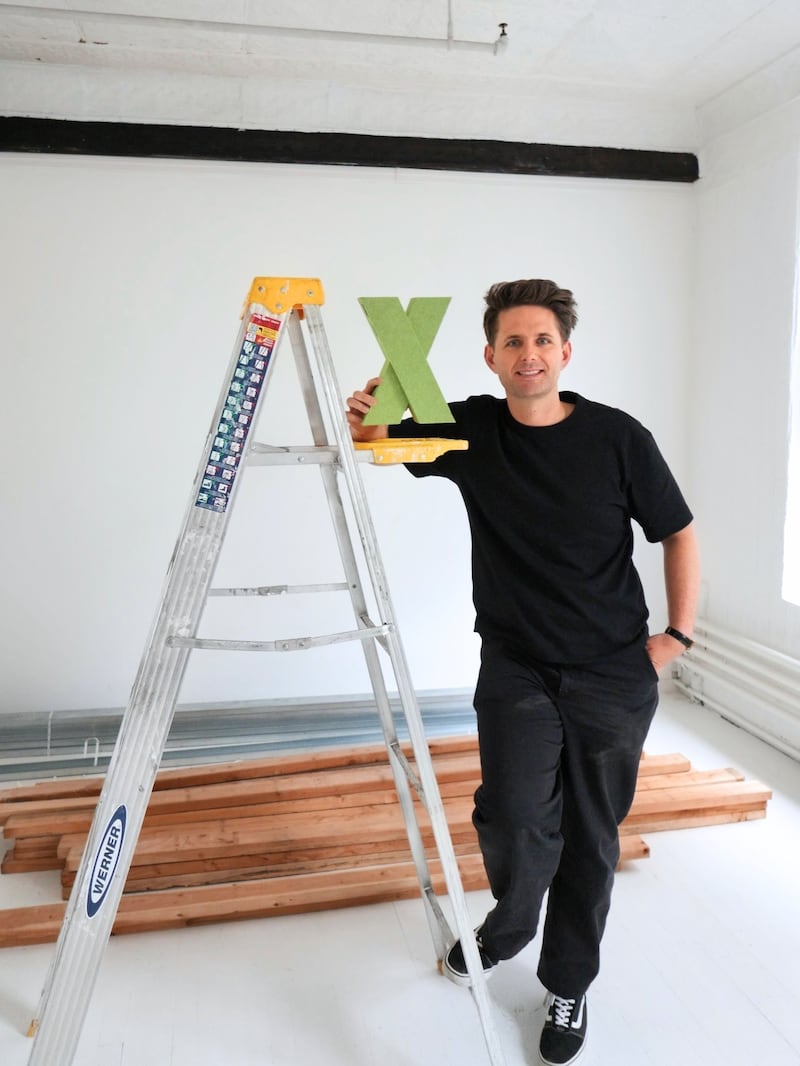
Buckeridge cites his design influences as land art, ancient monuments, especially Irish dolmens, surrealism and playfulness. He says he tries to inspire clients, balancing his own creative vision with the client’s budget aspirations.
“I try to push them in a direction that I feel is appropriate. Generally, we’ll work through things together and we’ll find the right zone.”
Buckeridge believes there is a creeping homogenisation across US cities, with downtown areas in cities such as Boston, New York and Washington increasingly resembling each other.
“Nearly all of the built environment is quite sterile, flat and ultimately boring. That’s not the work I’m interested in doing. I feel people are moving through their daily lives on autopilot. What I’m trying to do is to interject a little and wake people up.”
He acknowledges the loss of decorative elements and character in modern architecture but does not advocate copying classical styles. He cites instead the example of the Pompidou Centre in Paris, built in the 1970s, which first seemed alien to many but now feels woven into the fabric of the city.
Buckeridge lives in the Crown Heights area of Brooklyn, where there is a melting pot of nationalities. He is married to Marta, a graphic designer from Spain, whom he met in the city. The couple have recently had a daughter.
New York has a lot more energy than France, he says, and the pro-enterprise culture where you can start a business overnight is in sharp contrast to the more bureaucratic norms of France.
“The amount of energy you give to the city, the more it comes back to you. It’s a city where opportunity can strike at any moment, over a coffee, at a bar. Everyone is building something and there is a quickness to it that can knock you for six.”
The downside is the lack of a safety net, the constant grind, and the always-on-the-edge feeling.
“It’s definitely hard-core and it takes a lot to survive here,” he notes, admitting that, as he gets older, he can now see the attraction of Paris’s 90-minute lunches and long holidays.
[ Irish woman in NYC: ‘The Irish don’t celebrate our wins like New Yorkers’Opens in new window ]


