
Few directors successfully combine senior executive leadership with multiple plc non-executive appointments.
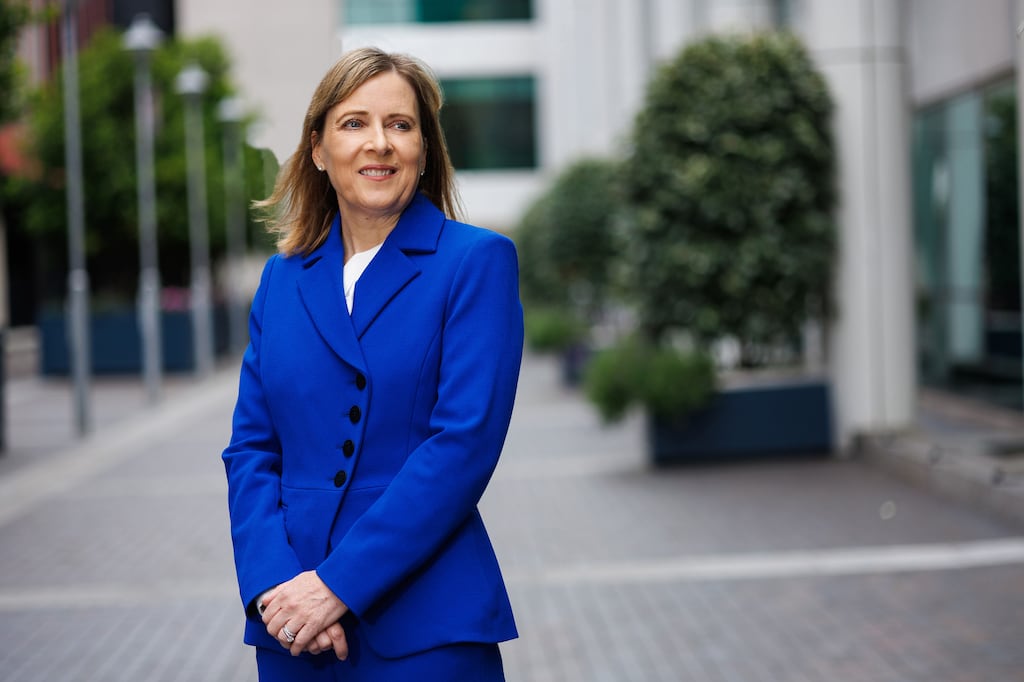
Experienced non-executive director and IoD Ireland member Emer Finnan occupies a position that relatively few leaders manage to sustain successfully. She balances senior executive responsibility with a portfolio of significant non-executive directorships.
Today Finnan combines her role as president Europe at private equity firm Kildare Partners with non-executive directorships at Bank of Ireland Group and Glenveagh Properties. Earlier in her board career, she served on a number of boards including C&C Group, her first plc appointment; Britvic; and Dublin Port Company. Finnan also serves on the board of The Ireland Funds Great Britain, a charitable organisation.
Finnan did not initially set out with a plan to build a non-executive career. “I don’t think I was really aware of non-executive directorships as a potential part of my career until I was asked to join the board of a semistate company back in 2005,” she recalls. Even then, circumstances played their part. Having trained as a chartered accountant with KPMG, she spent more than a decade in corporate finance and stockbroking before moving to EBS in 2005.
RM Block


“The move to EBS allowed me to take on non-executive directorships if the opportunity arose,” she says. “Since then, I have tried to have at least one non-executive directorship alongside my executive role,” she says. “Mainly because I enjoy it, and secondly, because I think it’s good experience to work with other companies and I believe that it adds to my effectiveness in my executive role.”
While her first appointment may have come unexpectedly, subsequent roles came about through a combination of experience and networking.
“Once I gained experience, I became quite interested in non-executive work,” she says. “I had it at the back of my mind that I would like to continue this work and move into the plc world.”
As her board career developed, professional networks and director forums, including IoD Ireland, became part of that wider ecosystem, helping to broaden her understanding of the board landscape and connect her with experienced peers.
‘Generally, my style is to be as constructive as I can be, but I do think you need to bring that challenge if you believe that there’s something that needs to be brought up and thought about in a different way’
— Emer Finnan, non-executive director of Bank of Ireland and Glenveagh Properties, and IoD Ireland member
Having operated in both executive and non-executive capacities for many years, Finnan has developed a clear view of what effective non-executive directors bring to the boardroom.
Central to that, she believes, is independence of thought. “You need to be independent in mentoring and giving advice to management and in working on various issues that arise, but you also need to be able to challenge,” she says. “It’s a combination of independence and bringing your skills into the boardroom but not stepping into the full-time executive role. It’s quite a fine balance that I’ve had to learn over a number of years, but I’ve done it for a while now, so I’m more experienced,”
That balance extends to the way challenge is delivered. “I think it’s important to be able to challenge and to bring that challenge into the room in a constructive way,” she says. “Generally, my style is to be as constructive as I can be, but I do think you need to bring that challenge if you believe that there’s something that needs to be brought up and thought about in a different way.”
For Finnan, constructive challenge is not about confrontation. Rather, it is about ensuring boards make better decisions through rigorous discussion and considered judgement. For her, the chair plays a pivotal role in creating an environment where boards can operate effectively.
“Good governance is led from the chair. It’s about inviting constructive debate, challenge, support, and views from all around the table. Good governance means being able to give your view.”
Learning never sleeps
“AI [artificial intelligence] is going to change the world that we work in,” she says. Quick to acknowledge that her own expertise lies elsewhere, Finnan views continuous learning as an essential part of modern directorship.

“I am definitely not an expert and therefore I have looked to learn more about AI through various briefings and events so that I can contribute more to the discussion and debate around this topic.”
At the same time, she points to the value of complementary expertise around the board table. “Someone with a technology background can add even more insight in this area, whereas the person with a technology background can’t necessarily add as much as I can in areas like finance,” she says. “It’s about looking at all those skills and constantly evolving and making sure that the board is dealing with all of the issues that we’re facing in the business world today.”
For those considering a non-executive path, Finnan’s advice is both practical and encouraging. “I would advise people who are interested to pursue it because I’ve really enjoyed the work and found that it’s aided my executive career,” she says.
At the same time, she cautions against expecting immediate access to plc board appointments. “You are not necessarily going to get a plc role on day one. You need to learn non-executive directorship skills, so it makes sense to start with a smaller company perhaps and learn the skills that way.”
Building relationships and investing in professional networks also matter, not as a substitute for experience, but as a way of staying connected to other directors’ perspectives and to the issues shaping boardrooms.
“There are more opportunities to do that now through an organisation like IoD Ireland,” she says. For Finnan, the value of that connection lies in practical peer learning: hearing how other directors are thinking about governance, risk, strategy and the changing expectations of boards.
“It helps in terms of keeping up to date with the issues facing boards,” she says. “It’s been important to network and meet other non-executive directors, talk about what issues they’re dealing with and maybe learn from them in some way.”
That kind of forum can be especially valuable for directors who are no longer in executive roles and may not have the same day-to-day team environment in which to test ideas or exchange views.
“I work with a team and I can bounce ideas off them and learn from them,” she says. “But if you’re a non-executive director and don’t still have an executive role, you don’t have that. IoD Ireland provides that forum and that ability to exchange ideas and learn from other companies.”
Despite her enthusiasm for board work, Finnan remains disciplined about the commitments she takes on.
‘I enjoy the pace, complexity and breadth of issues that PLC boards deal with. They provide an opportunity to contribute in a meaningful way and continue learning’
— Emer Finnan, non-executive director of Bank of Ireland and Glenveagh Properties, and IoD Ireland member
“I want to make sure that I can genuinely add value and devote the time and attention that each role deserves.”
Yet, ultimately, the number or prestige of appointments matters less than the contribution directors make once they are around the table.
“I enjoy the pace, complexity and breadth of issues that plc boards deal with. They provide an opportunity to contribute in a meaningful way and continue learning,” she says.
For Finnan, effective directorship comes down to a combination of preparation, curiosity, independence, and judgment: bringing different perspectives to the table, asking thoughtful questions, and helping organisations navigate an increasingly complex world.
Learn more about how IoD Ireland provides members, like Emer, with access to director education, board opportunities, events, and a powerful network of business leaders across Ireland


