“Costs, chaos, corruption”: after almost two years spent relentlessly criticising Donald Trump for failing to address those three broad political concerns, Democrats won a monumental return to power in Tuesday’s midterm elections that will give them potent new leverage over the president.
Now the question becomes: what will they do with it?
While party leaders say their exact strategy remains under discussion, all signs point to Democrats embarking on aggressive campaigns of both investigating and lawmaking, with the aim of giving their eventual nominee the ammunition they will need to win the 2028 presidential election.
“We are going to make sure that those candidates running for president of the United States aren’t getting asked about plastic-straw bans. Instead, we should be talking about all of the legislation that we pass out of the House, pass out of the Senate, and force to Donald Trump’s desk,” Greg Casar, chair of the Congressional Progressive Caucus, told reporters on Wednesday.
RM Block




He envisioned “passing bold legislation that people called for, every single week, off of the floor of the House and the Senate”, pointing to bans on price gouging, Super Pacs and stock trading by lawmakers as priorities.
“If [Trump] vetoes it, then that is the platform upon which candidates can run in 2028, and then we can get signed into law in 2029,” Casar said.
That election is still two long and unpredictable years off. And despite flipping seats across the country, the Democratic Party brand remains deeply unpopular.
But Democrats have reason to feel confident: Republicans suffered such a cataclysm Tuesday that they lost Senate seats they’d held for decades, and House seats drawn specifically to elect only Republicans.
It was the biggest midterm defeat for an incumbent party in more than 50 years, but the power Democrats have gained in Congress is not unlimited. Trump is still set to inhabit the White House until January 2029, and can veto bills that do not pass with overwhelming support.
And the Senate filibuster – which Democrats used to block many bills that Republicans attempted to pass along party lines over the first half of Trump’s second term – remains in place. Now the shoe is on the other foot: Republicans can use it to stop any incoming Democratic legislation that does not have 60 votes in a chamber. Ballot counting is still ongoing, but if the two outstanding Senate races are won by their candidates, Democrats and their allies will have 56 seats.
Congress’s incoming leaders have made clear those obstacles will not stop them from at least trying to enact legislative solutions to the problems they campaigned on fixing.
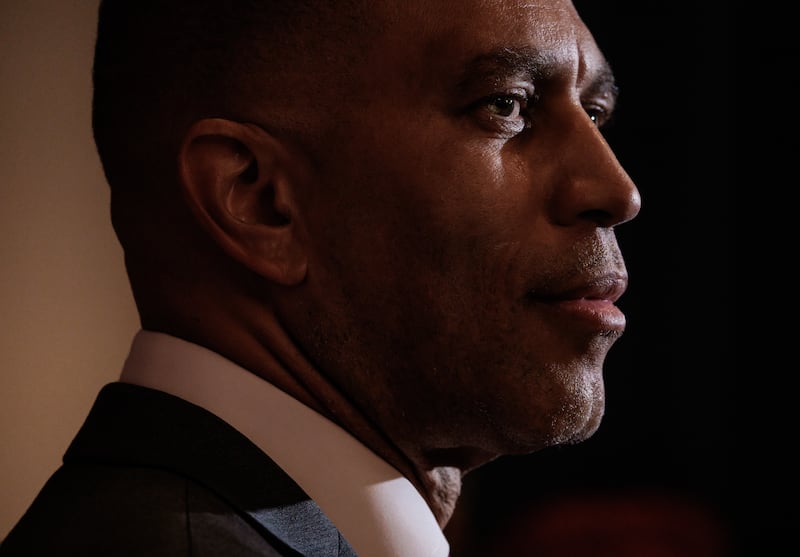
“We made a promise to the country that we would fight for an affordable America, and we intend to keep it,” said Hakeem Jeffries, who is set to become speaker of the House of Representatives when the new Congress convenes after the new year.
He named as priorities reimplementing premium tax credits for Affordable Care Act (ACA) health plans as well as undoing the cuts to the Medicaid insurance programme that Republicans approved last year. Jeffries also promised legislative action to make Trump undo his tariffs, and end the conflict with Iran.
“Everything we do maps on to three promises, the very same three we ran on, turning from a critique into a to-do list: lower costs, make your government work for you, clean up the corruption,” Chuck Schumer, who is expected to be the next Senate majority leader, said during an appearance at the Center for American Progress, a liberal thinktank.
One thing that does not seem to be on the table: impeaching Trump, for a third time. During his first term, Senate Republicans rescued the president after two impeachments, first on charges of leveraging aid to undermine his political rivals, and then again after his supporters attacked the Capitol on January 6th, 2021.
While Democrats have accused Trump of violating the law and the constitution regularly during his second term, they appear clear-eyed about Republicans’ willingness to force the president from office.
“I haven’t had a single member of the House Democratic Caucus talk to me about impeachment,” Jeffries said. “We’ve been relentlessly focused on affordability and on accountability.”
When it comes to the latter, Democrats have no shortage of ideas. After publicly issuing a warning to potential targets to “lawyer up”, Robert Garcia, who will lead the investigative House oversight panel, told reporters this week to expect inquiries related to allegations of corruption in Department of Homeland Security contracting, stock trading by lawmakers, corporate profiteering and the government’s release of files related to disgraced financier Jeffrey Epstein.
Neither does the party lack for ideas when it comes to addressing concerns about affordability, a big issue for voters in the elections.
It was Democrats’ demands to extend the ACA subsidies that led to the record-long government shutdown last year, and their candidates made warnings about the impending Medicaid cuts prominent in their campaigns.
The outgoing Republican congressional majorities have so far rejected attempts to address either issue, but Democrats did have some luck coaxing the majority to vote for war powers resolutions intended to end the conflict with Iran – one measure did pass, but the president has thus far ignored it.
“Trump has the ability to block our efforts to lower costs for American families, root out corruption in Washington, end the chaos in our streets and overseas,” Schumer said.
“But if he does that, I have no doubt the American people will rebuke him and his party just like they did in the election.” – Guardian.