
In 2016 Donald Trump declared war on the press.
He barred reporters from rallies, mocked them from the podium, and popularised a certain phrase – “fake news”.
Trump, a New York real estate developer long obsessed with his media coverage, had spent much of his career cultivating journalists and clashing with them in equal measure. His businesses, he once said, were “props for the show”, because “the show is Trump”.
As US president, Trump has mastered the show. Yet it is harder now to dismiss the outcome as spectacle. In just a decade, he has polarised America’s media, dominated it, and now watched as it transforms around him.
RM Block


Today, online personalities can boast audiences surpassing those of television anchors. Billionaires sympathetic to Trump now own major news outlets. Tech barons have switched from banning Trump to indulging him. His favourite channel, Fox News, dominates American television.
At the same time, Trump moved beyond rhetoric. He has sued media groups – many of whom have chosen to settle, rather than fight lawsuits that legal experts say are weak. His Federal Communications Commission (FCC) has turned into an attack dog, openly threatening broadcasters and declaring “wins” when their ownership has shifted into the hands of Trump donors.
As the US entered its war with Iran, Trump and his allies accused reporters of “treason”, threatened them with jail, and invoked the Bible – casting journalists as the Pharisees, the New Testament figures who opposed Jesus.
[ ‘There were signs of low character’: How Tucker Carlson soured on Donald TrumpOpens in new window ]
All of which will have hung over yesterday’s White House Correspondents’ Dinner, a century-old tradition now steeped in tension. For the first time as president, Trump and his top officials were due to mingle with journalists at a dinner meant to celebrate the First Amendment that guarantees freedom of speech, despite years of his attacks on the press.
They were due to be joined by a cohort of influencers and online media figures – providing a snapshot of an American media landscape almost unrecognisable from the one Trump entered a decade ago.
The old hierarchy of newspapers and broadcasters has fractured into a volatile ecosystem of partisan networks, influencers, megadonors, century-old stalwarts and newer platforms – all competing to shape how Americans interpret politics and information.

Part I: Fox and friends
At 6am on a morning in March, Fox News opened with war. “Another top Iranian leader allegedly behind global terror threats... dead!” announced host Brian Kilmeade.
He and his other hosts sat on a white sofa, with an American flag and view of bustling midtown Manhattan behind them. “Plus, take a look at these long TSA lines in Atlanta,” Lawrence Jones said, as the screen cut to footage of long queues of travellers waiting to go through security.
This is Fox & Friends: breakfast television blending banter, weather and war.
On Fox, the choices of what to emphasise – and what to move past – are revealing. When emails emerged last November linking Trump to Jeffrey Epstein, a story that dominated much of the global press, Fox News did not mention it on air for nearly three hours.
For readers outside the US, it can be difficult to grasp the reach of Rupert Murdoch’s flagship network. For many conservative Americans – particularly older viewers – Fox is a fixture of daily life, the default source of news in the home.
Trump treats the network as a source of information and a channel through which he absorbs and responds to events. In his first term, he installed a television in the dining room off the Oval Office and spent hours watching cable news, often reacting in real time online.
Inside Fox, editorial decisions are tightly bound to audience response, according to former employees. “The ratings were always the focus,” said one former producer who worked on multiple high-profile shows. The internal mantra was simple: “You win the day, you win the week, you win the month, you win the quarter, you win the year.”
Former employees say the network’s tone hardened during Trump’s rise, and changed more sharply after the 2020 election. “That’s when the real shift happened,” said one. “There were no dissenting voices.”
The relationship cooled for a time after Trump’s supporters attacked the Capitol on January 6th, 2021. He appeared less frequently on the network, before his enduring popularity with the Republican base became clear.
“The Trump era hardened the polarisation of cable news,” says Jeff Zucker, former chief executive at NBCUniversal. “Fox and MSNBC leaned further into their respective audiences, and that’s unlikely to reverse.”
Over time, Fox became the anchor of a broader right-wing media system, says Sarah Longwell, publisher of anti-Trump conservative media outlet The Bulwark, who describes a “layered ecosystem” – first conservative outlets, then more explicitly pro-Trump media, and now a wider constellation of influencers and podcasts. “They all fed off each other,” she says.
Fox did more than amplify Trump’s message. “To get lies repeated and institutionalised ... he needed Fox, and the right-wing ecosystem,” says Ruth Ben-Ghiat, a New York University historian.
Since returning to the presidency, Trump has escalated his use of litigation against the press, seeking damages on a scale that could cripple news organisations if successful
The alignment has proved expensive. Fox paid $787.5 million to settle Dominion Voting Systems’ defamation lawsuit over false claims aired by the network about the 2020 election – one of the largest defamation settlements in US history.
Yet its commercial success has insulated the model, widening Fox’s lead over rivals. It averaged roughly 1.9 million viewers a day in March, compared with 641,000 for CNN and 759,000 for MS Now, formerly known as MSNBC.
Brands that avoided the network during controversies in Trump’s first term have since returned, in part to reach what Fox’s advertising president described to the Financial Times as an “audience of one”: the president himself.
Part II: Rise of alternative media
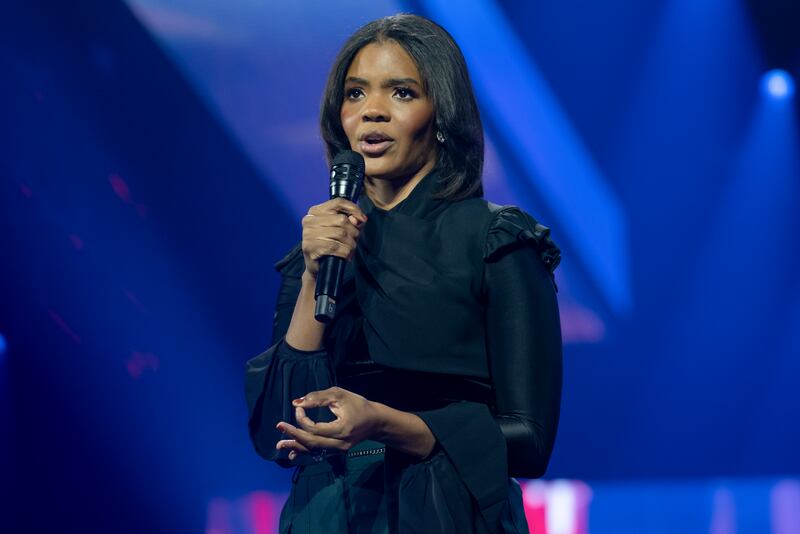
Candace Owens, online provocateur and conspiracy theorist, does not need a newsroom.
Seated at a desk arranged to resemble a small study, she addresses the camera directly. Sometimes a Bible rests beside her laptop keyboard.
On YouTube alone, Owens has nearly 6 million subscribers, more than The New York Times. “My sister said, ‘Listening to your podcast is like speaking to a friend on the phone,’” Owens says.
After coming to prominence as communications director for conservative activist group Turning Point USA, Owens built a career as a podcaster attacking what she calls the “corporate press”, first at right-wing site The Daily Wire and now as an independent.
On her programme, the Epstein files, parenting advice or her controversial claim that France’s first lady is a man can occupy the same hour. “I really am just a creative,” she says.
“I think established news organisations have just proven themselves to be liars. So I benefit from their lies.”
For most of the 20th century, political communication in the US flowed through gatekeepers: national newspapers, television networks and influential magazines. In the aftermath of Watergate, more than 70 per cent of Americans said they trusted the media.
[ Donald Trump’s lawsuit against Wall Street Journal and Rupert Murdoch dismissedOpens in new window ]
That system has fractured. Trust in the media has dropped to below 30 per cent. A decade ago figures such as Owens might have existed on the fringes of American media. Today they sit close to its centre.
In this new landscape, traditional reporting competes with a fast-growing constellation of personalities, podcasts and livestreams operating outside the norms of journalism.
No figure better illustrates the shift than Joe Rogan, whose podcast regularly attracts audiences larger than those of many television networks. Trump’s appearance on his show before the 2024 presidential election, and Rogan’s subsequent endorsement, helped boost his support from young male voters.
A newer generation of influencers is emerging alongside him. Brett Cooper built a following of millions on social media through delivering brisk monologues on culture and politics. Her style is conversational, a rhythm shaped by YouTube and TikTok rather than cable news.
Like Owens, Cooper does not see herself as a journalist. “I would say it’s probably a commentator,” she says. The term journalist, she adds, feels “a bit antiquated”.
Trump’s attacks on traditional media have accelerated that shift, undermining trust in established outlets and boosting alternative voices.
His rhetoric had a “significant” impact on how Americans view journalists, says Marty Baron, a former editor of The Washington Post. By “trying to dehumanise journalists... and suggesting they’re traitors to the country”, Trump’s attacks had a “cumulative impact”, he says.

Part III: The dawn of a new dynasty
In March, Paramount chief executive David Ellison attended Trump’s address to Congress as the guest of senator Lindsey Graham, one of the president’s closest allies in Washington. In photographs from the evening, the pair sit side by side on a patterned sofa, smiling and giving a thumbs-up – a casual image that belied the stakes of the moment.
Two days later, Paramount won a battle against Netflix to buy Warner Bros Discovery. In a matter of months, the son of tech billionaire and Trump donor Larry Ellison had gained control of CBS and CNN, two of America’s most prominent news organisations.
When the corporate tussle over CNN’s parent company broke out last year, Trump told reporters he would be involved and described the Ellisons as “friends”.
According to people briefed on the matter, David Ellison met officials at the White House in December and discussed CNN’s news operations, signalling that under his ownership the network would not function as a “branch of the resistance”.
People close to Ellison, who has no experience in journalism, say he believes the news industry “lost its way”, becoming “extreme, elitist and performative”. Ellison, they say, wants to return to more “traditional” reporting. “Not quotas, not ideology, just objective journalism,” says one person familiar with his thinking.
Ellison has installed Bari Weiss, a former New York Times opinion writer and anti-woke crusader, to lead CBS News. Star reporter Anderson Cooper and anchor John Dickerson are among journalists who have left amid accusations of editorial interference, including the delaying of a 60 Minutes investigation into migrants deported from the US.
The Ellison story shows how Trump’s fight with the press has changed. In his first term, it played out on tarmacs, at rallies, at briefings. In his second, it has moved into a more opaque but higher-stakes world of merger approvals, defamation settlements and corporate calculation.
Since returning to the presidency, Trump has escalated his use of litigation against the press, seeking damages on a scale that could cripple news organisations if successful. In the past year alone, the US president has sued The New York Times for $15 billion (€12.8 billion), the Wall Street Journal for $10 billion and the BBC for $5 billion.
At a Republican fundraiser last month, he ticked through settlements with media companies as if they were victories. “If you bring lawsuits against these guys,” he said, “they’ll ... pay it.”
The threat that Trump might derail a deal has raised the stakes. In July, Paramount settled a lawsuit Trump brought against CBS News – a case widely seen as weak – as it sought regulatory approval to merge with Ellison’s Skydance.
Jeff Bewkes, who ran Time Warner when the Trump administration tried to block its sale to AT&T in 2017, says he received overtures to “come over and talk” about CNN, and resisted. It was expensive. That legal battle delayed the deal by two years and cost shareholders billions.
Media companies today have been quicker to accommodate the administration’s demands.
[ The real Donald Trump is the Trump of the foul-mouthed, late-night rantOpens in new window ]
Paramount’s $16 million settlement with Trump drew sharp criticism from press freedom groups. But people close to Shari Redstone, the controlling shareholder who sold the company to Ellison last year, say she saw little alternative. “You can’t just be in endless litigation with the president,” says a person familiar with her thinking. “It was a $20 billion suit for a company with an $8 billion market cap.”
The FCC – which regulates the US airwaves – has also taken on a more assertive role under its Trump-appointed chair Brendan Carr.
In March, he warned that broadcasters airing what he described as “fake news” about the war in Iran could face licence revocation. Trump responded the next day that he was “thrilled”.
Speaking at the Conservative Political Action Conference (CPAC), Carr said Trump had “smashed the facade” of the “fake news media”. He pointed to changes across the media – including CNN falling under Ellison’s control – as evidence that “Trump is winning”.
Carr, a former telecoms lawyer, frames his actions as enforcing broadcasters’ obligation to serve the “public interest”.
In practice, critics say that standard is being reinterpreted. “[Carr] is interpreting public interest as things that the president likes,” says Tom Wheeler, who led the agency from 2013 to 2017 under Barack Obama.
The FCC has not revoked a major broadcast licence in decades, and doing so would require a lengthy legal process likely to be challenged in court. But media executives say the prospect alone is enough to shape behaviour – particularly when companies are seeking approval for mergers or other deals.
‘When the three wealthiest men in America sit behind Trump at his inauguration, everyone understands that the billionaire class now controls our government’
— Senator Bernie Sanders
“He has been a master of intimidation. It has a huge chilling effect,” Wheeler says. “Everybody is on notice. Don’t p**s this guy off.”
The elder Ellison, meanwhile, now has a hefty stake in another social media group where young Americans increasingly get their news: TikTok.
With holdings spanning studios, news networks and technology, the Ellisons have a claim to being the defining dynasty of the Trump era, challenging even the Murdochs.

Part IV: New allies in tech
The new order was visible in a single image.
At Trump’s 2025 inauguration, the president stood in the marbled Capitol rotunda flanked by the leaders of the world’s most powerful technology companies. Behind him were Meta’s Mark Zuckerberg, Amazon’s Jeff Bezos, Apple’s Tim Cook, OpenAI’s Sam Altman and Google’s Sundar Pichai – executives who collectively control trillions of dollars and the infrastructure of modern communication.
A month later, Elon Musk took the stage at CPAC waving a bejewelled chainsaw and promising to dismantle the federal government.
The visuals capture how a once tense relationship between Trump and Silicon Valley gave way to accommodation.
“When the three wealthiest men in America sit behind Trump at his inauguration, everyone understands that the billionaire class now controls our government,” senator Bernie Sanders wrote on X.
It was a far cry from January 2021, when Facebook and Twitter suspended the president’s accounts in the wake of the storming of the Capitol. Inside tech companies, the thinking was: “This is not worth the headache,” says Katie Harbath, a Republican strategist who was Facebook’s director of public policy for global elections.
But the retreat did not last. In 2022, Musk purchased Twitter for $44 billion, promising to loosen moderation rules and position the platform as a champion of “free speech”. Rebranded as X, it lifted the ban on Trump and became a central channel for the circulation of pro-Trump content as he mounted another campaign for the White House.
As it appeared increasingly likely that Trump would regain power, the calculus began to shift for the tech elite. “I can either be his target... or I can try to get along,” says Harbath.
Zuckerberg, once threatened with jail by Trump, adopted a markedly different public posture – describing the then presidential candidate as a “badass” in July 2024, visiting Mar-a-Lago, even transforming his own physique and wardrobe.
With Trump in power and Republicans controlling Congress, maintaining access to the administration became essential as they shaped regulation of AI.
Bezos, who had previously called Trump a “threat to democracy”, also repositioned himself – visiting Mar-a-Lago, killing a Washington Post editorial endorsement of Kamala Harris and overhauling the paper’s opinion section.
Harbath sees these moves as commercially motivated. “Their calculus is, sure, Democrats might take over in four years, but it’s in the next four years that the winners and losers in AI get determined.”
Although the major tech platforms are now more favourable to Trump, the president’s preferred mouthpiece is Truth Social, the conservative-leaning social media company he launched while he was exiled from the more mainstream sites.
Trump’s unique ability to communicate directly with supporters, says Kathleen Hall Jamieson, a communications scholar at the University of Pennsylvania, is supported by the degree to which the other channels now operate in tandem.
“We’ve never had a politician controlling the communication like Trump,” she says. “Through direct contact with a mass audience? It just doesn’t exist.”

Part V: Propaganda
In 2018 the former White House strategist Steve Bannon described the Trump administration’s approach to dealing with reporters: “The Democrats don’t matter. The real opposition is the media. And the way to deal with them is to flood the zone with s**t.”
A report by the Varieties of Democracies Institute found the US was experiencing the sharpest decline in democracy in its history, citing pressure on the media as a key factor
The strategy was less about persuading journalists than overwhelming them, saturating the information environment with claims, counterclaims and spectacle.
This approach has been a theme in Trump’s second term, as reporters struggle to keep up with a blitz of executive orders, policy announcements, Truth Social tirades and attention-grabbing antics.
Yet as the president has launched globally reaching conflict in recent months, the White House has gone from alternately befuddling and haranguing the press to attempting to define the terms under which it reports.
At the Pentagon, reporters have been required to sign agreements not to solicit information that the administration had not approved for release. Many mainstream outlets refused and surrendered their credentials. In their place came a press corps of Trump loyalists, including figures such as far-right activist Laura Loomer and pillow entrepreneur Mike Lindell.
A federal judge last month struck down the policy, calling it a violation of the First Amendment. The Pentagon said returning reporters would be moved out of their long-standing offices and into an “annex” outside the building.
The tensions are revealing. As the chief executive of a major news publisher put it: “There’s no question, [Trump] is trying to chill the press.”
At the same time, Trump has appeared more available to the press than ever, speaking on the White House lawn, on tarmacs and in official briefings. He has also answered his mobile phone to journalists at all hours. He speaks to the major English-language outlets but also to the likes of Italy’s Corriere della Sera.
His answers often shift and contradict themselves, sometimes within the same day.
As the mainstream media struggles with the fog of war, the administration’s message appears to have filtered through to its intended audience.
Surveys this year found strong support for the war among Trump’s core base, even amid rising costs and dissent elsewhere. A Pew survey in March found that 69 per cent of Republicans and Republican-leaning independents approved of how the president is handling the conflict.
Trump’s ability to conjure up and sustain an alternative narrative for his supporters remains one of his most powerful tools. New York University’s Ben-Ghiat says Trump is “one of the most skilled [propagandists] in history”.
“He was able to do this working in a totally free society,” she says. “He still got people to think and say what he needed... it’s extraordinary.”
“A lot of the fight is not over opinions. It’s over facts,” says Baron, the former Washington Post editor. There is no evidence the 2020 election was fraudulent, he notes, yet many Republican voters still believe it was.
Recent research suggests the effects are measurable. A report by the Varieties of Democracies Institute found the US was experiencing the sharpest decline in democracy in its history, citing pressure on the media as a key factor.
“There’s no comparison,” says University of Southern California Annenberg journalism professor Gabriel Kahn of Trump’s sustained attacks on the press, combined with the growing concentration of media ownership among his allies.
The US president’s strategy of flooding the news with claims and counterclaims, and discrediting opponents, collided with an atomised media industry, exposing its vulnerabilities – and weakening its power in the face of the US’s populist leader.
“In that environment... state TV is possible in America in a way that it never has been before.” – Copyright The Financial Times Limited 2026


