

Israeli elections are invariably described as critical or watershed, but this time the descriptions really do ring true. Next month, Israelis will go to the polls following three years of never-ending wars on multiple fronts and unprecedented social upheaval that have left the country’s global image at an all-time low.
The election polls show prime minister Binyamin Netanyahu’s bloc of right-wing and religious parties with no clear path to a majority of seats, currently polling a maximum of 54 seats in the 120-seat Knesset parliament.
The disparate anti-Netanyahu, or change bloc, comprised of parties from across the political spectrum, also falls well short of a 61-seat majority.
Two Arab parties are projected together to win 12-14 seats.
RM Block


Most of the recent polls show the centrist Yashar, led by former top general Gadi Eisenkot, topping Likud as the largest party with a margin of a few seats, making him the favourite to replace Israel’s longest-serving prime minister.

But it appears Israel is heading for political deadlock and much will depend on how a number of small right-wing parties, currently hovering around the 3.25 per cent minimum threshold for Knesset representation, fare. If one or two of these parties fail to pass the threshold on election day, the result could lead to a dramatic shift in favour of the change bloc.
If no candidate for prime minister can win enough votes in the new Knesset after the October 27th election, a new election will take place in the spring, with Netanyahu staying on as caretaker prime minister.
A similar scenario of ongoing political stalemate played out between 2019 to 2022. During this period, Netanyahu served as a caretaker prime minister for more than 17 months when Israel was forced to hold a series of elections in rapid succession.
To avoid a repeat scenario, Eisenkot has drawn up a plan of action in the event the opposition bloc fails to clinch a parliamentary majority.
[ This ‘anti-Netanyahu’ candidate is leading Israel’s polls. Can he succeed?Opens in new window ]
“Even if we get 58 or 59 Zionist Knesset seats (a euphemism for non-Arab parties) and the other side gets 51 or 52, I will put forward a Government ... I won’t ask anything from the Arab parties. They will support, abstain or be absent (from key Knesset votes). It’s their business,” he said.
“The main thing is to replace the government, to remove the ministers from the positions of power.”
The main weakness in this strategy is that not all the right-wing opposition parties are on board and have made it clear that they won’t sit in a government that relies on the support of Arab parties, particularly after the trauma of the October 7th, 2023, Hamas-led attack on southern Israel.
“I want to make it clear here and now that Yisrael Beiteinu will not be a partner in any constellation of minority government, period,” said Avigdor Lieberman, head of the hawkish opposition Yisrael Beiteinu, one of the four key parties of the anti-Netanyahu bloc.
In an open challenge to the premise, including from many in the anti-Netanyahu bloc, that the next government cannot include Arab parties, earlier this month Yoav Segalovitz, a former police commissioner and centrist politician, joined the United Arab List (UAL), led by Mansour Abbas.

Dubbed “supercop” by the Israeli media, the former paratrooper built his career on tackling organised crime and corruption.
“I am Jewish, a Zionist, secular, an officer in the IDF and a police commissioner in Israel. Mansour is Arab, a practising Muslim and a conservative. What unites us is that we are both Israelis and that is our shared identity. Yes, there are differences between us. Yes, there is a complicated history between Arabs and Jews in this country,’’ he said, explaining his decision to join with Abbas. ‘’But there is a shared future.”
Abbas has steered the party, known in Hebrew by its acronym Ra’am, away from its Islamic Movement roots and, in July, formally separated it from the Shura Islamic council, which functioned as an Islamic advisory body based on sharia principles.
Abbas rejected criticism from within the Arab community after the dramatic alliance was announced. “I know what people will say. They’ll ask me, ‘Why would an Arab need a Jewish police commander?’ My answer is simple: I’m not looking for someone who’s just like me. I’m looking for someone who knows how to do the job.”
In 2021, Abbas made history when he led the UAL into the coalition headed by Naftali Bennett and Yair Lapid. But the inclusion of Segalovitz on the UAL list indicates the party is now pushing for more influence and particularly in an area of critical importance for the Israeli Arab community which makes up 21 per cent of the Israeli population: tackling the surging rate of crime and the almost daily killings in Arab towns and villages, with under-policing or police indifference a key contributing factor.
Segalovitz has a proven record on this issue. As a senior police officer and then deputy national security minister from 2021 to 2022 he succeeded in reducing the number of Arab fatalities from the ongoing turf wars from organised crime gangs.
The second Arab party in the elections, the Joint List, is a merger of the three other main Arab parties, although one of them, Hadash, also has a minority of Jewish supporters- mainly veteran communist activists.
Joint List politicians accused Abbas of “deserting the Palestinian cause” but he remains an advocate of the two-state solution and believes his party can act as a bridge between Jews and Arabs in Israel.
Some 75 per cent of Israeli Arabs support the idea of Arab parties being part of the government but more than 70 per cent of Jewish voters are against it.

The right-wing in Israel wasted no time in condemning the development.
Prime minister Binyamin Netanyahu’s ruling Likud party submitted a petition to the Central Elections Committee to disqualify Ra’am and Mansour Abbas from running in the elections, citing “support for armed struggle by a terrorist organisation against the state of Israel, alongside denial of Israel’s existence as a Jewish and democratic state”.
Far-right national security minister Itamar Ben-Gvir described the rapprochement as “a joint plot by the left aimed at paving the way for a future government with the Muslim Brotherhood”. Similar messages, often overtly racist in nature, are relayed every night on the popular pro-Netanyahu Channel 14 news station.
What the right-wing pundits conveniently forget to mention is that Netanyahu himself in the past sought to form a government with Mansour Abbas’ party, before his far-right coalition partners vetoed the initiative.
With the election outcome hanging in the balance and with so much at stake, many fear this could be the most divisive campaign in the country’s history. President Yitzhak Herzog called for moderation.
“It is difficult for me to see a scenario in which the election results are not accepted,” he said. “Elections are not a civil war. We will continue living together the day after, and I think it is legitimate to raise an agenda, present plans and propose bills. I think it is very dangerous to go to places that could cause people to do dangerous things.”
[ Who is the charmless challenger who could oust Netanyahu?Opens in new window ]
Israel’s election campaign is heating up. Here’s who’s running
Polls show that neither Netanyahu nor Eisenkot has yet gained a decisive majority of voters, and there is no guarantee either will become the next prime minister, writes Jonathan Reiss.
The result is an unpredictable race, with profound implications for Israelis and the millions of Palestinians living under Israeli occupation, as well as for the country’s regional conflicts, its international relations and the Jewish diaspora.
About a dozen parties are expected to clear the electoral threshold to make it into Israel’s 120-seat parliament, the Knesset. The real political wrangling begins after the election, when party leaders will try to forge a governing coalition of at least 61 lawmakers.
Leading contenders
Likud (Consolidation)
Historically the largest conservative party; increasingly populist.
Leader: Binyamin Netanyahu (76)

Many consider this election a referendum on Netanyahu who, as prime minister, has not delivered on his promise to achieve “total victory” in Israel’s wars and has not accepted responsibility for security failures preceding the Hamas-led attack on October 7th, 2023, the deadliest day in the country’s history.
He has also faced blowback over a deeply unpopular military draft exemption for ultra-Orthodox Israeli Jews and a divisive push for judicial reforms, which would in part reduce the Supreme Court’s powers.
A right-wing party with strong support in working-class and traditional Jewish communities, Likud has governed Israel for more than 34 out of the past 49 years, including 19 under Netanyahu.
Netanyahu, who faces corruption charges and an international arrest warrant in connection with the conduct of the Israel-Hamas war in the Gaza Strip, has vowed to “complete the job” in waging Israel’s various conflicts and block the formation of a Palestinian state.
Yashar! (Honest, or Straight)
New party aimed at centrists and centre-right voters worried about where the Netanyahu coalition is leading Israel.
Leader: Gadi Eisenkot (66)

A former military chief of staff, Eisenkot served in Netanyahu’s war cabinet for part of the Israel-Hamas war, in which one of Eisenkot’s sons and two nephews were killed. He formed his party a year ago and has emerged as Netanyahu’s top challenger. His platform strikes at Netanyahu’s vulnerabilities, including by endorsing calls to investigate the failures preceding the October 7th attack.
Eisenkot has rejected the prospect of Palestinian statehood in the near term. He has also voiced support for a more restrained expansion of Israeli settlements in the West Bank while promising to curb settler violence.
Other big opposition parties
B’Yachad (Together)
A partnership between the centrist, secular and liberal Yesh Atid (There Is a Future) party and Naftali Bennett, a right-wing nationalist.
Leader: Naftali Bennett (54)
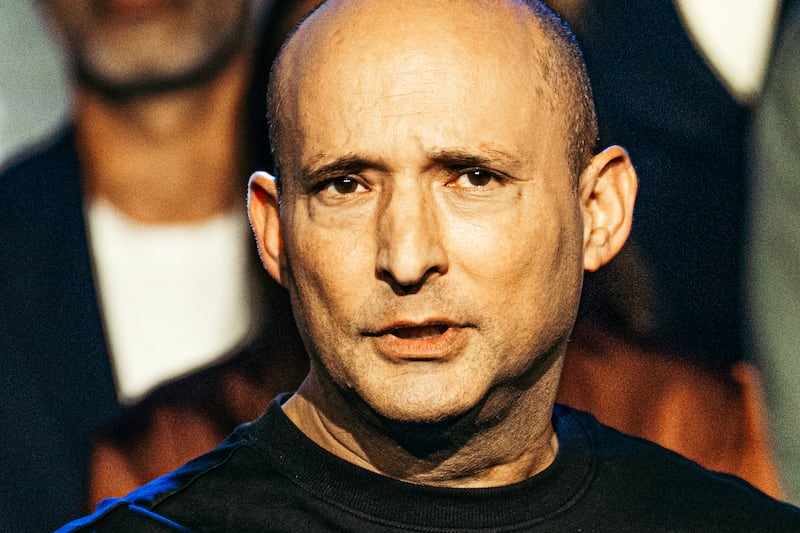
In 2021, Bennett and Yair Lapid (62), the leader of Yesh Atid, allied to oust Netanyahu in a short-lived government. This year, they have sought to lead an anti-Netanyahu front again, emphasising unity amid Israel’s bitter divisions. They have called for an expanded draft of the ultra-Orthodox and an inquiry into the October 7th attack.
Yisrael Beiteinu (Israel Our Home)
A secular Jewish party that is right-wing on security matters but broke with Netanyahu years ago.
Leader: Avigdor Liberman (68)

Founded in 1999 as a political home for immigrants from the former Soviet Union, the party has since expanded its appeal by promising to defend Israel’s secular Jewish character against the rising influence of ultra-Orthodox rabbis.
The Democrats
Heir to two parties from Israel’s dwindling political left, which once dominated the country.
Leader: Yair Golan (64)

Golan, an outspoken former two-star general, formed the Democrats in 2024 out of the remnants of the storied Israeli Labor Party and the more left-wing Meretz party. It favours a two-state solution to the Israeli-Palestinian conflict, while seeking to forge Israel’s identity as a liberal, secular Jewish state.
Other pro-Netanyahu parties
Otzma Yehudit (Jewish Power)
A far-right, ultranationalist, anti-Arab party.
Leader: Itamar Ben-Gvir (50)

Ben-Gvir, a right-wing provocateur, made his name as a lawyer defending Israeli settlers arrested for attacking Palestinians. His support appears to have grown amid a shift to the right among Jewish Israelis since the October 7th attack. He has called for the removal from Gaza of Palestinians through “voluntary emigration”. Ben-Gvir has drawn international condemnation and sanctions for his anti-Arab rhetoric and conduct as national security minister in Netanyahu’s government.
Religious Zionism
A far-right, ultranationalist party with a focus on expanding Israeli settlement of the West Bank.
Leader: Bezalel Smotrich (46)
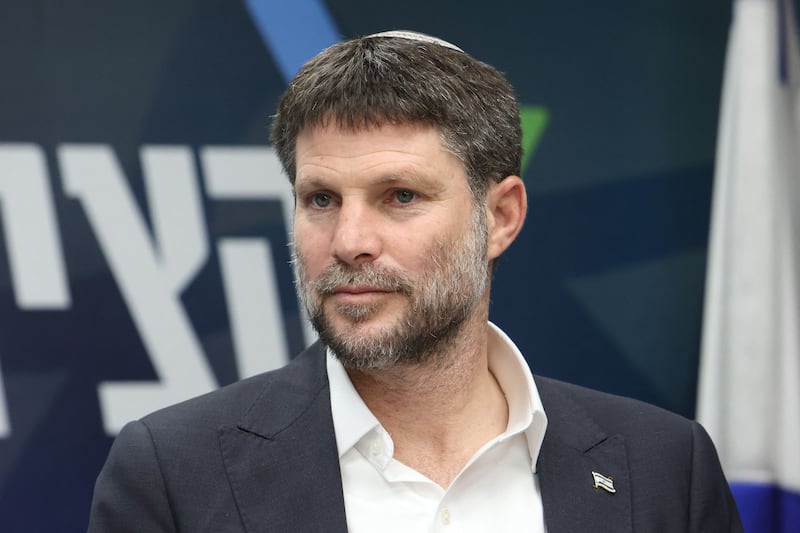
As finance minister and a minister in charge of the administration of the West Bank, Smotrich has masterminded the steady advancement of Israel’s de facto annexation of the territory by expanding settlements, building roads for Israelis and crippling the Palestinian Authority, which administers part of the West Bank. He has repeatedly said that Israel should permanently occupy and resettle the Gaza Strip with Jews.
Amcha Yisrael (People of Israel)
A right-wing party that supports Netanyahu but opposes a draft exemption for the ultra-Orthodox.
Leader: Ofer Winter (55)

Winter, a former brigadier general who formed the party in August, gained prominence for his hawkish national security views. He has spoken of encouraging the voluntary emigration of Palestinians from Gaza.
Shas
Traditional political home for ultra-Orthodox Jews whose families came to Israel from the Middle East and North Africa.
Leader: Aryeh Deri (67)

Deri, a veteran political operator, spent time in prison for bribery and fraud, and was later convicted of tax fraud and barred from serving as a government minister. Shas’ following extends beyond ultra-Orthodox Jews to others who are less religious but whose roots are likewise in the Middle East and North Africa.
United Torah Judaism
An alliance of two parties representing different streams of ultra-Orthodox Judaism with roots in eastern Europe.
Leader: Yaakov Asher (61)

UTJ’s politics centre on protecting the ultra-Orthodox, or Haredi, community’s strict religious way of life. It has long been allied with Netanyahu, whose governments have supported UTJ’s voters with subsidies. But the partnership has grown increasingly shaky.
Arab parties
Raam (United Arab List)
An Islamist party that increasingly advocates coexistence between Arabs and Jews.
Leader: Mansour Abbas (52)

Abbas has taken a pragmatic approach to Arabs’ participation in Israeli politics, and in 2021, he made history by joining an Israeli governing coalition. In August, he recruited a Zionist former senior police commander as Raam’s No 2 candidate. If Jewish opposition parties drop their resistance to joining a coalition with an Arab party, Abbas could be crucial to ousting Netanyahu.
The Joint List
An alliance of three parties representing Palestinian citizens of Israel.
Leader: Yousef Jabareen (54)

The Joint List’s component parties represent a range of ideologies, including a Jewish-Arab communist alliance and a Palestinian nationalist party. Their goal in uniting is to bring more Arab voters to the ballot box, expanding their representation in parliament. – This panel originally appeared in The New York Times.


