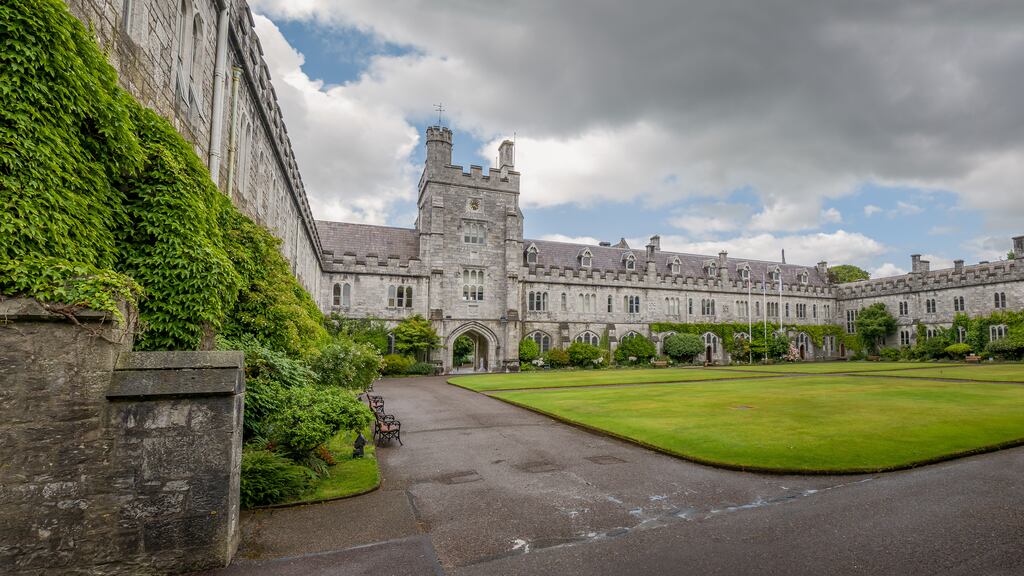
Concerns have been raised about a dual degree course offered by University College Cork (UCC) and a Beijing university with ties to the Communist Party of China (CPC).
The agreement to establish a BA (hons) course in Digital Culture and Society was signed by representatives of UCC and Communication University of China (CUC) in January at an event attended by Taoiseach Micheál Martin.
Increased higher education links with China was a big focus of the Taoiseach’s visit to China.
The head of the CPC cell in the university is entitled to a place on the seven-person joint management committee that oversees the new course, according to an agreement signed by the two universities.
RM Block




The committee, which is chaired by a Chinese nominee and has three UCC representatives, will include “the person in charge of the grassroots party organisation” in the CUC, according to the 20-year agreement.
All Chinese universities have an embedded CPC cell or branch that ensures compliance by universities and their students with party policy.
Students doing the four-year course are selected by CUC, spend the third year of the course in Cork, are taught by academics from both universities, and independently receive degrees from both universities, according to the agreement, which has been seen by The Irish Times.
“Contents of the teaching materials for teaching used in China by both parties shall not contradict the constitution and laws of China, or jeopardise China’s national sovereignty, public security and public interests,” according to the document.
UCC academics involved with the new course and who were asked to comment all either failed to respond or referred queries to the university’s press office.
One former UCC academic, professor of Sinology Julia Schneider, now with the University of Hamburg, said she and others raised concerns about the then-proposed dual-degree programme when she was still working in the Cork university. She left UCC in late 2024.
UCC staff who go to China to teach the course must comply with Chinese laws, “including those related to sovereignty, security, and [the] social interests of China”.
Furthermore, they “shall not offer religious education in the program, organise or conduct religious activities in the program, or solicit membership to any religion in the program”, the agreement says.
The fact the Chinese university selects the students, who are likely to all be Chinese, is among the agreement’s problematic aspects, according to Schneider.
“The issue of how the students are selected is very important, because of the criteria on which they are selected: on merit, but also on political ideas, and how they behave in public, and if they have posted problematic things online,” she said.
“All of these things have an impact on how students are selected in the People’s Republic of China,” said Schneider, who emphasised she had not seen the final agreement.
“Who can guarantee that the students will enjoy academic freedom, while they are in Ireland, but particularly when they are in China?”
By giving the programme “an Irish stamp of approval, you do, somehow, corrupt this idea [of academic freedom], because you cannot guarantee academic freedom in a state like the People’s Republic of China”, she said.
Chinese law operates on the basis that it applies to Chinese citizens even when they are not in China. People who criticise the state or the CPC can be subjected to heavy penalties.
Because of the nature of Chinese law, Chinese students “control each other” when in university, said Schneider.
“This is something that colleagues have observed in classes where they have more than one [Chinese] student. The students do not dare speak their mind openly, because they cannot know who of the other students might tell on them.”
The CUC was founded by the CPC in 1954 and its charter says it “serves the governance of the Communist Party of China”.
Among those who regularly receive training at CUC are employees of propaganda departments in Tibet and Xinjiang, where the Beijing regime has for decades operated repressive policies in relation to the Buddhist and Muslim populations.
In Xinjiang, where the Uyghur Muslim population has been subjected to extraordinary repression, a key role is played by a state paramilitary organisation called the Xinjiang Production and Construction Corps.
As recently as last month, a 14-day training course was held at CUC for “grassroots backbone personnel of the publicity and ideological culture system” in Xinjiang, according to the university’s website.
The participants were welcomed by the university’s vice-president, Li Xinjun, and the course was hosted by the publicity department of the party committee of the 14th division of Xinjiang Production and Construction Corps, according to the website.
A spokesman for UCC said transnational education structures are a widely accepted model and enable students to access high-quality programmes and qualifications through partnerships between institutions in different countries.
“Collaboration with higher education institutions has been a particular focus of Irish Government policy,” the spokesman said.
“China is a major partner for transnational education in Ireland with over 100 joint programmes between Irish and Chinese universities. The details of UCC’s newest dual degree are common in global higher education agreements.”
He said all partnerships UCC enters into globally are subject to UCC’s commitments to uphold academic freedom and protect human rights.
The annual fee for the UCC/CUC dual degree is approximately €11,300, the spokesman said.
“It is great when Chinese [academic] colleagues or students come to Ireland to work and study together,” said Schneider.
“But these structural agreements where, for example, the Irish university gives away their right to select students, or their control of the programme, that is problematic.
“And also, where the university uses its good name to whitewash a Chinese programme that cannot guarantee academic freedom, that, I think, is very problematic.”
As far as she is aware, Schneider said, no German university has a dual-degree programme with a Chinese university. The reason Irish universities do, she presumes, is “money”.
Earlier this year a study by the Central European Institute of Asian Studies, which receives funding from, among others, the European Commission, raised concerns about the extent of the links being established between Irish and Chinese universities.
“These arrangements expose Irish universities to significant risks, including to the welfare of students and staff, and to the safeguarding of academic freedom,” said the report.
The most significant risk arose from “the potential chilling effect on academic freedom within Irish higher education,” it said.


