A case for the defence
The case for the defence is, if not watertight, then very strong. Ireland’s work in this facet of the contest was excellent, underpinned by good communication, cohesion and being connected with some fine individual displays.
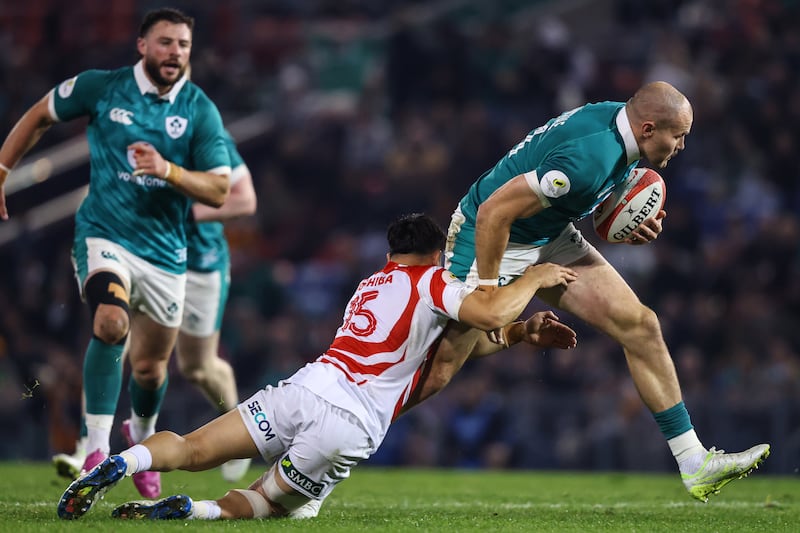
The decision-making for the most part was good, players like Robbie Henshaw and Jacob Stockdale cutting down time and space by coming forward, while the tackling around the fringes of the breakdown was authoritative.
There were just one or two moments when Ireland were undermanned out wide, if Japan had played a little flatter and moved the ball with greater urgency to width. New Zealand will have noted that space in advance of next Saturday’s game.
Reaction: Ireland run in five tries as they beat Japan
Ireland made 135 tackles, missed 11, won six turnovers and made nine dominant hits. The one metric that they’ll want to change is that they allowed Japan 12 dominant shots; no footwork, static starts a recurring issue. However, the overwhelming throughput on the day was that the defence for a scratch team performed impressively.
RM Block


Mitigation for Ciarán Frawley’s performance
The lack of game time in the outhalf position was clearly visible in Ciarán Frawley’s performance, having last started there for Ireland A in February and before that the previous April in a Leinster jersey. There is no substitute for match minutes in a position and especially one as pivotal as outhalf, through whom so much of the game flows; or is expected to when the team is humming.
Frawley moves to Connacht next season to get regular game time in the 10 jersey and it will be fairer to judge him when he’s had regular time in the saddle so to speak. Playing behind an Ireland team hampered by a misfiring setpiece, Frawley had less time and space than he might reasonably have expected and that was manifest in a few questionable decisions.
Test rugby is quicker and Japan hustled the Irish outhalf, blocked down a few kicks and Frawley’s frustration was manifest in other mistakes, albeit that there were green shoots in several things that he did well. The fitful quality of the ball he received with a fractured setpiece and slow breakdown ball won’t have helped.
Stockdale unlucky to suffer from mid-game backline reshuffle
Stu McCloskey was the first to go, followed by left wing Jacob Stockdale who would have been entitled to feel slightly bemused by the decision. Whereas Bundee Aki’s arrival was a like-for-like replacement for McCloskey – the Ulster centre gave his team the lion’s share of their positive gainlines – getting Harry Byrne on the pitch at outhalf required greater upheaval.
Ciaran Frawley switched from outhalf to fullback and Jamie Osborne from fullback to wing to accommodate Byrne’s arrival. Frawley was supposed to offer his credentials for the outhalf role, Osborne to reinforce his position as Hugo Keenan’s understudy, which he had done so capably in the Six Nations.
At that point, the game was still in the melting pot, so this wasn’t a case of “let’s experiment”. This was done because the principals mentioned can’t have convinced Andy Farrell that they should be left in situ to close out the contest. Stockdale, on starvation rations, was one of the few players who beat the first tackle and made one super read in defence. The irony was that he made way when others played less well.
Substandard setpiece is a concern
There’s no escaping a substandard performance from Ireland at scrum and lineout. The bare statistics inform that Ireland lost four of 18 lineouts – there were several scruffy wins in their too – while the return from their scrum feed was nine from 13. Neither of those metrics will be acceptable and there’s no need to recourse the statistics either.
Japan’s first try came from an Ireland lineout. Rónan Kelleher either overthrew or threw early according to those who were exemplars in the art. The lineout is made up of so many moving parts, lifting, calling and throwing. Ireland have turned over lineouts with Dan Sheehan, Kelleher and Tom Stewart over the past two matches so there’s more than pilot error on the throw.
There’s a nervousness or edginess there at times. The Japan starting secondrows were six-eight and six-nine respectively so there was some tall timber to avoid but New Zealand’s eyes will light up at the prospect of having a crack at Ireland in this facet of the game. Patching the scrum, new personnel et al is another on the to-do list.

Sean Jansen the pick of the debutants
A proud day for debutants Billy Bohan, Sam Illo, Bryn Ward and Sean Jansen, with the latter topping off a memorable occasion by winning the man-of-the-match award. It wasn’t just the case of the newbies looking to grasp the opportunity but also for those players who weren’t first choice in their respective positions.
The 27-year-old Jansen couldn’t have been any more forthright or authoritative in the quality that he brought to his work, a continuation of his consistent excellence for Connacht last season. He carried with typical power, breaking the line, and put in some big tackles, augmented by a relentless work-rate.
Nick Timoney, Jack Conan and Robbie Henshaw were three other players who were conspicuously excellent in their input. Timoney and Henshaw were rewarded with tries for their efforts and they will be part of any conversation between the coaches this week. Illo and Bohan discovered what a Test rugby scrum looks like, while Ward warmed his shoulders with typically robust carries.