Nobody, it seems, is quite sure where Gaelic games currently is along its rocky road to integration. And in the Houses of the Oireachtas on Wednesday, the journey veered down an unexpected off-ramp where Jon Bon Jovi was deemed as reliable a weathervane on the matter as anybody else right now.
For two hours and 14 minutes, the leadership of the GAA, LGFA and Camogie Association fielded questions on integration.
At times, the discourse meandered off point, from the Garvaghy Road to the GAA’s ongoing sponsorship arrangement with Allianz, from Man City’s overspending to 80s big-hair rockers Bon Jovi.
But within the jumble of it all, it was evidently clear that more than anything else the one morsel of information the 12 members asking the questions wanted to know was if there was a new target date for integration.
RM Block


Some called it a timeline, others a timeframe. A timetable. A deadline. Call it what you will. “Just tell us, when will it be done?”
But if that was the general thrust of the questions, those in the dock didn’t come with answers.
In that regard, while the GAA, LGFA and Camogie Association arrived to the Oireachtas with good intentions, they also arrived with very little detail.
About 40 minutes in, on questioning about the letter that prompted Mary McAleese to step away from the process, GAA director general Tom Ryan namechecked the day Bon Jovi played Croke Park at the end of August (as he couldn’t recall the precise date) as the afternoon the association essentially resolved to step back from the 2027 commitment.
Senator Rónán Mullen later suggested it seemed the GAA had for a period been Livin’ on a Prayer in hoping the mess would somehow untangle itself.
GAA president Jarlath Burns grabbed his opportunity: “The line before Livin’ on a Prayer is, ‘We’re halfway there’.”
Laughter spread across Committee Room One. Mullen – who had handpassed the ball across the small parallelogram to Burns – congratulated the GAA president for taking full advantage of that open goal. Everybody was delighted with themselves.
Somewhere in New Jersey, one can only presume Jon Bon Jovi was busy laying out cones for under-14 camogie training when he received a text from the club chairperson to tell him he’d just been namechecked in Government Buildings in Ireland. “Oh, and by the way Jon, you’ll have to move to the back field tonight because the senior men’s footballers need the main pitch. Good lad.”
Integration. Everybody wants to make it happen. Everybody has committed to making it happen. But the mechanics of how the three organisations get there and when they’ll get there didn’t become any clearer on Wednesday.

It was a source of frustration in the room for the duration of the meeting.
All six power brokers arrived together – Ryan and Burns from the GAA, CEO Lyn Savage and president Trina Murray from the LGFA, and Camogie Association CEO Karen Dessain-Gelinet and president Brian Molloy.
They sat with each other in the upstairs lobby beforehand and they descended the stairs in lockstep. The optics were clear. Nothing like a show of unity to reassure the doubters. We’re all in this together, lads.
But of course it was a lack of unity that had brought them back to Leinster House. When they had appeared last in June, chairperson of the Steering Group on Integration (SGI), McAleese, had reaffirmed the group’s commitment to achieving integration by 2027.
A couple of months later the SGI was back in front of an Oireachtas Committee, McAleese had resigned, and the aspiration of 2027 had proven to be nothing but a fanciful fairytale.
And so Labour’s Alan Kelly, chair of the meeting, threw the ball in by pulling hard across the ankles of those seated to his left.
“I’m quite conscious of the fact, having read the transcripts of the last two meetings with this group, of the narratives and statements that were made previously and in some cases only a few months ago, so I’m going to ask members and witnesses to bear that in mind, the content of what was stated to this committee only three months ago, I think it’s important, I rarely ever have had to say that before.”
It was an early scolding. But not an unexpected one.
[ GAA integration will take ‘years’ to come together, says directorOpens in new window ]
Senator Alison Comyn was the first to ask questions. And the first to seek a new timeline. She was not to be the last.
Over the course of the meeting, mostly Burns and Ryan offered various “personal” aspirations but they stopped short of committing to any date. They had been too badly burnt with the 2027 target to go stoking the cinders of that firestorm.
“I think that is a process that will take a number of years,” said Ryan.
Over the course of the conversation, vague possibilities about progress in 2028 were put forward, while Burns offered that it could take three meetings of Congress – for each association – to get it over the line incrementally.
They did, however, provide more clarity on the appointment of a new SGI chair, with an announcement expected in the next 48 hours.
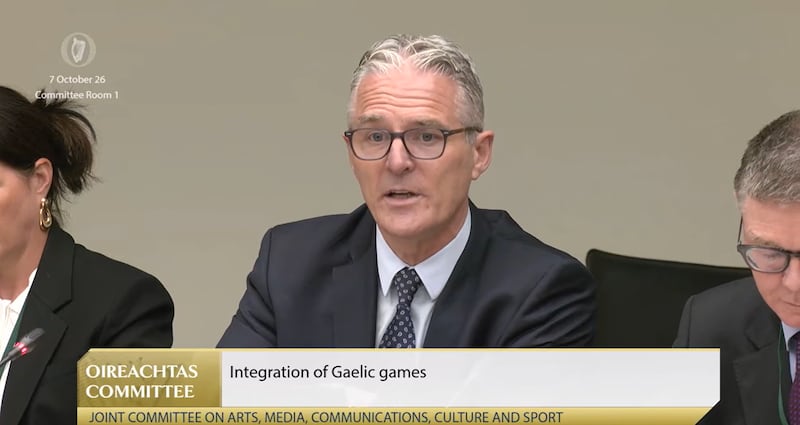
“We met as a group on Monday and we agreed unanimously on a nominee for that position and that person has agreed to take up that role,” confirmed Ryan.
“Each organisation over the course of the next, I want to say 24 hours, will be meeting to formally ratify that person.”
Fianna Fáil’s Peter Cleere went for a straightforward approach, asking each organisation if they were completely committed to integration.
“Absolutely 100 per cent, that’s the easiest question I’ve been asked today,” replied Burns.
“Yes Deputy, we’re fully behind integration,” added Murray.
“100 per cent,” said Molloy.
Cleere raised his arms out wide and smiled: “Jeez lads, we’re halfway there.”
Burns: “There’s Bon Jovi again.”
But if the meeting starting with a scolding from Kelly, it ended with one too. Perhaps the GAA had hoped the loose promise of having something tangible to show at their Congress next February had sated the Oireachtas members, but they were mistaken.
Because Kelly informed them he was scheduling another meeting for December.
“We look forward to a very positive meeting come December where we should have a lot more information,” he said.
Across the way, some folk started to scribble in their notebooks. A meeting that provided no timelines had ended with one. December, best to put that in the diary.
Halfway there?
Time will tell.