When Rhasidat Adeleke and Kate O’Connor visited the Los Angeles Memorial Coliseum last Monday morning, they were entering an arena that has already staged glorious moments in Irish athletics history. They hope to enjoy a couple more if they get to return there less than two years from now.
During their trip, Adeleke and O’Connor scouted out several venues that will provide backdrops to the 2028 Olympics, including the Coliseum.
It was there, in 1932, where Bob Tisdall won Olympic gold in the 400m hurdles, followed by Pat O’Callaghan winning his second gold in the hammer. Fifty-two years later, John Treacy arrived to the Coliseum after running 26 miles around the streets of LA to take silver in the marathon, the last event of the 1984 Games.
Adeleke and O’Connor’s promotional visit came after a summer in which, for the first time, both won medals at the same championships; Adeleke taking European silver in the 200m in Birmingham before O’Connor struck heptathlon gold. Their trajectories are neatly aligned as they approach LA, two years on from their contrasting experiences in Paris.
RM Block


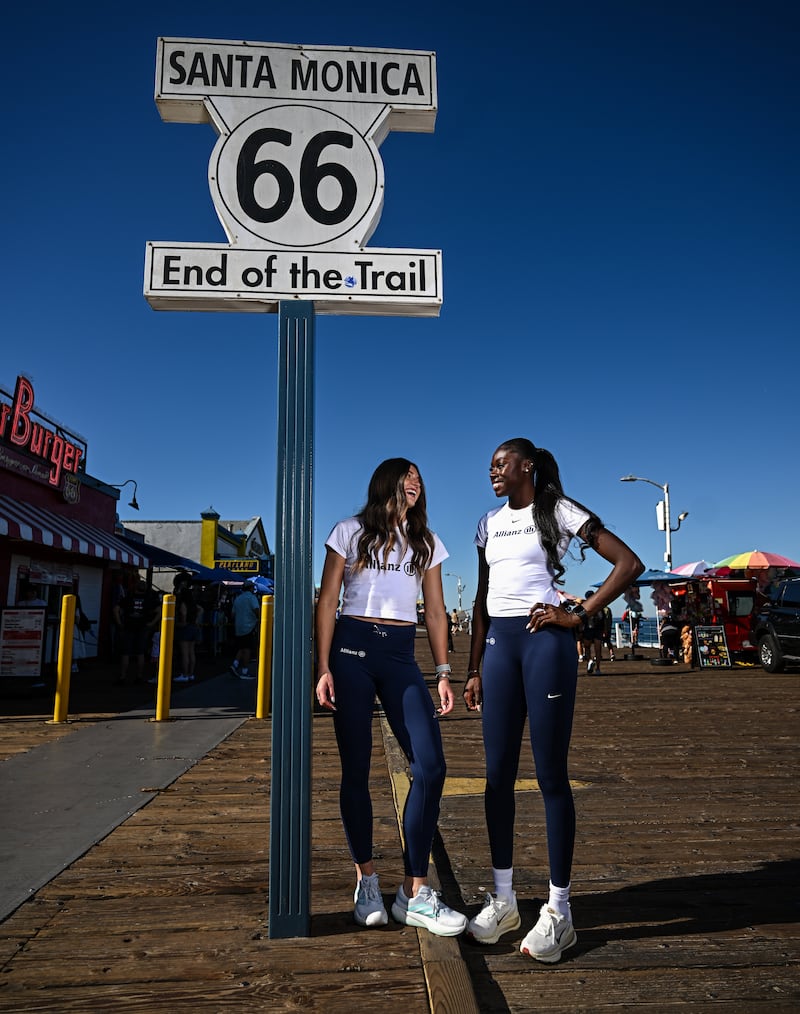
Their time in LA – they travelling as ambassadors of Allianz, title sponsor of the Olympic Federation of Ireland (OFI) and Paralympics Ireland – gave them the chance to bounce ideas off each other and reflect on how they’ve got to where they are, and what they need to do to be at their best if they return to LA in 21 months.
“Just being at the Coliseum, it really puts it into perspective,” says Adeleke. “We were just speaking about how huge it is, and envisioning the track being laid out here, and the fans screaming up. It just makes it all feel a lot more real.
“But staying mentally fresh, I think that’s something that, for me, we’re going to definitely try implement a bit more. Especially after the [Paris] Olympics, and 2025 and 2026, with the injuries, and the constant need to make sure that I’m at the top of my game.
[ Dr Pat O’Callaghan ‘the greatest all-round athlete in the world’Opens in new window ]

“I’ve realised how important it was to get that downtime, get that family time, get that time to get away, and have that mental break. But also working smarter, not necessarily working harder. Because we’ve done the working hard part, the really difficult sessions and the gruelling work. And that essentially caused me a lot of injuries.
“So now we’re going to take things back to basics, focus on what works, and the quality of the work. And also making sure I’m living a full life, that I can enjoy, have fun, and time to breathe. And when I do come back to the track, when I do go to train, I’m in the best position to give 100-per-cent effort, and just not experience any burnouts again.”
Paris for me was that turning point ... Just the switch in mindset over the last two years is crazy
— Kate O'Connor
From here, Adeleke returns to her training base in Texas, continuing to work under coach Edrick Floréal, with no plans to change that before LA. Her 200m silver medal at the European Championships, where she improved her Irish record to 22.28 seconds, has given the Dublin sprinter another option for next year, and possibly 2028. But at her peak fitness and potential, she still considers the 400m her strongest event.
“At the moment, the 400m is still my main goal. But the 200m this year has shown that there is a possibility. But it’s all about timing, we’ll see how it plays out. The season can be unpredictable sometimes. You can set out to do one thing, and one event, then things can change.”
For O’Connor, the LA trip is a first excursion to the west coast, making the visit to Venice Beach, Santa Monica Pier or Old Route 66 almost as exciting as the Coliseum. She’s approaching the Olympics with a completely different frame of mind compared to Paris. At the 2024 Games, O’Connor finished 14th in the heptathlon on the same day Adeleke finished fourth in the 400m her heptathlon competition in 14th place – a mere footnote to the Irish performances over the entire 16 days.
“Paris for me was that turning point,” says O’Connor. “Those Games opened my eyes to the athlete I wanted to be. And from there I kicked on, so that going into LA, my goal is to be on the top of the podium. Just the switch in mindset over the last two years is crazy.

“And 2024 was such a tough year for me. I had a really bad injury, in December of 2023, where I ruptured two ligaments in my ankle and had a flaring of my tibia and fibula. It was a terrible injury, I couldn’t walk for months, and I thought that my season was over.
“I’d this lifelong dream of qualifying for the Games, and I managed to make that happen. And while I was there, I enjoyed every single second of competing. I absolutely loved it, and that buzz of the village, the buzz of the crowd in the stadium, it’s indescribable.
“But I definitely left feeling unsatisfied, and trying to figure out probably at the time whose fault was it. I was pointing the finger at my dad [Michael], at my other coaches, and everybody that was working with me. I was saying to them, ‘Maybe I need to try something different, something new?’
“Then, maybe after a week, I was doing some self-reflection, and I came to the decision to try to change everything that I’m able to – whether that was sleep, nutrition, recovery, turning up to training and giving 100 per cent.”
Seven months after Paris, O’Connor won bronze in the pentathlon at the European Indoors. With that, the Dundalk athlete kick-started her extraordinary run of seven medals in seven successive championships, the latest of which was gold in Birmingham.

“This year, I probably had a lot more improvement in my locker that I didn’t end up showing,” she says. “So I just plan on chipping away on all seven events. The top girls are scoring 7,000 points, I’m still sitting at 6,750 and need to get closer to that 7,000-mark if I want to stand a chance for what could happen. I don’t feel like I’ve reached my ceiling at all, but with multi-events, it’s also about staying healthy.”
O’Connor will be 27 by the time the LA Olympics roll around, Adeleke, just 25. Both very much coming into their sporting prime.
“We’ve been speaking a lot over the last couple of days, and Rhasidat had so much success as an underage athlete and right into the senior ranks. And then 2025 and 2026, she faced her first bit of adversity. Whether that was injury or just different things going on in her camp, and she’s managed to come out of it.
“For me, it was almost the opposite. [When] I was a kid, growing up and coming into the senior ranks, I was injured quite often, and really trying to figure out what works for me.
“Now, the two of us are very much of the same mindset, that we want to be the best possible athletes that we both can be by the time LA comes around.”