
Achieving energy efficiency doesn’t happen in an instant. As David’s story shows, it’s about making the best decisions you can – for you and for the environment.
Recently retired couple David Moore and his wife Anne live in a beautiful pocket of the countryside outside Midleton, just east of Cork city.
The pair, who have two grown-up children, built their 2,500sq ft home to their own design in 2012 on a one-acre plot which now boasts a lovingly nurtured garden.
“We’re very much an eco family in that we love nature,” says David. “So we’ve planted around 70 trees and have left much of it go wild.”
RM Block


It’s a continuing labour of love. “Our most recent project, earlier this year, was to install a pond. It’s not the best-made pond in the world, but it’s already attracting dragonflies,” he says with pride.

When they built their home, the couple made what they felt were the best heating and energy choices available at the time, which resulted in the installation of oil-fired central heating.
But when the current boiler reaches the end of its life, David plans to replace it with a heat pump.
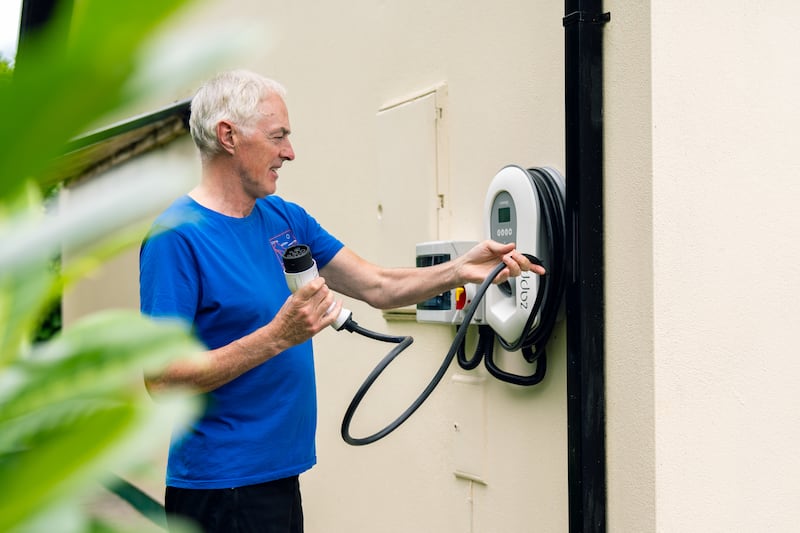
He has already made another significant step towards greener living since the time came for the couple to change cars. They swapped their old diesel for a new electric one and chose Electric Ireland to install their EV charger in the driveway.
As well as installing the charger, Electric Ireland helped David understand how to make the most of home charging through smart tariffs and overnight charging, allowing him to maximise savings and convenience.
Before retiring, David ran his own research and development food consultancy, while Anne worked in a hospital laboratory. Both hate waste, whether it’s energy or money.
“We built our home pretty well for the time and had it well insulated, with triple-glazed windows, so it has always been an efficient house, using the best of what was available then,” says David.
Back then, solid fuel stoves were all the rage, and he bought one, something he now regrets. “Whether you’re burning wood or coal, it’s a dirty fuel,” he says.
On the other hand, the couple had solar tubes on their roof from the beginning, taking advantage of the available grant. “Because of that, we have always had free hot water during the summer months, and warm water during the winter months,” he says.
In May 2025 the couple went further, installing 12 photovoltaic solar panels through Electric Ireland, which are even more effective. Electric Ireland helped David understand the benefits of solar, including long-term savings, and guided him through the available grants.
“They sounded good, so we went for it. It cost us around €6,000 with the SEAI grant, and we have been in credit on our electricity bill ever since,” he says.
“I’m only sorry now I didn’t put in more, because I had space for 14. I also made a mistake in that I didn’t install a battery for energy storage at the same time. I regret that now, but it would have added too much to the cost. As it happens, I can see prices have come down since then,” he says.
Waste not, want not
The couple have always been careful about energy usage.
“We’re not big users at all. We’re thrifty in that we always put the washing machine on a short cycle, and we fill the dishwasher to the brim before using it every second day. We don’t leave lights or the telly on. We’re careful,” he says.
Because their new solar panels enable them to export energy back to the national grid, so far all of the couple’s electricity bills have been in credit. “It means that instead of being nervous when the bill lands, I’m looking at it and smiling,” he says.
“If I’d have gotten the battery, I’d have been in credit even more, so I’d strongly advise others to put in a battery.”
David reckons the couple will pay off the cost of the new solar panels in six years. “Even if it takes me seven, it doesn’t bother me, because I still have no bills,” he says.
“I don’t see the point in complaining about bills if you’re not going to try and do something about it. And the one bill you can do something about is electricity.”
“After all, nobody is out there offering me free car insurance, or free health insurance for life, if I pay a lump sum up front,” yet that’s exactly what investing in solar panels has done for his electricity bill, he says.
Happy out
He’s equally happy with the cost-in-use savings he will make from his new EV, not to mention the satisfaction of knowing he won’t be paying for diesel or adding unnecessary pollution to the environment anymore.
“We went for the cheapest one we could get, with the longest warranty. The EV we opted for has a seven-year warranty plus three years free servicing,” he says.
David also looked closely at how and when he uses his electricity to make the most of his solar panels and charging his EV. Through Electric Ireland’s range of smart meter tariffs, he found the tariffs that suited him the most.

Thanks to the Electric Ireland Night Boost smart meter tariff he is on, between 2am and 4am the cost of his electricity is around a third of the day rate.
“The charger does 7kW per hour, which means I can put in 14kW between 2am and 4am, which will get me 100km of driving a day, and cost me just €1.50. With the diesel, that would cost me €8.50. It means my driving is five times more efficient,” he says.
“Being retired, it’s nice to know you can go for daily spins to the beach and not have to think about the cost of pulling into a petrol station. We can just enjoy going for a drive without feeling guilty about burning diesel or because it costs us money.”
Of course, he can’t achieve everything he would like to when it comes to energy efficiency. He is aware that new generation windows would be even more energy efficient than the triple-glazed ones he chose when building the house. “But it would be just too expensive,” he says.
In the meantime, he is enjoying thinking about how he could use his EV as a battery, such as to power the electric mower that cuts his lawn. Or, better still, he might use it to power an outdoor heat lamp so that the couple can sit out, even on chilly nights, and enjoy the burgeoning wildlife in part of their garden they’ve given over to nature. The large amounts of cheaper night-rate energy stored in his car’s battery will essentially turn it into a low-cost portable power bank.
All in all, becoming energy aware has been rewarding for the couple in so many ways.
“I suppose we’re from a generation that learned the importance of being thrifty from our parents. But far from having a negative influence on our lifestyle, all these decisions are having a positive influence,” he says. “I just can’t see a downside.”
David’s story demonstrates that some practical steps, supported by expert advice and solutions tailored for him, really made a difference to how sustainable his home and lifestyle are. From solar panels and EV chargers to smart meter tariffs, Electric Ireland helps customers make informed decisions at every stage of their journey to net zero.
For more information on the steps you can take in your journey to Net Zero, visit the Electric Ireland Net Zero hub


