Polestar is at its ‘difficult second album’ period. Ever since the company was founded — spun off from Volvo, where it was once the Swedish brand’s racing team and high-performance specialist, and funded by Chinese cash from owner Geely — it has been a vibes-based affair.
Polestar models were supposed to be design-led (the company’s first chief executive was a designer, Thomas Ingenlath, who has since returned to Volvo as head of design there) and made to fit into the white spaces of the car market where Volvo didn’t tread.
That’s officially over now. Polestar’s second chief executive is Michael Loscheller, formerly of Opel. From here on, the brand has to stop paddling around in the shallows of niche models and start swimming into the deeper waters of the broader premium car market.
That may well occasionally bring Polestar into conflict with its senior partner at Volvo — look at how the new Polestar 4 SUV effectively competes with Volvo’s own EX60 — but as Philipp Römers, Polestar’s head of design, told The Irish Times: “We will make Polestar commercially successful; that is what this second chapter of Polestar is all about.”
RM Block


That chapter opens with a new concept car, the Polestar Formula 2030.
At first, a concept car might seem like Polestar is backsliding into niche territory, especially as Formula 2030 uses a combination of hatchback and shooting-brake estate design cues.
However, it’s a far more serious car than that for the brand. While the Formula 2030 may never be built or put on sale as it is (in spite of Römers telling us “it’s the car that I would want to drive”), it effectively previews Polestar’s next two new and potentially most crucial models.
The first is the new Polestar 2 saloon, a car that will replace the brand’s first proper production model (the gorgeous Polestar 1 was a strictly limited-edition coupe) and which will finally break away from the company’s Volvo roots (the Polestar 2 is, and has always been, effectively a production version of an old Volvo concept car and carried over Volvo styling cues). At the front, then, the Formula 2030 is essentially what we will get when the new Polestar 2 arrives next year.
“It’s clearly a Polestar, and you can see that from the light graphic,” Römers told The Irish Times. “Then also we have this aero wing, which we invented for the Polestar 3, but this is the first time that we’re using it without a grille-style shape below it.”
That aero wing is a slim front aerodynamic device that sits almost flush with the tip of the Formula 2030’s bonnet and which deftly ducts air up and along the bonnet and over the car’s roof.
That roof is spectacularly low compared to the hordes of SUVs that more normally fill dealerships and roads, so hopefully the Polestar 2 in production form can be similarly low-slung.
However, there are no major deviations from current Polestar design cues in the Formula 2030. It has the same split arrowhead headlights and smooth, uncluttered body shapes. “We are still a young brand. It’s all about brand awareness and kind of anchoring the brand in the market, so let’s aim for an evolution, but an evolution which can be clearly seen,” said Römers.
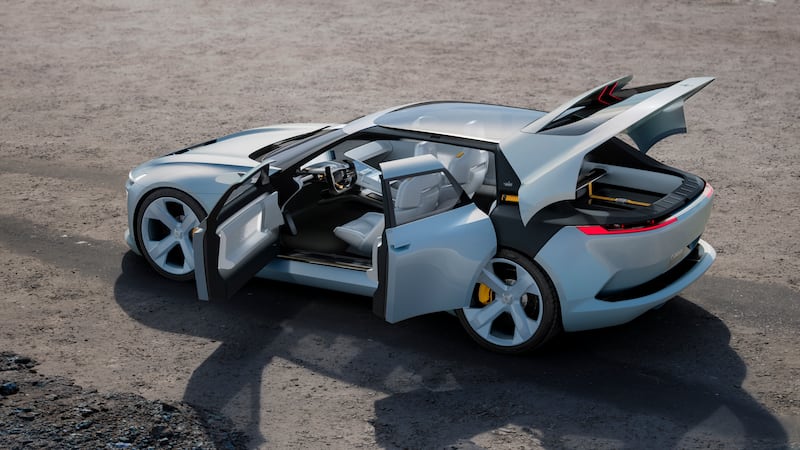
Lifting from Polestar’s roots as a motorsport brand, there are some racing cues in the Formula 2030’s styling, such as the massive wheel arches that reference 1980s rally cars, the single, upright windscreen wiper which is a nod to classic touring car racers (such as the 1990s BTCC Volvo 850 Estate that Polestar, in its infancy, helped to create), and spaces in the ‘frunk’ storage area in the nose to stash a pair of crash helmets. Even the ‘clamshell’ manner in which the bonnet and boot are designed to open is a nod to racing cars.
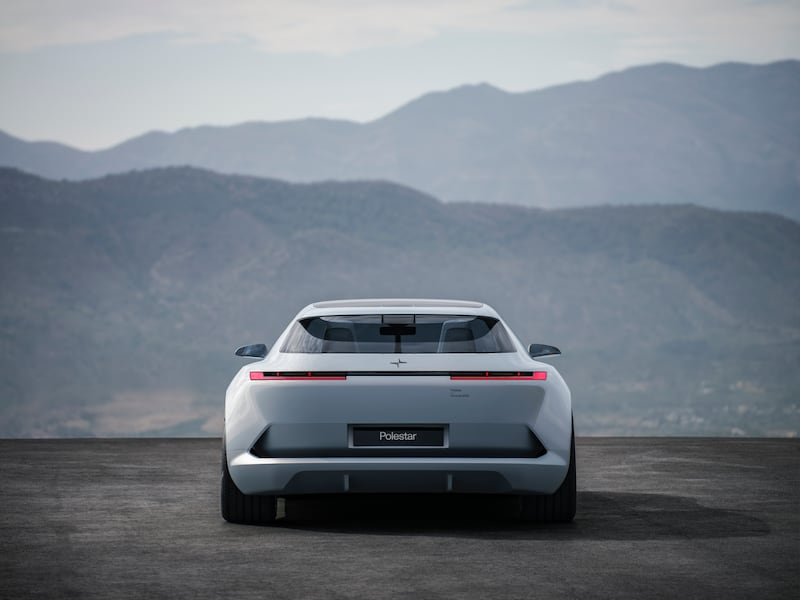
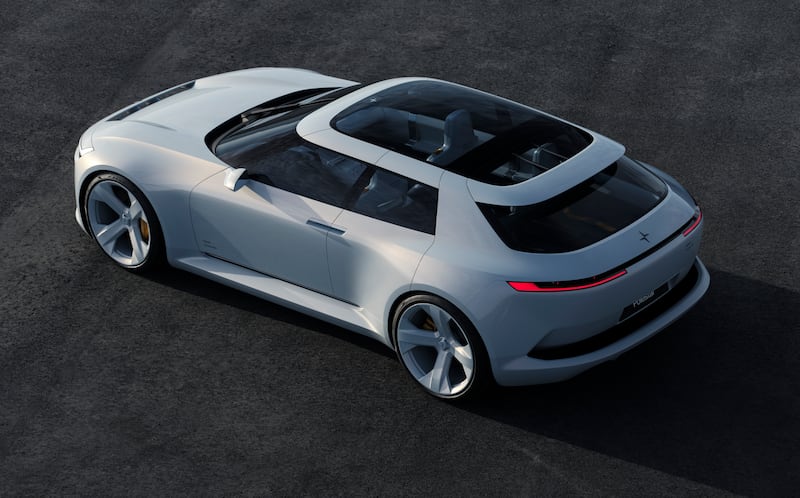
At the back, in contrast to the front end’s overtly muscular look, the Formula 2030 goes all smooth, with a rounded tailgate featuring two ultra-slim brake lights (not linked by a too-predictable full-width light bar) whose shape is meant to be a half-sized replica of the headlights.
More significantly, the shapes and volumes of the rear — if not quite the overall height — are a dead ringer for the new Polestar 7 SUV, a model due on sale in 2028 set to be Polestar’s foil for the likes of the BMW iX3 and the Audi Q4 e-tron.
Arvid Esser, the young designer whose work the Formula 2030 is primarily based on, told The Irish Times: “We had introduced the aero wing with the Polestar 3 and the dual-blade light signature with the Polestar 4 and 5, and so we wanted to combine these two milestones.
“When we talk about the rear of the car, it now speaks the same language as the front, so there’s not any line that is unnecessary, and we merge functions, so everything is in the right place and in the front and in the rear.”
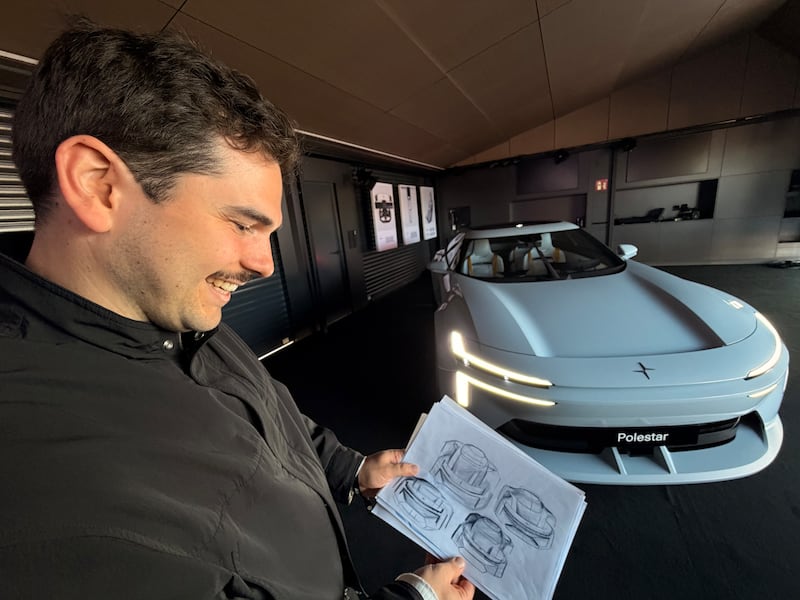
Esser showed us some of his original pencil and pen sketches of the Formula 2030, on paper much worn and marked by constant thumbing and folding, a refreshing touch in these days of AI-everything.
That’s the outside, but the Formula 2030’s interior might yet be even more influential. So far, Polestar’s cabins have been almost entirely screen-based, but Römers now accepts that this has gone too far. “We want to bring the best balance of physical buttons and screens into our cars, and we call it ‘Mechatronic’,” said Römers.

“How we do it, this blend, this perfect balance between the physical and digital world, is also, I think, very important when it comes to performance cars – to have easy and quick access to important functions.”
So instead of an all-screen environment in the cabin, the Formula 2030 features a large, versatile, wraparound instrument screen for the driver, backed up by a much smaller touchscreen in the centre which can, in sportier driving modes, lay flat on the centre console so as not to be a distraction.

Better still, on that centre console is a lineup of what appear to be delightfully tactile (we couldn’t play with them as the Formula 2030 is for now a mere clay styling model, not a functioning car) switches and buttons, and not only do these look great, they are also customisable, so you can pluck them off, like Lego bricks, and rearrange them to your taste. A bit of concept car pie in the sky?
Apparently not. Römers confirmed to The Irish Times that we will see the beginnings of this new cabin layout in the new Polestar 2 next year and that the moveable buttons idea is one that’s actively being worked on.
The concept Formula 2030 has a ‘yoke’ style steering wheel that’s connected to a putative steer-by-wire system, but that may not be the development route which Polestar actually follows. Such systems have had mixed feedback in real-world use by other car makers, and Polestar’s engineers tend to favour setups that are more ‘honest’ in their feedback and connection to the driver.
There are some clever environmental touches, though — Polestar has long been a company more keen to talk about its overall eco-impact than most others — such as the replacement of carbon fibre with a material that uses flax fibres, from European-grown plants, for rigidity and strength combined with light weight.
As well as being plant-based, it’s easier to recycle than conventional carbon fibre, and interior colour and trim expert Komal Singh told The Irish Times that Formula 2030’s pale purple interior colour was inspired by flowering flax plants.
All of which is all well and good, but what’s critical here is not the Formula 2030’s niche design flourishes, but how it will influence future products we can actually buy. Getting us to actually buy them is ever more critical, especially now that convoluted politics has shut Polestar out of the all-important US market, making the European reception for the next Polestar 2 and Polestar 7 beyond crucial. Can Polestar emerge from its niche beginnings to become a bigger market player?