
Last September, the United Nation’s World Intellectual Property Organization published a ranking of the planet’s most “innovation-intensive” places. Towns and cities were judged on the number of patents, scientific papers and venture capital deals they produced, relative to the size of their population.
The top five featured some predictable names: the US “clusters” of San Jose-San Francisco and Boston-Cambridge and the UK university cities of Cambridge and Oxford.
In fourth place, however, was a Chinese town of fewer than 400,000 people that until quite recently ranked as one of the least prosperous urban centres in its province, and was unknown to most people in China, let alone the rest of the world.
Ningde’s rise to prominence is due entirely to a single company: Contemporary Amperex Technology Co, Ltd, which has grown with extraordinary speed to become by far the world’s biggest battery producer – giving it a key role in the low-carbon transformation of both transport and power generation.
RM Block


“Long story short, CATL is an innovation-driven company,” its chief manufacturing officer and head of research and development, Ni Jun, said at the Ningde HQ. “Many companies, if you visit, have a big sign about innovation, creativity. Here it’s not just a slogan.”
The relentless focus on cutting-edge research has been drilled into CATL since its foundation just 15 years ago by Robin Zeng, who was born into a farming family in a village near Ningde and went on to gain a doctorate in advanced physics.
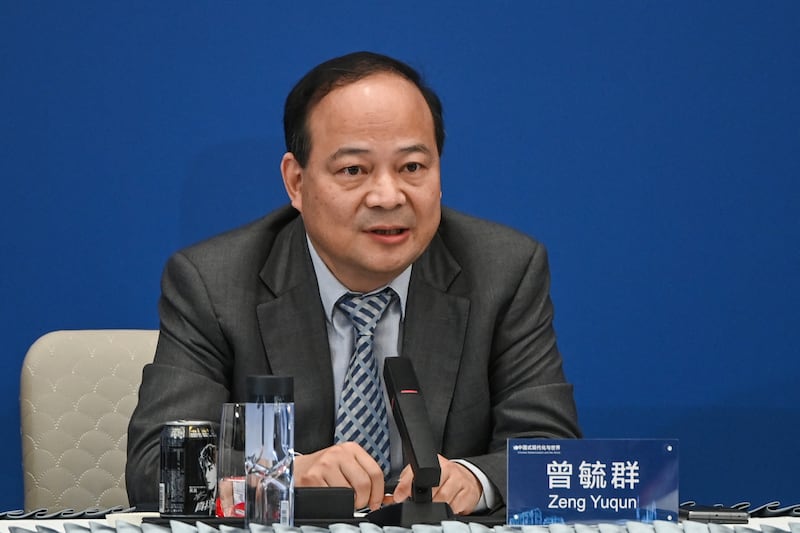
Zeng built a successful business supplying small batteries to consumer electronics companies including Apple, before founding CATL in 2011 to focus on larger batteries for electric cars.
Today, CATL makes over 40 per cent of the world’s electric vehicle (EV) batteries, and Zeng is China’s fourth-richest person according to the latest Forbes billionaires list, which estimated his wealth at $53 billion (€46.4 billion).
It’s all built on the aggressive pursuit of innovation, says Ni, wielding some punchy numbers to back up his claim. As of the end of last year CATL had over 54,000 patents issued or pending, a number that has since risen to more than 60,000, Ni says. Last year it ploughed almost a third of its net profit into R&D, giving Ni a research budget of over $3 billion.
Then there’s the manpower: nearly 30,000 of CATL’s 240,000 staff work in R&D, more than 700 of them with PhDs. In a 2024 interview, Zeng cited a huge supply of skilled engineering graduates as a vital advantage for China’s battery and wider clean energy sector – contrasting this with the US where, he said, young talent tended to be drawn to highly paid work in sectors such as finance.
At a nearby factory I watched one of CATL’s most advanced production lines, where electrode materials are painted on to copper and aluminium foils just 5 microns thick: one-20th the width of a human hair. Sections of electrode are rolled into cells roughly the size of a hardback book, which are then compressed using a force of 25 tonnes (think five adult elephants).
At every stage, cameras connected with AI-powered quality monitoring systems are keeping watch, backed up by human staff patrolling the automated production line, which has more than 7,000 quality inspection points.
Technological and manufacturing advances from CATL, and rivals like Shenzhen-based BYD, have driven battery cost and performance improvements that are changing expectations for the global energy transition.
Plug-in vehicles now account for over 60 per cent of new cars sold in China and are rapidly gaining share in the rest of the world.
CATL‘s researchers have been steadily pushing up the performance of electric car batteries. One of its new cell ranges can power a passenger car for 1,500km between charges, CATL says; another can be charged from 10 per cent to 98 per cent in just 6½ minutes.
For drivers wanting even shorter stops, the company is investing in battery swapping systems, with 2,300 swap stations already installed in China, a figure that it plans to increase to 4,000 by the end of this year.
I tested out the system at a station in Ningde: 100 seconds after driving into this structure, which looks from the outside much like a car wash, I drove out with a fresh battery, automatically screwed into the car from below.
Ten Chinese carmakers, including upmarket brand Nio and state-owned GAC, have signed up to use the system. Ni says consumers using it will be able to buy EVs at much lower upfront cost – since they’ll be accessing batteries as a subscription service, rather than buying one with the car – and won’t have to worry about their battery degrading over time or becoming outdated.
Meanwhile, CATL has a growing focus on grid-scale batteries to complement intermittent renewable power, which contributed 15 per cent of its revenue last year. Large-scale batteries are now so cheap that renewable power plants combined with battery storage can provide 24-hour electricity more cheaply than coal or gas-fired plants, according to new research from the International Renewable Energy Agency and other analysts.
A new direction in battery chemistry would send costs still lower, Ni told me. CATL has been making a push into batteries that use sodium – which can be sourced from common salt or soda ash – instead of lithium ions.

CATL began mass production of sodium-ion batteries this year, and has inked a three-year agreement with Shanghai-listed energy storage company HyperStrong to provide 60 gigawatt-hours of sodium-ion batteries (for context, that’s enough to meet the daily power needs of about 8 million homes).
The energy density of sodium-ion batteries can’t yet match lithium-ion ones, which will limit uptake in EVs to lower-end models, at least for the near term. But the adoption in grid-scale batteries could be much more rapid, Ni says, predicting that CATL’s sodium-ion batteries will reach cost parity with lithium-ion ones next year, and will become significantly cheaper over time.
Like China’s broader clean tech sector, CATL has had a significant helping hand from the government. Judging by the company’s own stock exchange disclosures, it has been among the biggest corporate recipients of state subsidies in recent years, according to analysis by Nikkei Asia.
As the US reacts to China’s growing clout, CATL has become a target. In January last year, during its final two weeks in office, the Biden administration designated CATL as “a Chinese military company” – in effect, a public warning to potential US investors or business partners – claiming it was contributing to Beijing’s efforts to strengthen the People’s Liberation Army.
Six weeks ago, a US House subcommittee called for further action against CATL, alleging links to human rights abuses against the Uyghur population in China’s Xinjiang region. CATL rejected the claims, saying it “has never engaged in any military-related business or activities, nor has it used forced labour or has any connection thereto”.
CATL also faces scrutiny in Europe, where officials are fretting about what China’s rocketing EV and battery growth means for the huge, ailing European auto sector. The EU’s proposed new Industrial Accelerator Act would impose new constraints on clean energy investment, targeted at Chinese companies – a prospect that has drawn strong complaints from Beijing.
Ni says CATL is taking a pragmatic approach as it pursues international expansion amid these tensions. In the US, he points out, CATL has sealed a deal with Ford, which is using its technology to produce batteries under licence. It is already producing batteries at a plant in Germany and is building two much larger ones in Hungary and Spain, the latter through a joint venture with European carmaker Stellantis.
“We want to provide local production,” Ni said. “We’re not just interested to set up a factory there ... We hope to invest locally, develop the entire ecosystem in terms of R&D, in terms of engineering, in terms of our supply network.
“We view ourselves as a global company,” Ni added, “even though it started in China.” – The Financial Times Limited 2026


