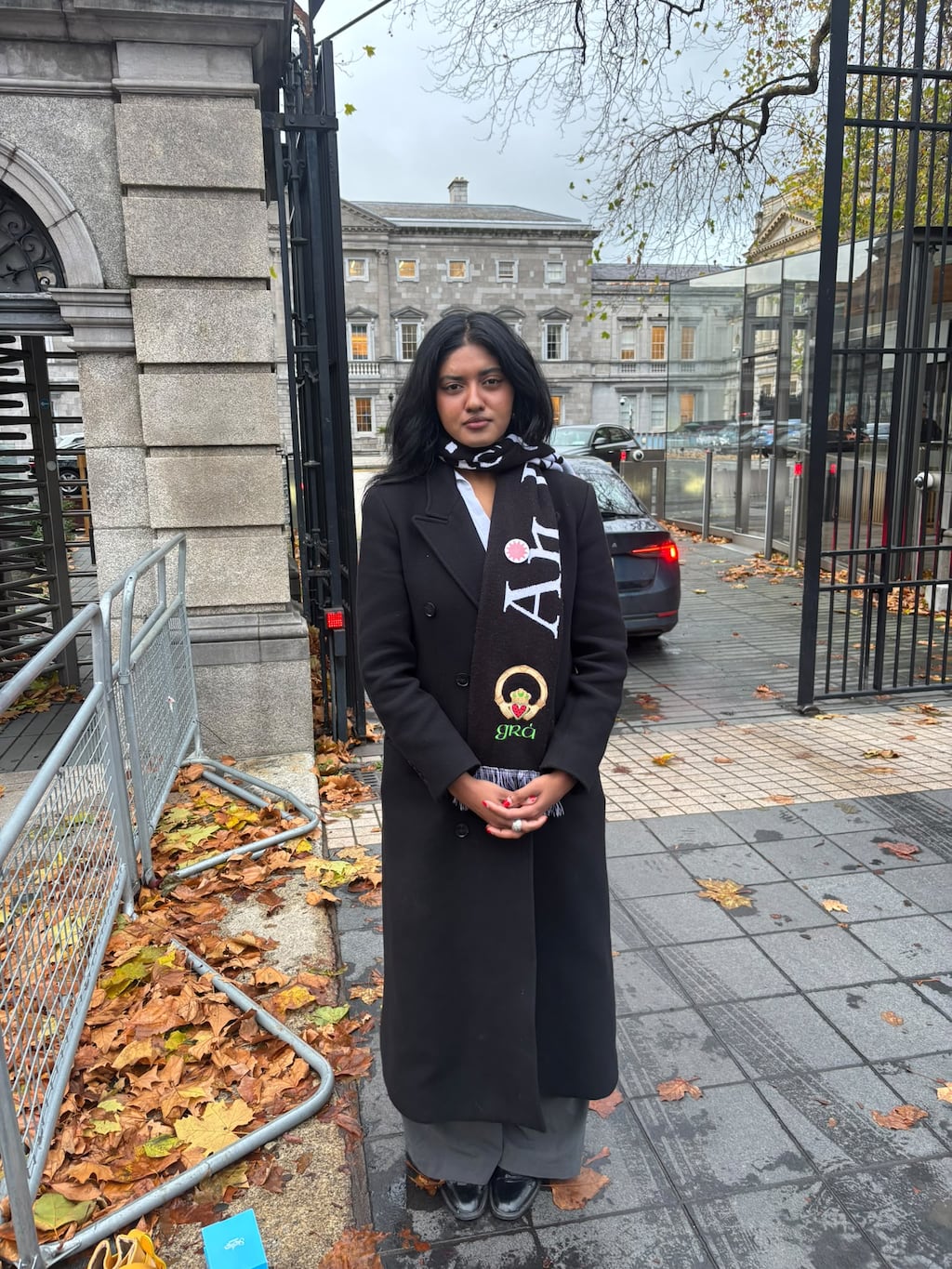
Sumyrah Khan came to Ireland six years ago, but even now she is unsure what the future holds. She feels as if the Government “is constantly moving the goalposts”.
Khan was speaking as a joint statement signed by 115 organisations, including trade unions, civil society bodies and community and faith groups was read out at Leinster House as part of the Citizenship is Belonging campaign, an effort to push back against controversial changes to citizenship laws.
It has urged the Government to scrap its “performative and cruel” plans.
The proposals include increasing residence requirement from five to eight years, a new language and civics test, and financial self-sufficiency rules which would make it more difficult for people who have received social welfare payments.
RM Block



Khan came to Ireland on a scholarship for a master’s degree in international relations and is in full-time employment with the Irish Network Against Racism.
“The Government never talks to the migrant ... they never told us why they’re making these changes,” she told The Irish Times.
“We constantly feel like a chess piece that they’re moving around and you can’t help but feel like a scapegoat.”
She loves living in Ireland, she said, but is “so unsure” of her future here amid the proposed changes.
“I’ve lived here six years coming up to seven. I’m still so unsure of my future here and even though I’ve worked in public service – and I am working in public service continuously, working towards bettering Irish people’s lives and also migrants’ rights – I still don’t know what the future holds.
“It’s just so unfair and we really have no answers.”
Khan also feels the planned legislation will “reduce migrants to economic units”.
“But we’re so much more than that ... we’re integrated within our communities, we pay our taxes.”
At a press conference on Thursday, Immigrant Council of Ireland chief executive Teresa Buczkowska; Migrant Rights Centre Ireland director Neil Bruton; Ukraine Civil Society Forum national co-ordinator Brian Killoran; and Doras chief executive John Lannon all called on Minister for Justice Jim O’Callaghan to cancel the changes.
[ ‘Deport Jim O’Callaghan’: Proposed citizenship changes condemned at protestOpens in new window ]
Henderson said the changes were “unfair, unjust and unnecessary”.
“Keeping people who enrich our communities, workplaces, cultural and public spaces behind a wall of exclusion ... which this Bill would do, weakens our democracy and society,” he said.
For Bruton the Bill is just the latest in a series of policies aimed at making Ireland as unwelcoming as possible.
“Every piece of recent research produced by the Government itself or its advisers says that because of our ageing population and low birth rate we need to attract more migrants to sustain our economy and we desperately need to retain them in order to avoid a demographic disaster.”
He cited the Department of Finance’s Future Forty report, and the National Economic and Social Council Building a Virtuous Demographic Cycle report.
“These citizenship proposals completely ignore that evidence in favour of a performative anti-migrant policy,” he said. “They are going to have a huge effect on migrants and will be detrimental to Ireland’s economy and society.”
Killoran pointed out that Ukrainians living in Ireland under the temporary protection scheme cannot put that time towards a citizenship application.
“This is unfair given their contribution to Irish society,” he argued. “About 82,500 people displaced by Russia’s invasion are still here ... 30 per cent of those are under the age of 20. Sixteen thousand are safe and secure in Irish schools across the country and have propped up Irish schools and revitalised Irish schools.”
He said there was a working-age cohort of Ukrainians of up to 55,000 people, of whom 32,000 are currently in full-time employment.