Temperatures dropped. Birds stopped singing. Even the seagulls of Dublin briefly suspended their missions to steal chips off tourists and rip refuse sacks apart.
Perhaps they were as much spooked by the spectacle of so many humans gazing skywards in strange glasses as by the sudden gloom.
Whatever the reason, the gull too took a moment for apparent reflection, as if wondering: what’s it all about?
Ireland’s first major solar eclipse this century was an occasion for awe, contemplation, and in some cases at least, more iPhone selfies, this time with the sun as background detail.
RM Block


The event brought strangers together as few things do. In Stephen’s Green and other Dublin vantage points, scarce eclipse glasses were shared around as people took turns to inhale the view and say: “Wow!”
If you were so inclined, the day’s confluence of strange events might even have inspired poetry.
WB Yeats once dreamed of owning “the heavens’ embroidered cloths/Enwrought with golden and silver light/The blue and the dim and the dark cloths/Of night and light and the half light”.
Were he still around, he would have experienced something close to all of those on an evening when an azure August sky was interrupted by a brief, foreboding gloom, followed by the spectacular reappearance and then setting of the sun, which in turn gave way to a night when the annual Perseid meteor showers reached their peak.
The cosmic coincidences included – fresh from its involvement in the solar drama – a new moon. And at the risk of stretching the date’s significance, it was also the month’s mind, or just past it, of Bonnie Tyler, forever associated with a song called Total Eclipse of the Heart.
Dublin was already in party mood from early in the day, with sweltering weather, tourists everywhere and a sell-out soccer match at Croke Park.
The football did not quite overlap with the eclipse, so that the hydration breaks of last month’s World Cup did not have to be followed by an obfuscation break during the Leeds v Manchester United game.
Still, certain founders of the GAA, and some latter-day opponents of Rule 42’s removal, might have been unsurprised by the dark omen.

Had they been told the game would be accompanied by strange events from the sky, they might have been hoping for thunderbolts to strike down those responsible for the outrage.
Instead, it was just the dimming of the sun over the Davin Stand shortly before kick-off. And on a doubly historic occasion at the stadium of light, night, and the half night, the football somehow went ahead.
Among the best places in Dublin to view the eclipse were the Liffey bridges, ranged in an east-west alignment along the river. The benches of Grattan Bridge, in particular, were front-row seats to the greatest show in town.
The many sun-watchers gathered there included Rebecca Sartor and André Barros, both employees of a camera shop in Grafton Street and with equipment to match.
Rebecca had set up her Canon R6 Mark 2 with a 400mm lens and a very dark filter (otherwise the sun would “burn a hole in the camera”, she said).
As she trained it westwards at 6.30pm, The Irish Times asked if, as photographic experts, they had chosen here as the best viewing point in Dublin. “No,” she explained patiently. “We were working till six – this is as far as we could get.”
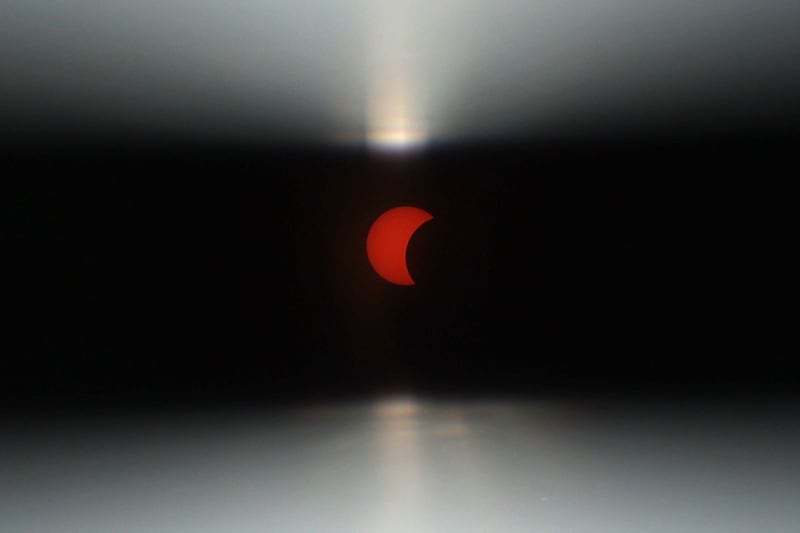
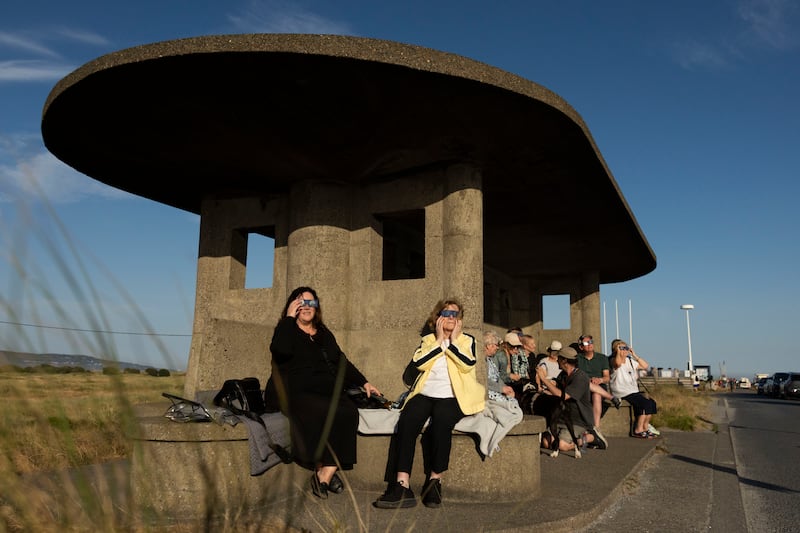
Other city centre office staff poured into Stephen’s Green, where there was an unofficial ceasefire of activities against people sitting on the grass, even around the beautifully manicured flower beds, although a warden appealed in vain for sun-gazers to keep the paths clear.
Amid the crowds there were Ignacio Caballo, from Zamora in northwest Spain. That place was close to the path of the total eclipse, seen in Europe only in Spain and a small part of Iceland.
But Ignacio had to make do with watching Ireland’s 95 per cent version and, like many people, was experiencing the phenomenon via a makeshift camera, constructed from a cereal box.
Not all the local animal life, meanwhile, was as impressed by the celestial spectacle as the ducks and seagulls.
Walter, a grizzled 15-year-old Jack Russell from the Liberties, turned his back on the eclipse (as he would have been advised to do by veterinary opticians) while his owner gazed at the sky, in between sharing her special glasses with others.
But it wasn’t because he was unnerved by this once-in-a-dog’s lifetime phenomenon. “No,” confirmed Aoife. “He just wants his walk.”