
Never work with animals and children, goes the old showbiz adage.
One could say the same about Ireland and astronomical events, but, for once, the capricious weather behaved itself. A once-in-a-lifetime eclipse event was accompanied by blazing evening sunshine at Dublin’s Dunsink Observatory.
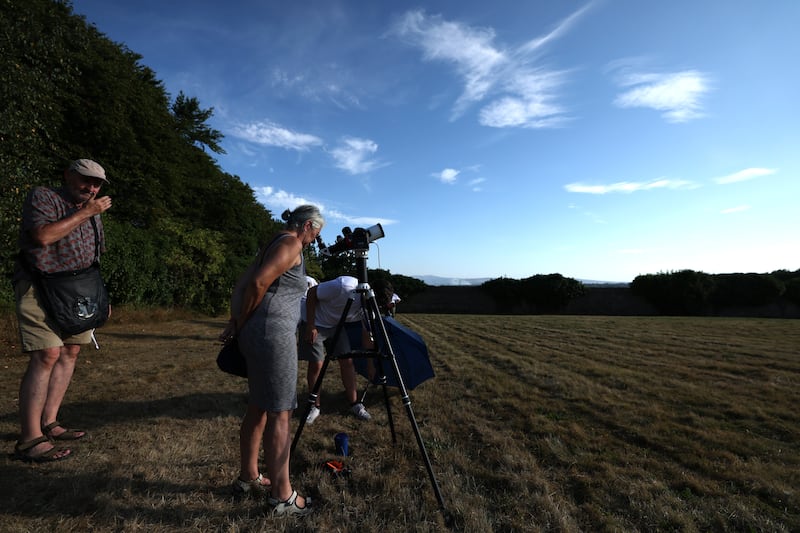
The coffee truck ran out of water, but the hot weather brought with it a phenomenon mid-eclipse: a marked drop in temperature as the moon almost completely blotted out the sun, casting shadows on the people sitting on the grass watching.

On one of the hottest days this year, the observatory hosted 150 people on its open day for the 2026 eclipse.
RM Block


It had a waiting list of 3,000 people; such was the clamour to view the greatest show not on Earth. The sign on the gate apologised to arriving guests. There were no eclipse glasses.
Dunsink Observatory education officer Sadbh Leary joked that you could buy a four-bedroom house in Dublin for the price of a pair of eclipse glasses, but most of those who arrived came prepared.
Dunsink Observatory dates back to 1785, nine years after the last time there was a comparable solar eclipse in Ireland. In the 19th century, Ireland was a world centre in astronomy and for a time had the largest telescope in the world at Birr Castle in Co Offaly.
The Grubb telescope, dating from 1868, when Grubb’s in Rathmines was one of the most successful telescope makers in the world, was still in working order and was used to project images of the eclipse on to a sheet of paper for guests.
In 1999 – the last time there was a partial solar eclipse – Jacob Byrne was 3½. His late grandfather Brendan Jordan was the experimental officer at Dunsink. He operated the large telescope when the 1999 eclipse happened.
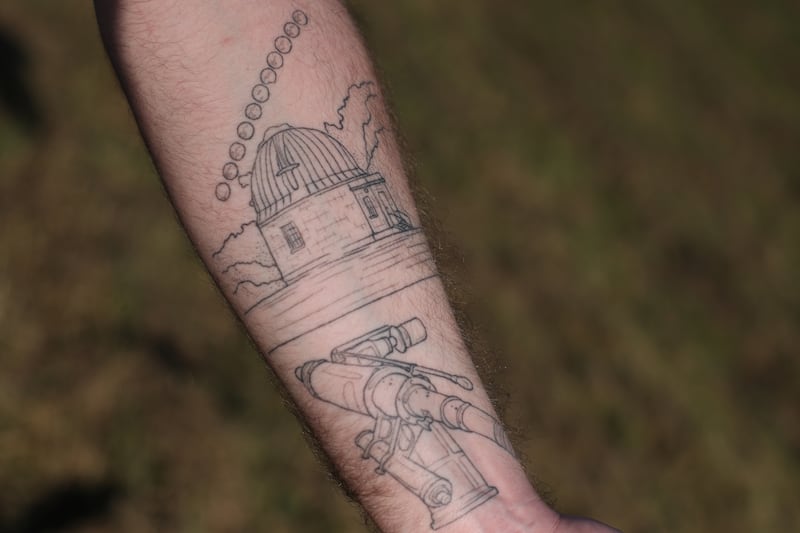
Byrne has a tattoo of Dunsink on his arm. “I have this in memory of my grandfather. It’s been incredible to be here to see it happen,” he said.
Elaine Mernagh was like a fan looking for Oasis tickets on the day that Dunsink Observatory released tickets for the eclipse. She brought her extended family along.
“It is so special to be here in Dunsink. It was harder than trying to get any concert ticket on Earth, but magic,” she said.
“I was there on the button ... to get tickets. My family were asking, ‘what’s happening’ – and I said, ‘this’,” she added, looking up at the eclipse.
It was an evening for families. The adults are highly unlikely to be around when the total eclipse happens in Ireland in 2090, but their children could be.
[ Thousands across Ireland witness rare eventOpens in new window ]
Alva Hammond brought two of her sons and some of their friends to witness the event. Her nine-year-old son Fiachra said it was “probably the funnest day I’ve seen in a while”.
“You don’t get to see this very often,” he said. “This probably doesn’t happen except once every 150 years.”
Six-year-old Will Higgins compared the eclipse to a “half moon” and his father Paul said the spectacle was worth waiting for. “It’s a really incredible occasion and I’m so glad I brought the whole family along.”
It was a triumphant day and night for all the staff at the Dublin Institute of Advanced Studies (Dias). Too often their work in astronomy and astrophysics seems arcane to the general public, but the eclipse has captured the imagination like no other astronomical event this century.
Prof Caitríona Jackman, head of the planetary magnetospheres group at Dias, said it was a “wonderful event from start to finish”.

“It’s such an accessible thing for the public to be involved, but also the thousands of people at home who watched our social media feed,” she said.
“It’s been really successful and we hope it, if you will excuse the pun, shines a light on the amazing space science we do in Ireland.”


