Main Points
- A meeting between several Ministers and industry representative groups has ended with the Government confirming a “significant and enhanced support package” is being finalised
- Up to 500 forecourts could run out of fuel this evening, the National Emergency Co-ordination Group has said
- A small group of protesters, including spokesman John Dallon, failed to get access to the meeting between industry representative groups and Ministers.
- The Taoiseach said because of the blockades Ireland is now “on the precipice” of having to turn oil away in the middle of an international supply crisis.
- One of the leaders of the fuel protests has convictions for animal cruelty and neglect involving large numbers of cattle.
- Dublin Bus warned of severe service disruptions and Luas Green line services were partially suspended.
- See full details of where the protests are and what roads are impacted.
Best Reads
- Friday transport update: which roads are blocked?
- The Irish Times view: patience is running out
- Have your say: How have home-heating oil price rises affected you?
- Delayed hospital appointments and “unnecessary heartache”: Readers on fuel protests’ impact.
Total of 113 vehicles blockading O’Connell Street and immediate vicinity
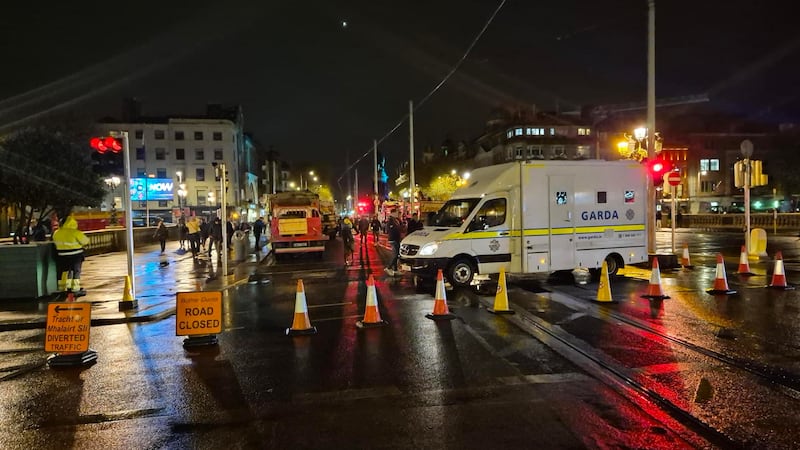
As of 11:20pm on Friday, the number of vehicles blockading O’Connell Street and its immediate vicinity is 113.
The majority of which was long haul trucks. The number does not include Garda vehicles, or the single horse-drawn carriage on O’Connell Street.
Five trucks remain on O’Connell Bridge, with Garda vehicles blocking the access to the northbound side of the road bridge.
Garda declare ‘exceptional event’ in light of protests
It is understood An Garda Siochána has declared an exceptional event as a result of the protests in agreement with Garda associations.
Under the declaration, gardaí can be prevented from taking leave and other exceptional measures can be used to ensure sufficient staffing.
More farmers join O’Connell Street protest as working week ends
Farmers and contractors who were unable to join the fuel protests across Ireland during the week are adding to the numbers in Dublin on Friday, a number of protesters said.
Adam, a contractor from Meath, said he had been unable to come to Dublin during the working week as it is busy period on the farm he is working for.
Alongside four other agricultural workers from his area, Adam – who did not want his full name published – drove to Dublin to show support and intends to stay the night.
“Most of us can’t leave the farm willy-nilly during the week, but you are seeing the numbers grow here now,” he said.
Among the newcomers was agricultural contractor, Aodhán Kent who said he had been unable to attend the protest until Friday night as he was required to work, while speaking to The Irish Times earlier on Friday.
“I was working all week and I couldn’t get the time off,” he said.
Kent said there is “no point” in Government Ministers negotiating solely with the various representative bodies, such as the Irish Road Haulage Association (IRHA), the Irish Farmers’ Association (IFA).
“They’re not organising these protests,” he said. “The IRHA said they would not take part in the protests, the IFA have said nothing.
“At the end of the day, they have to have the organisers of the protest in the meeting.”
He said protesters would not cease their civil disruption until the original organisers of the protests meet with Ministers.

Convoy of motorcycles joins the blockade in Dublin city
As the fuel protests continue on O’Connell Street, a convoy of motorbikes drove across the bridge and joined the assembled crowd. The group of motorcyclists had been riding around the city, revving their engines and blowing the horns in support of the protesters.
Another addition to the fuel protests on O'Connell Street: a convoy of motorbikes who have been revving their engines in support of the protesters. A crowd assembled around the bikers. pic.twitter.com/crIkwHtuci
— Hugh Dooley (@HughPDooley) April 10, 2026
‘We are here for as long as needs be,’ says truck driver
Gardaí have yet to decide whether the seven trucks parked on O’Connell Bridge will be permitted to stay put.
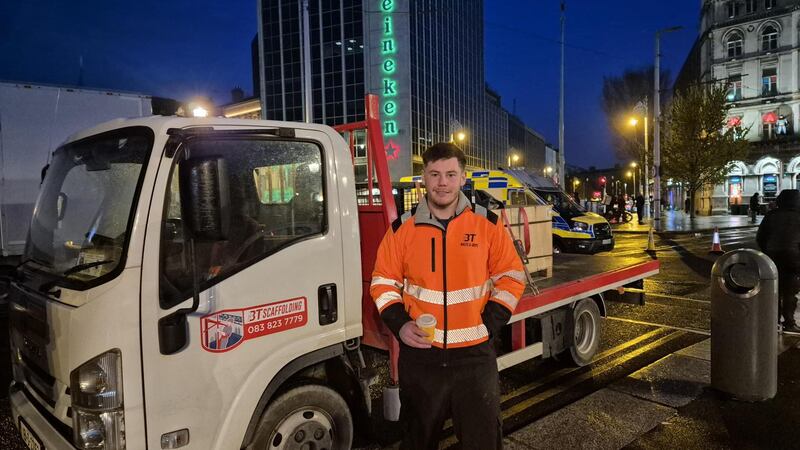
At 9pm, six trucks arrived and parked on the road bridge, avoiding the Luas tracks at the request of a transport worker. Shortly after, a seventh vehicle arrived.
Until now, the bridge itself had remained largely clear of vehicles even as O’Connell Street itself was blockaded.
Tom Sherlock, a 21-year-old business owner from north Dublin, drives one of the vehicles.
“We’re here for the night, and we are here for as long as needs be,” he said, before being interrupted by a passerby shouting: “Good on you”.
Across his 15-employee businesses, which offers scaffolding, waste management and skip rental, Sherlock uses 2,000 litres of fuel each week.
Recent increases in energy prices have seen his fuel costs increase by €1,500 each week, he said, adding that he has reduced his own pay to keep the business going. The increasing costs are “not viable”.
“It is a joke, and the Government is not helping us out,” Sherlock said. “Unless something is done, we won’t be able to see this out.” — Hugh Dooley

Growing number of protesters in central Dublin
The number of protesters at the top of O’Connell Street and across O’Connell Bridge has grown in the past hour, writes Hugh Dooley.
Several farmers and contractors who spoke to The Irish Times said they had not been at the protests during the week due to work commitments but were now free to show support.
Following the meeting between Ministers and farming, haulage and business groups, the frustration among some protesters seemed to be growing.
A table with food has been set up at the top of O’Connell Street laden with soft drinks, pot noodles and warm food.
One agricultural mechanic said the protesters would not be deterred by the cold and wet weather.
“We’re good country men; we’re used to the weather,” said Francis Allen. He said there is significant frustration among farmers who are seeing the viability of their livelihood threatened by fuel increases, which is the “final straw”.
Protesters being treated like ‘criminals’ by Government, says spokesman
The Government has treated fuel protesters like “a bunch of criminals and hooligans”, a spokesman for the protesters has said.
Speaking to reporters immediately after a meeting between industry representative groups and Ministers, Christopher Duffy said the protesters have had “fantastic” relationships with the gardaí since they began to blockade O’Connell Street.
“We are not criminals; we are Irish farmers and contractors and people in the transport industry.”
Duffy said the protesters were “devastated” to have been refused entry to the meeting at the Department of Agriculture.
“I feel so sorry for all of the people that are on the pickets ... We put everything on this. We asked politely, we wrote our letters. We have done everything right,” he said, adding that the protesters were originally told they would be able to attend the meeting.
“Absolutely nothing has changed” following the negotiations attended by representative bodies for hauliers and farming groups, said Duffy. There would need to be a “serious reduction in our costs” to end the protests “because we have nothing left to lose”.
Duffy said he does not expect any change to the protest actions being carried out across the State: “I think everyone is happy just to carry on.”
He said the meeting was a waste of taxpayers’ money, and the outcome provided “nothing for the people”.
Asked if protesters want to attend further meetings with the Government, Duffy said: “At this stage is there any point in us making demands? Nobody is listening to us. We are immaterial, we are irrelevant according to Government.”
The organisers of the protests “would love to be at the table tomorrow, absolutely”, he added.
“If we are invited into that room tomorrow we will be in that room,” he said. — Hugh Dooley
‘Optimistic’ hauliers hope agreement will come tomorrow
The president of the Irish Road Haulage Association said he hopes a package of measures will be agreed by tomorrow evening, writes Hugh Dooley.
Speaking after a meeting between Ministers and industry representative groups, Ger Hyland said the association is “optimistic” and he hopes its members can “bear with us; we are doing what we can”.
Asked if the Ministers understand the perspectives of the protesters, Hyland said: “Certainly after this meeting this evening, there will be urgency that there has to be something done here and it has to be done very fast.”
Following a meeting between industry representatives groups and Ministers, Francie Gorman, president of the Irish Farmers’ Association, said there were “no proposals put on the table today”.
“We met the Tánaiste and Minister for Agriculture 10 days ago with proposals but they wouldn’t budge. The [Government] needs to act immediately and substantially,” he said. — Ellen Coyne
Health Minister concerned about emergency services
The Minister for Health has expressed concerns about emergency services getting access to fuel and the impact restrictions have on patient safety, writes Emmet Malone.
“We cannot be in a situation where because we can’t get fuel that someone’s care or, worse still, their life is comprised,” said Jennifer Carroll MacNeill.
It is “simply not appropriate” for protestersto determine who can and cannot get access to care, she said.
She said elective vehicles are being made available to ensure home support services can continue even if home support workers run out of fuel.
“Our healthcare teams across the country are working to ensure that access to care is not compromised,” she added.
Up to 500 trucks parked at Rosslare harbour
Up to 500 articulated trucks were parked up at Rosslare harbour and Europort on Friday, most of them stuck because of the ongoing fuel protests.
Protesters made up of small business owners, bus drivers, small hauliers, construction workers and members of the public started to gather in the village of Kilrane on the edge of the Europort early on Thursday morning.
By Friday it had grown to about 110 protesters despite the cold temperatures and driving rain throughout the day and night.
Read Sarah Slater’s full report here.
ICMSA wants Government to finalise proposals over weekend
Speaking immediately after the meeting, the president of the Irish Creamery Milk Suppliers’ Association said it is imperative the Government immediately brings forward proposals to address the crippling costs on agriculture and other sectors. These need to be finalised over the weekend, said Denis Drennan.
Farmers entirely understand the motivation and original aims of the protests and are “uniquely positioned” to appreciate the ruinous effects of the current price rises on, specifically, fuel and fertiliser, he said. Drennan said the current situation is moving very rapidly in a direction that would undermine basic animal welfare and he asked those participating in the blockade to ensure essential feed, fuel and other inputs are allowed to move freely immediately.
“We are aware of farmers who are unable to get feed or nuts from merchants who have been unable to get their supplies out of the ports. We know that milk processors are worried that by early next week, due to a lack of diesel, they will be unable to collect milk from our members supplying them. Farmers are already under a ‘financial hammer’; every action and statement from here on must be judged on the basis of a single criterion: does it make the situation of farmers better or worse? On that basis, we’d ask the Government to bring forward proposals immediately to alleviate the pressures, and we’d ask those mounting the blockades to allow essential goods to move freely.” — Ellen Coyne, Political Correspondent
‘Significant and enhanced support package’ being finalised
A meeting between several Ministers and industry representative groups has ended with the Government confirming a “significant and enhanced support package” is being finalised, writes Political Correspondent Cormac McQuinn.
This follows supports of €250 million already allocated to help alleviate pressures from energy price rises, a Government spokesperson said.
Ministers will continue to engage with stakeholders over the weekend, reconvening tomorrow to finalise details of the Coalition’s response.
The Government emphasised its understanding of the seriousness of the situation and pressures being experienced by farmers, contractors and transport operators.
The meeting was attended by Minister for Agriculture Martin Heydon, Minister for Transport Darragh O’Brien and Ministers of State Sean Canney, Noel Grealish, Timmy Dooley and Michael Healy-Rae.
Among the 13 industry groups in attendance were the Irish Farmers’ Association, business group Ibec, the Irish Road Haulage Association, the Irish Creamery Milk Suppliers’ Association, and the Coach Tourism and Transport Council.
A small group of protesters failed to get access to the meeting.
Government working on ‘substantial’ new measures to tackle fuel prices
The Government is looking at introducing further “substantial” targeted supports that would help supply chains and the agri-food sector, Tánaiste Simon Harris has said.
Today’s talks with elected industry representative groups went well, but it is likely further intensive engagement will occur over the weekend, he told RTÉ’s Six One news.
More could potentially be done with European Union agreement, he said.
Asked to put a figure on the potential new measures, he said they would be “substantial and significant” and aim to keep key sectors of the economy going.
Asked if fuel price caps would be introduced, he said caps cost “potentially billions” and “quite frankly don’t work”.
Why could the protestors not join the meeting today between industry representative groups and Government? Harris said: “We cannot have a situation where we are engaging with people who are blockading key parts of our country.”
“We are trying to come up with economic solutions at the same time as blockades are causing significant economic damage to Ireland,” he said.
The State faces a “very dangerous economic moment”, he said. “The people engaged in the blockade today ... please please step back from the brink.”
Small businesses around the State are running low on supplies and health services are complaining about the effects on cancer treatments and people missing hospital appointments, he said.
The Tánaiste said he is “extremely concerned”, and the word “protest” does not adequately capture the current situation.
“People have made their point; they have been heard; we are under no illusion about the pressures they are under ... More help and support will come but we will do that through the normal, calm, democratic way,” he said.
Protester arrested in Cork
A protester at the Whitegate oil refinery in Cork has been arrested by gardaí for an alleged public order offence, reports Barry Roche, Southern Correspondent.
Up to 500 forecourts could run out of fuel this evening
More than 100 fuel stations are out of supply, but this could rise to 500 as early as this evening, the National Emergency Coordination Group has said.
That would equate to about a third of the State’s 1,500 fuel stations.
The emergency group learned of “growing concern” from international shipping companies about their ability to offload stock at some Irish ports.
Three national fuel depots, at Whitegate Refinery, Shannon Foynes Port and the Port of Galway, remain restricted, with movement “extremely limited” at these sites.
The group, comprising Government departments and State agencies, met again today to assess blockades on the road network and the effects on vital services.
Blockades around the State are posing a threat to emergency response services and supply chains, the group said.
Fuel supplies for emergency response vehicles, which rely on retail forecourts, are under increasing pressure due to the blockades, it said. Fire services have put in place contingencies to manage restricted availability of fuel and will cease non-essential services.
The National Ambulance Service continues to respond to 999 and clinically urgent calls, but transport services for routine care and discharges are being curtailed.
The emergency group urged the public to only buy the fuel they need.
Minister of State at the Department of Justice Niall Collins has said it cannot happen that any unmandated group can “lock down the country” and expect to be part of a negotiation with Government.
He told RTÉ’s Drivetime he has heard of protesters stopping carers and asked for identification to be let through.
He said the situation will end by the Government speaking with various industry representative groups.
Sinn Féin’s justice spokesman Matt Carthy said the Government’s measures to tackle energy price rises do not go far enough. He said the Government’s “stubborness” and “arrogance” have created this situation.
Crisis ‘could have been avoided’ if protesters allowed at meeting
Fianna Fáil TD for Carlow-Kilkenny, John McGuinness, said the current crisis “could have been avoided” if the protesters had been accommodated at the meeting between industry representative groups and the Government.
“The protesters should have been invited to the meeting,” he said. — Jack Horgan-Jones
Health services prioritised emergency and time-sensitive care on Friday as the continued fuel protests disrupted patients and staff around the country, writes Health Correspondent Shauna Bowers.
Minister for Health Jennifer Carroll MacNeill and HSE chief Anne O’Connor this week called for approaches to medical facilities to be kept clear for emergency service access.
Childrens’ hospitals have been feeling the impact, with management saying families of children receiving chemotherapy have taken hours to get home.
The widespread disruption caused by the protests and blockades for the fourth consecutive day resulted in some health regions moving to “contingency plans” to ensure continuation of care to patients.
Dan McCarthy, an independent councillor who runs a petrol station in Kenmare, Co Kerry, said his station ran out of petrol and diesel this evening.
“There is nothing and no prospects of anything coming,” he told RTÉ’s Drivetime.
He said there have been queues at the forecourt and they limited customers to €50 per fill “to try to keep as many people as we could going”.
His suppliers do not know when fuel will be flowing again. “We have to take it when we get it ... We can’t do nothing about it.”
He said he hopes the negotiations with Government today “lead to a positive result”.
Gardaí are in a stand-off situation with a lone protester at the Whitegate oil refinery in Co Cork. The man has climbed on top of an oil tanker waiting to access the refinery, reports Barry Roche, Southern Correspondent, who is at the scene.
The man is carrying an Irish flag and walking along the top of the tanker as it stands parked outside a cordon of gardai who are attempting to negotiate its entry to the refinery.
It is understood gardaí are waiting to try to persuade the man to come down from the truck before attempting to escort the vehicle past the blockade of protesters in order to gain access to the refinery.

One of the leaders of the fuel protests that have brought much of the country to a standstill has convictions for animal cruelty and neglect involving large numbers of cattle.
James Geoghegan (57), who has also been the subject of Revenue judgments of more than €500,000 in recent years, is one of most prominent voices in this week’s protests.
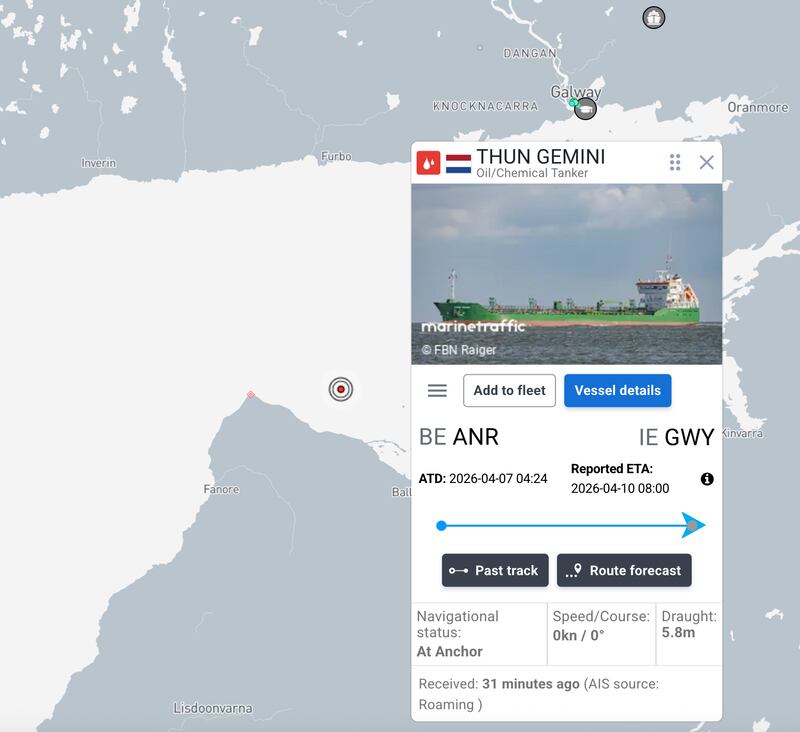
This is the oil tanker anchored off the Galway coast referenced earlier today by the Taoiseach. Micheál Martin said the oil on board could be sold off elsewhere if blockading prevents it unloading.

Whitegate protesters will lift blockade if representatives meet Government
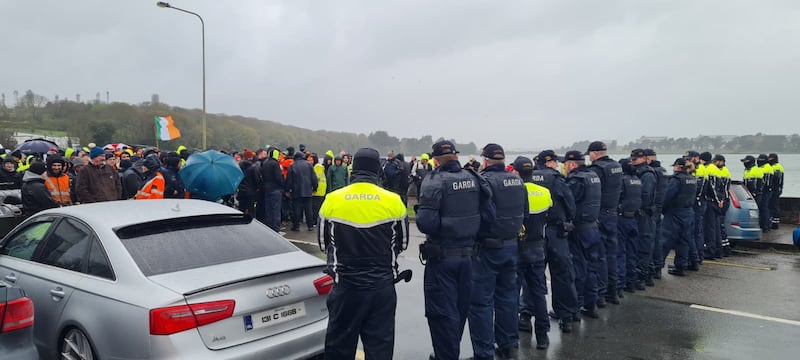
Protesters at Whitegate Oil Refinery in east Cork say they will lift the blockade the moment they get confirmation their representatives have been included in the meeting with Government to discuss the fuel crisis, reports Barry Roche, Southern Correspondent
Millstreet haulier Anthony Kelleher said none of the 150 or so hauliers, agricultural contractors, building contractors and farmers maintaining the blockade in Whitegate want to be doing this.
He said they were left with little alternative because of the Government’s failure to recognise their concerns about the price of diesel.
“The minute we get confirmation that our people have been included in the delegations that are meeting the Government Ministers and that there is some sort of a deal that we can agree to we will be packing up here and out of here in 20 minutes.”
Kelleher said the protesters agreed to allow two tankers access the refinery. One was permitted in to collect white diesel for emergency services vehicles such as ambulances, fire brigades and Garda cars. The other vehicle collected home heating or kerosene oil.
Kelleher said the the group will be checking the paperwork of the two tankers permitted entry when they exit “to see that they have what they are supposed to have”.
Gardaí had erected barricades around the protesters, effectively hemming them in around the main entrance to the Irvine Oil plant. However, a slip road to the side was left open from where the agreed vehicles collecting their white diesel for emergency services and kerosene could access the refinery.
He said that protesters were hearing that there were four or five other tankers waiting outside the village hoping to access the plant from the same slip road. Kelleher expressed concern that they might to trying to bring out more diesel to replenish stocks in filling stations around Cork that have run out of supplies.
“People here are very angry,” said Kelleher. “They feel that gardaí may have pulled a fast one on us to get other tankers in. We have just heard the Taoiseach was on the radio recently saying that gardaí have restored full access to the refinery here.”
Up to 100 gardaí have been deployed to the area, including officers from Cork city and county, Limerick and Kerry. Several public order units are on standby in the village.
Other units have been deployed outside and have stopped additional protesters joining with tractors and trucks. These protesters instead have maintained a rolling protest from Saleen to Midleton.
Farming and haulage groups have been told this afternoon the Government does have a package of supports ready, but it will not be announced until the blockade is lifted. — Ellen Coyne, Political Correspondent
A social media group behind the ongoing fuel protests and blockades has responded angrily to four of its spokespeople being turned away from a meeting with Government.
The People Of Ireland Against Fuel Prices Protest has issued a “nationwide call” for members of the public to join demonstratons in their own vehicles, reports Ellen Coyne.
“Our representatives were refused the opportunity to enter and speak on behalf of the people. Rather than listening to the concerns of ordinary workers, families, farmers, hauliers, and small businesses, the government has chosen not to take this issue seriously,” it said in a social media post, which has been shared across multiple WhatsApp groups.
“This has only strengthened the resolve of everyone involved.”


Protesters fail to get into Government meeting
A small group of protesters including spokesman John Dallon failed to get access to the meeting between industry representative groups and Ministers.
Government officials were only allowing access to people named on a list, writes Political Correspondent Cormac McQuinn.
One protester said: “There’s no one gone in there that can represent us.”
Dallon said: “We came here today as a voice for the people of Ireland … We were told there was a meeting last night. This morning they changed around.
“There’s so much controversy around all of this ... One minute there’s a meeting then there’s no meeting. Look, we don’t know where we are.”
He said their names should have been to the Government’s list of attendees.
Dallon added: “We wanted to be able to get into Ag (Agriculture) House, into talks, get a result ... We are the voice for the people of ireland.”
Put to him he has not been elected, he replied: “This shouldn’t be where it is ... It’s the Government that’s holding this country to ransom, not the protesters. We are having a peaceful protest.”
Earlier, speaking before the meeting Ger Hyland the president of the Irish Road Haulage Association said the stakes are “massive” for the country, the association and for the protesters.
“They’re on the protest because they’re on the breadline same as ourselves,” he said.
Political Correspondent Cormac McQuinn reports Hyland as saying his organisation spoke to some of the protest leaders on Friday morning and they had some “mixed messages”.
He added: “They have their asks going into the meeting and it’ll be discussed inside in the meeting. I’m not going to preempt anything.”
“I hope by this evening we might have some sort of a resolution or an end, something that maybe can take these people off the streets and the roads. They don’t want to be protesting either, no more than we want to see it.”
ICSA distances itself from protests after attendance of president
The Irish Cattle and Sheep Farmers Association (ICSA) has distanced itself from the protests on O’Connell Street after its president Sean McNamara attended and supported the protest this week.
Political Correspondent Ellen Coyne reports that a spokeswoman said: “While individual members, including officeholders, may choose to participate in protests in a personal capacity, those actions are not undertaken on behalf of ICSA and do not reflect an organisational mandate.”
“ICSA’s focus remains on ensuring that farmers’ concerns are addressed through direct and constructive engagement with Government, and we remain available to participate in those discussions.”
Fuel protest organiser says people of Ireland ‘in control’
Fuel protest organiser James Geoghegan has said Taoiseach Micheál Martin is not in control; “the people of Ireland are in control”, writes Caroline O’Doherty.
“They have every motorway and road blocked in Ireland, nearly have every business shut down and this is going to change Ireland forever because the people of Ireland [are] sick and tired of being bullied and robbed for years and it ends today,” he told RTÉ’s Liveline.
Geoghegan said the Government has “its eyes shut and let this happen”. He called for Martin to resign.
He repeated his insistence that the Dáil be recalled and new supports for farmers and businesses signed into law before blockades of roads and fuel depots are stood down.
Speaking ahead of talks between Government Ministers and recognised groups representing farmers, contractors, hauliers and bus operators, he said the protesters “don’t have a choice” except to fight their corner.
It remains unclear in what capacity he and three other organisers are attending the talks to which they were neither invited nor barred from attending.
Geoghegan said he would not be speaking at the meeting but the view of the public would be clear.
He said he had 1,000 people behind him walking to Leinster House with a coffin bearing the lament: RIP Ireland.
“This is a revolution. This is not just James Geoghegan,” he said.
Government won’t dictate who forms part of industry representatives at meeting
Cormac McQuinn reports: The Taoiseach also said that the Government would not dictate who forms part of the industry representative groups due to meet ministers this afternoon when asked if anyone who has been out protesting would also attend.
However, he also said highlighted “difficulties” the Government is facing.
He said: “There was talk of some of the protesters coming along today.
“I’d ask people to look at Chris Duffy’s post last evening when all of that was out there.”
This was a reference to a speech to protesters on O’Connell Street on Thursday night where Duffy, a contractor and a spokesman for the group, said the organisation “said when we’d get a meeting, we’d go home. Well, we’re not”.
“We’ll go home when we see what we get at the meeting. There’s not a f****ng idle truck moving in this country until we get what we want,” he said.
Martin spoke of this saying that Duffy “announced in O’Connell Street ‘we did say we would stand down the blockades if we had a meetings. Well we won’t be standing them down he said and we won’t be standing them down until we get what we want’.”
The Taoiseach also said the Government “want the blockade lifted” and “I can’t dictate who’s going to turn up [to today’s meeting].”
He added: “I would alert people to what is being said by some of the leaders.”
Construction sites could ‘come to a halt’ if blockade continues
The construction industry is calling for an immediate end to the fuel blockade, stating the sector is in the “eye of the storm”.
In a statement on Friday, the Construction Industry Federation said there was a need for further Government action to alleviate severe pressure on the sector.
Andrew Brownlee, chief executive of CIF, said construction sites “cannot operate without fuel for essential machinery such as diggers and mobile cranes”.
“The blockade of fuel depots and the oil refinery must end. There is serious concern about fuel supply for site machinery over the coming weeks,” he said.
“If this continues, there is a real danger that sites will come to a halt. The spike in fuel costs is already placing significant pressure on construction companies.”
He added: “The fuel protests are beginning to disrupt the delivery of construction materials to sites due to blockades at ports and along transport routes. We are already hearing reports of concrete deliveries being negatively affected.”
In its requests to Government, CIF called for further reduction in excise duties on fuel, removal of VAT on fuel, a pause on increases to carbon tax and a temporary pause on the concrete levy.
New package of fuel support measures to be prepared
Cormac McQuinn reports:
The Government is preparing a new package of fuel support measures and ministers will meet with representative organisations this afternoon.
On what will happen should the protests continue, Martin said it will “Fundamentally be a policing issue and a public order issue and very clearly the law will be upheld.”
He said the Government will protect people’s rights including access to fuel and hospitals and the ability to travel to work.
Martin also said the blockades “have to end” because the current protests are “injuring people” and “damaging Ireland’s economy and society”.
Current situation ‘very severe’, Taoiseach says
Political correspondent Cormac McQuinn reports:
Taoiseach Micheál Martin has said the ongoing situation with protests blocking ports and the Whitegate oil refinery is “very severe”.
Martin told RTÉ Radio that because of the blockades Ireland is now “on the precipice” of having to turn oil away in the middle of an international crisis of supply.
He said that other countries will buy oil due to be delivered to Ireland’s ports if it can’t be landed here.
Martin said what is happening is “unconscionable, illogical and difficult to comprehend”.
He said this is why gardaí are at Whitegate in Cork to “ensure we get vital and needed supply for our people.”
Martin added that “non-elected” and “self-appointed people” cannot determine who gets oil and that their actions are “not a legitimate form of protest”.
Cork protesters hope for deal following Government meeting
Barry Roche reports from Cork:
Fuel protestors outside Ireland’s only oil refinery say that they are hoping that negotiations between the government and organisations representing hauliers, contractors and farmers can agree a deal that will lead to a reduction in diesel and other fuel prices.
Around 150 protestors are gathered and are maintaining a blockade with trucks and tractors on the road leading to the Irving oil refinery at the end of Whitegate village in East Cork .
Gardai have cordoned off the village, and according to the protestors, have stopped other truckers and farmers from joining them. These other protestors have begun a rolling protest between Saleen and Midleton on the approach road to Whitegate.
Several dozen gardaí are also maintaining a presence at the protest and it is understood that senior officers have deployed uniform members from Kerry and Limerick divisions as well as Cork county division.
Gardaí are speaking to the protesters and their protest remains peaceful – with protesters saying they are unsure as to what is happening nationally.
Haulier Anthony Kelleher from Millstreet ,said it was their understanding that the representative organisations, including the Irish Road Haulage Association , and the Irish Farmers Association, were due to meet cabinet ministers at 2pm.
Asked if he had faith that the representative organisations would secure a deal that would satisfy their demands, Kelleher said. “ I hope they can agree a deal that will satisfy everyone”
Fellow protestor, Mark Troy, an agricultural contractor from Bandon, said that no oil delivery trucks had attempted to access the Irving oil refinery since early Thursday morning and none had approached the blockade today.
However, he said, they had agreed with fellow protest organisers in Dublin to allow one tanker in to collect kerosene heating oil and one tanker in to collect white diesel for emergency vehicles such as ambulances, fire brigades and garda cars.
However no such tankers have approached the blockade so far today.
Protesters have allowed in a truck bringing in food for the Irving oil refinery canteen and a tanker carrying liquid nitrogen used in the refining process.
Ireland ‘close to widespread no-fuel conditions at forecourts’, industry body says
Up to 500 forecourts could be out of fuel by Friday night if blockades continue, the representative body for the fuels industry has said.
Kevin McPartlan, chief executive of Fuels for Ireland, said even if the protests ended on Friday, the “consequences would not end today”.
“It would still take up to a week before forecourts were operating close to normal again, and in some cases recovery could take longer,” he said.
“Once a disruption of this scale takes hold, there is no instant reset. Stocks have to be rebuilt, deliveries rescheduled and normal distribution patterns restored across the network.”
He added: “If current conditions continue, there could be up to 500 forecourts out of fuel by tonight.”
McPartlan said there is a “national fuel distribution issue” and is “no longer confined to one area”.
“The longer this continues, the greater the risk to motorists, businesses and essential services right across the country,” he added.
“Fuels for Ireland wants to make clear this is not an actual shortage of fuel in the Irish market. The immediate problem is a serious supply disruption. Fuel is there, but it is not moving normally through the system because key infrastructure and distribution routes have been blocked.”
McPartlan added the country is now “close to widespread no-fuel conditions at forecourts, not because the country has run out of fuel, but because the supply chain is being prevented from operating as it should”.
DPD suspends service on Saturday
Courier and parcel delivery service DPD Ireland has “temporarily suspended” its service in the Republic of Ireland on Saturday due to the ongoing protests.
In a social media post, the company said it was a “difficult decision”.
“We understand this may cause inconvenience and sincerely appreciate your patience and understanding during this time,” the post said.
“Our team is working hard to resume normal service as quickly as possible.”
Latest on road closures and delays
Fuel protests on a range of national routes are causing disruption for motorists in counties Clare, Limerick, Tipperary, Laois, Westmeath, Offaly, Kildare, Galway, Cork and Dublin.
In Dublin, the M50 is closed at junction 3/the interchange with the M1, which will impact traffic heading to Dublin Airport.
The M50 northbound is blocked between junctions 6 and 5.
The M1 is blocked southbound at junction 18, which is the Carlingford exit.
The M7 remains closed at Portlaoise in both directions, while the M8 northbound from Cashel to Cahir is also blocked by protests.
In Limerick the M7 is blocked at Annacotty in both directions and the M18/N18 is closed southbound at junction 2.
In Co Westmeath, the M6/N6 is blocked at junction 8 near Athlone, while the M4/N4 is closed at junction 14 near Mullingar.
In Co Kilkenny, the M9 is blocked northbound at junction 9.
The M18 in Co Clare is closed at Dromoland.
Trade mission to Canada cancelled
Political Editor Pat Leahy reports:
The Taoiseach and several Ministers have cancelled a trade mission to Canada next week, it is understood.
Micheál Martin had been due to travel to Canada with several Ministers for meetings with prime minister Mark Carney and a number of trade-related engagements next week.
However, as fuel protests continue around the country, Government Buildings has informed Ministers the trip will not go ahead.
A spokeswoman for the Government said that it is hoped the trade missions and associated meetings in Canada can be rescheduled for later in the year.
Dublin City Centre restaurants concerned about ‘viability’ amid footfall dropoff
The Restaurants Association of Ireland has said it is concerned about “business viability” due to the reduction in footfall as a result of the protests since Tuesday.
Adrian Cummins, chief executive of the organisation, said there had been an “impact” on businesses, particularly around O’Connell street in Dublin.
“We’ve seen a drop off in footfall. It’s good to see the quays being opened up and traffic going up and down but we’re concerned in terms of the ongoing protest in terms of our business viability,” he said.
“We’re looking for a resolution to this and hopefully the talks today will bring around a resolution.”
Cummins said for city-centre businesses, deliveries are a “big issue”.
“We’re trying to get food produce into our businesses for our customers. There’s also a knock on effect in terms of tourism for Ireland, with tourists coming into the country and they’re concerned about how they get around the country,” he said, before calling for a “resolution”.
Emergency services could be curtailed due to fuel supply issues, Darragh O’Brien says

Political Correspondent Cormac McQuinn reports:
Emergency services could be curtailed because of fuel supply issues, Minister for Transport Darragh O’Brien warned as he called for an end to the protests and blockades.
O’Brien also told Newstalk Radio that the Government has been working on an additional fuel support package and that industry representative groups are to be briefed on this at a meeting with Ministers later today.
However, he said: “Blockades need to end and they need to end now and the concerns that many of the protesters have are the same concerns that have been raised through representative bodies like the IRHA [Irish Road Haulage Association], like the IFA [Irish Farmers’ Association] and indeed others.”
On whether protesters could join today’s meeting he said: “I’m not going to dictate who is in each delegation”.
He declined to offer details of the new fuel support package in advance of the meeting.
O’Brien also said: “The situation is now absolutely critical. I just got a message earlier on this morning that our fire and emergency services, that their services will be curtailed because of fuel.”
He said the blockaded Whitegate facility in Cork is the only refinery in the country and while Ireland has no fuel supply issue, the protests mean it cannot be dispersed.
O’Brien added: “We do not want to have to deal with the situation in a heavy-handed way and I don’t think that will happen. What we need to do is to deescalate this now, today.”
‘We’ll close the country down’: Protesters say they will continue for a month if necessary
Coach and bus operators to meet with Government
The Coach Tourism and Transport Council of Ireland (CTTC) has confirmed it will attend this afternoon’s meeting at Government Buildings in relation to the concerns around fuel prices.
David Conway, chairman of the organisation, said bus and coach operators are “facing mounting cost pressures, compounded by service disruptions and rising fuel costs”.
“The CTTC reiterates that it is not involved in the fuel protest and hopes to see it concluded swiftly to alleviate these pressures and to keep Ireland moving,” Conway said.
He welcomed the opportunity to engage with Government ministers on Friday and next week.
“During these meetings, the CTTC will bring forward practical solutions to support commercial bus and coach operators during this period of sustained cost pressure,” he said.
“Our focus remains on engaging constructively with the Government to secure practical supports for our members during this period of exceptional cost inflation.”
Large Garda presence at Whitegate in Cork
Caroline O’Doherty reports:
A large convoy of Garda cars, vans and public order units has arrived at Whitegate in Cork where fuel protesters have been blocking deliveries leaving the oil refinery.
More than 20 Garda vehicles have taken up position on the access road to the refinery which protesters have been using to come and go to the site.
About a third of the country’s petrol, diesel and home-heating oil is produced at the refinery and supplies have been prevented from leaving, with some forecourts and distributors running out.
Protest organisers said this morning they had eased the blockade out of concerns for householders and emergency services and were letting some delivery trucks leave.
But the heavy Garda presence suggests an attempt will be made to achieve a full reopening of the supply route today.
Doctors call for immediate end to blockades due to ‘detrimental’ impact on patients

Ireland’s largest doctors’ union has called for an “immediate end” to fuel blockades, warning slower response times and missed apppointments will have a “hugely detrimental” impact on patient welfare.
Speaking at the annual meeting of the Irish Medical Organisation in Killarney on Friday, Prof Matthew Sadlier, president of the union, said it was unacceptable that the disproportionate actions of a minority are having such a significant negative impact on patients.
“There should always be room for peaceful protest in this country, but not at the expense of patient welfare due to the deliberate targeting of critical infrastructure,” he said.
“These blockades mean our emergency services are not currently able to respond as quickly as they ordinarily do, meaning patients will be delayed receiving urgent and, in many cases, life-saving treatment. This cannot continue.”
He added that the knock-on impact on scheduled appointments would create added pressure on the healthcare system, which is already struggling.
“The ability of both patients and healthcare staff to actually get to healthcare appointments has been severely compromised by the blockades.”
Nursing home body to meet Minister to discuss impact of fuel prices on workers
The representative body for nursing homes is calling on the Government to implement “immediate measures” to support essential workers, particularly in more rural areas.
Tadhg Daly, chief executive of Nursing Homes Ireland (NHI), said the organisation has been invited to meet Minister for Older People Kieran O’Donnell next Wednesday to discuss the issues facing the sector in light of the fuel price rises.
“NHI is now calling on the Government to implement more immediate measures to support all essential workers access to fuel, especially in areas of the country where public transport is limited and fuel shortages are most acute,” the statement said.
“As the current energy and fuel crisis continues, it is vital to ensure the inclusion of all nursing homes (public, private, and voluntary) in the development of the emergency plans and additional energy supports currently being developed by Government and the Office of Emergency Planning.”
‘Grass growing down the middle of the M50′: Protesters say they’re not moving until demands met
Caroline O’Doherty reports:
One of the organisers of the fuel protests has said there could be “grass growing down the middle of the M50” if protesters’ demands were not met.
Christopher Duffy, an agricultural contractor from Co Meath, said protesters had only agreed to end their blockades if they got a dedicated meeting with the Government.
A meeting due to take place this afternoon that protester representatives are allowed to attend, along with the Irish Farmers’ Association, Farm Contractors Ireland and Irish Road Haulage Association, was not the kind of engagement requested, he said.
In a social media post, he said they had decided to go along with the meeting but the blockades would remain in place pending the outcome.
“Talks are better than no talks but without results, I’m afraid I will be looking at Nelson’s Pillar for a long time,” he said, referring to O’Connell Street where the protesters have congregated and the site on the street where the sculpture used to stand.
“There could be grass growing down the middle of the M50 yet because there will be nothing moving on it.”
Non-urgent healthcare activity in Cork and Kerry may be deferred
Non-urgent healthcare activity in the southwest of the country “may be deferred” in light of the disruption caused by protesters.
In a statement, HSE South West, which covers Cork and Kerry, said it is “actively managing the emerging fuel supply issue” in the region, which has “the potential to impact” service delivery.
“As a precaution, local contingency plans have been activated, and senior management teams are maintaining close operational oversight to ensure the continued safety of patients and staff,” the statement said.
“Critical services, including emergency care, urgent patient transport and time‑sensitive treatments (eg, dialysis, oncology, complex paediatric cases, bowel care, urgent care, etc) will be prioritised.”
Services in the region were directed to “review staffing, transport, supplies, and discharge arrangements to minimise disruption, and non‑urgent activity may be deferred where necessary".
“HSE South West is working closely with national colleagues and relevant agencies to monitor the situation,” it said.
“HSE South West advises the public attending appointments to contact the service directly if they are concerned about being late or missing their appointment.”
Fuel industry body welcomes report that finds price increases have not breached any law
The representative body for the fuel industry has welcomed a report by the consumer watchdog that found the price increases in the home-heating oil and road fuel markets in recent weeks have not been “in breach of any law”.
The Competition and Consumer Protection Commission (CCPC) on Thursday published a report following significant price increases and calls from Government representatives to the public to notify it of high fuel prices and price gouging.
“This is in the context of conflict in the Middle East and the resultant impacts on international commodity markets,” the watchdog said in a statement.
It said price hikes were driven by significant increases in international wholesale costs rather than competition issues.
Kevin McPartland, chief executive of Fuels for Ireland, said the watchdog’s conclusions “are clear”.
“It has found no evidence of any breach of competition or consumer protection law in how fuel prices have been set in Ireland, directly addressing concerns around price gouging or anti-competitive behaviour,” McPartland said.
“The report also confirms that the recent increases in fuel prices were driven by significant rises in international wholesale costs, rather than decisions taken by companies operating in Ireland.”
McPartland said the report “makes clear” that prices at Irish forecourts rose by less than other global markets.
“Ireland is part of a global fuels market – we are a price taker, not a price setter,” he said.
“We recognise the very real pressure this has placed on households and businesses. As acknowledged by the CCPC, there is a level of distress and concern among consumers, and we absolutely recognise that.”
He added: “The cause of high prices is global market conditions, which are outside of the control of Irish fuel retailers.”
Fuel protesters not leaving ‘until we get what we want’
Fuel protesters have rowed back on their pledge to end their blockades after they get a meeting with Government, now stating they won’t leave “until we get what we want”.
In a speech to protesters on O’Connell Street on Thursday night, contractor Chris Duffy, a spokesman for the group, said the organisation “said when we’d get a meeting, we’d go home. Well, we’re not”.
“We’ll go home when we see what we get at the meeting. There’s not a f****ng idle truck moving in this country until we get what we want,” he said.
Government is due to meet official representative groups this afternoon in relation to fuel supports.
Members of Government have maintained they have not invited members of the protest directly but the protesters could attend the meeting as part of a delegation for an existing representative group, such as the Irish Road Haulage Association.
Confusion abounds over whether protesters invited to Friday meeting
Ellen Coyne, Political Correspondent, writes:
Friday morning began with confusion over whether the protesters had indeed secured a meeting with the Government.
It followed a claim made on RTÉ’s Prime Time on Thursday night by spokesman James Geoghegan.
The Irish Times understands that the confusion arose after demonstrators in Galway spoke with local Government TDs, who were trying to act as intermediaries between the Government and some local protesters who were known to the politicians.
It is understood that at some point during these discussions, it was suggested the protesters might be able to join a round-table discussion between the Government and representative groups from the farming and haulage sector. This round-table meeting had been planned separately to the protests this week.
But the Government insists it was only ever suggested the protesters would attend the meeting as part of a delegation for an existing representative group, such as the Irish Road Haulage Association. It maintains the protesters were not invited to the meeting by Government.
Two members of the IRHA are due to attend the meeting with Government today, along with nine other farming and haulage representative groups. The IRHA has said it will meet with protesters today, but the haulage group believed “it’s up to Government who goes to a Government meeting”. One Government source said Ministers would be agreeable to a protester attending if they came with a representative group such as the IRHA. At this point, there has been no invitation extended to the protesters themselves.
The protesters had consistently said the blockades would end as soon as a meeting with Government was secured. On Thursday night, spokesman for the protesters Chris Duffy walked that promise back in a speech to demonstrators on O’Connell Street.
“We said when we’d get a meeting, we’d go home. Well, we’re not,” Duffy said. “We’ll go home when we see what we get at the meeting.”
Protesters add new conditions to ending blockades
Caroline O’Doherty reports:
Protesters have added new demands to the conditions under which they say they will end their blockades.
They now want the Dáil recalled immediately and want the ban on oil exploration off the Irish coast rescinded.
That is in addition to removal of the carbon tax from fuel products and price caps on agricultural diesel, auto diesel and home heating kerosene.
James Geoghegan, one of the organisers of the protests, told Newstalk the new demands came from discussions with protesting groups around the country.
But confusion remains over whether he will be at a meeting scheduled for this afternoon between the Minister for Agriculture and the Irish Farmers Association, Irish Road Haulage Association and Farm Contractors Ireland.
Geoghegan, who is not a representative of those groups, said he and three other protest organisers had been invited to the meeting by Fianna Fáil TD John Connolly.
He said his local TD, Fianna Fáil’s Robert Troy, had also been involved in brokering the protesters’ attendance.
The Government is maintaining, however, that no formal invitation has been issued to protesters and that it is up to the recognised representative bodies whether to take them along to the talks.
Originally, protesters said they would call off their action if talks took place.
Geoghegan said things had changed since then due to a lack of trust in the Government but he added: “We have reduced the protest, we are allowing out more fuel out today, we have lifted some of the blockades off the ports.”
‘It’s blackmailing society’: Readers explain how they feel about protesters
Reporter Jack White has a powerful read this morning about the impact the protests are having on some people around the country:
As her mother began to receive end-of-life care, Claire McIver left Dublin at 7.30am on Wednesday morning to ensure she could say goodbye.
The journey to Tipperary University Hospital in Clonmel should have taken two hours but instead took five, she says.
She encountered traffic at a standstill on the M7 as a result of a blockade, all the while experiencing “anguish” at the thought of not being able to say goodbye to her 93-year-old mother, Tess.
“I shouted at them: ‘Do you know the havoc you’re causing?’ and they laughed at me,” she says, recalling the blockade near Portlaoise.
Read his full report here
Demands of protesters to be ‘interrogated’ on Friday, Social Protection Minister says

Caroline O’Doherty reports:
Minister for Social Protection Dara Calleary has said An Garda Síochána will decide whether to call in the Army to remove blockades after an announcement by Justice Minister Jim O’Callaghan that the Defence Forces would be deployed overnight.
“The gardaí will make operational decisions as to whether the army will get involved,” Calleary said as most of the blockades remained in place this morning.
The Minister confirmed a meeting with recognised organisations for groups with fuel price concerns would take place this afternoon and that it was up to those organisations whether to bring protesters to the talks.
The main organisations – the IFA, Irish Road Haulage Association and Farm Contractors Ireland – that have been invited to the meeting are not officially behind the protests.
“We’re not dictating who can come to that meeting from the organisations so certainly if protesters come representing the farm organisations, we’re not dictating that they can’t come” he told RTÉ’s Morning Ireland.
Calleary said measures suggested by protesters, such as a cap on fuel prices and further tax cuts, would be “interrogated” but he stressed the Government had already provided €250 million worth of supports.
Protesters close to Rosslare Europort served with section 8 of the Public Order Act by gardaí
Protesters close to Rosslare Europort were served with a section 8 of the Public Order Act by gardaí last night, Sarah Slater reports.
Gardaí in the village of Kilrane over a loudspeaker issued a warning to protesters that they that had to leave the area and failure to do so “in a peaceful and orderly manner” would “possibly” lead to them being arrested and, if convicted, liable to a €1,000 fine or a six-month-prison sentence.
A garda added: “I would just urge you all to please peacefully remove yourselves from the area.”
Many of the protesters retorted by saying: “The people of Ireland say No.” The incident was recorded by scores of those gathered.
Local Aontú councillor Jim Codd said “there were extraordinary scenes” in Rosslare. “The Government has it in their power to stop this now,” Codd added.
An Army truck has also been reported to be at the location.
Meanwhile in Co Kilkenny, numerous filling stations have reported they have no fuel left following a surge in motorists panic buying.
Service stations locations include Thomastown, Goresbridge, Slieverue and Kilkenny city.
Sections of the M9 northbound also remained blocked on Friday morning.
Protests impact M50, M1, M7, M8 and M18
Fuel protests on a range of national routes this morning are causing disruption for motorists.
In Dublin, the M50 northbound is blocked at Junction 6, which will impact traffic heading to Dublin Airport.
The M1 southbound is blocked at Junction 3 (where it meets the M50) and also at Junction 18th, which is the Carlingford exit.
The M7 remains closed at Portlaoise in both directions, while the M8 northbound from Cashel to Cahir is also blocked by protests.
In Limerick the M7 is blocked at Annacotty in both directions and the traffic delays are backing up to the Limerick tunnel.
The M18 IN Co Clare is blocked at Dromoland.
As the protest action enters a fourth day, tensions are beginning to rise, particularly in relation to access to health services for vulnerable patients.
Prof John Crown, oncologist, had this to say on X, formerly Twitter.
Number of forecourts without fuel to get ‘much, much worse’ on Friday as protest continues
Fuel supplies at more Irish forecourts are under threat of running dry as a days-long blockade of major supply depots continues.
Hauliers and agricultural contractors began a series of protests on Tuesday, which have grown from slow-moving convoys on motorways and restricted access to Dublin’s busiest streets, to blockades of fuel depots that supply half the country.
They want the Government to commit to further action on fuel costs.
A spokesman for the protesters said some participants may attend a meeting with Government on Friday that was originally scheduled for national representative bodies, with a coalition spokesman saying who the official groups bring is a matter for them.
Their widespread action enters a fourth day on Friday with demonstrators facing a reaction from the Garda, which said it was entering an “enforcement” phase of its response – accompanied by support from the military.
Social media footage late on Thursday showed gardaí warning protesters they could be arrested if they did not peacefully disperse from an area near Rosslare Europort in Co Wexford.
The Government’s intolerance of the action escalated on Thursday, with Justice Minister Jim O’Callaghan and Defence Minister Helen McEntee stating that the Defence Forces “remain on standby” to assist the police in clearing heavy vehicles from the blockades.
Protesters have restricted access to a major oil refinery in Whitegate, Co Cork, as well as fuel depots in Galway City and Foynes, Co Limerick.
It has raised concern over panic buying at forecourts, some of which have run out of fuel, as well as impacts on emergency services and deliveries of key supplies for animal welfare on farms.
A leading industry representative warned that the number of forecourts running dry would get “much, much worse” from Thursday evening’s position of affected service stations being in the “low double digits”.
Fuels For Ireland chief executive Kevin McPartland said “panic buying has absolutely taken hold” and warned that “real significant life-death problems are going to be caused” with fuel supplies to emergency service vehicles under threat.
Ireland’s emergency planning group echoed the comments with “serious concern”, saying there may be an impacts on availability for some vital services, supply chains and public transport.
The National Emergency Co-ordination Group (NECG) said Ireland’s overall fuel supplies remain “robust and resilient” but said the obstruction of key routes from ports is threatening the provision of animal feed supplies, fertiliser and other vital materials, resulting in potential animal welfare issues and a threat to livelihoods in the agriculture sector.
Ireland’s Health Service Executive (HSE) said the disruption is causing people to miss medical appointments and is impacting the provision of home care and critical care, such as dialysis and cancer treatment.
The HSE also warned that the blockades could disrupt the time-sensitive delivery of key medicines and medical devices. - PA
IRHA to act as ‘honest broker’ between protesters and Government
Ger Hyland, president of the Irish Road Haulage Association, said he had been asked to act as an “honest broker” on the issue ahead of a planned stakeholders meeting on Friday.
Speaking on Friday morning, Hyland said he had spoken to “intermediaries” for the protesters but had yet to meet the protesters themselves.
Two people from the IRHA are due to attend a meeting with the Government, along with other stakeholders, on Friday afternoon, Hyland said.
In advance of that meeting, the IRHA had made itself available to talk to the protesters “and bring their concerns into Government”.
He said this was dependent on the protesters being “happy that we will bring them concerns with us. If they’re not, well then there is nothing more we can do for this,” Hyland told RTÉ Radio’s Morning Ireland.
Luas Green line services disrupted
Due to the fuel protest in Dublin city centre Luas Green Line services are currently not operating between St Stephen’s Green and Dominick St. Services are operating between Broombridge and Dominick St and between St Stephen’s Green and Brides Glen only.
⚠️Passengers, please be advised Green Line services are currently not operating between St. Stephen's Green and Dominick. Services are operating between Broombridge and Dominick and between St. Stephen's Green and Brides Glen only. This is due to a protest at O'Connell Bridge. We…
— Luas (@Luas) April 9, 2026
Fuel protesters explain the pressures they are facing
North and south quays in Dublin are open
The north and south quays in Dublin are open for traffic as normal today but O’Connell St bridge remains closed for traffic.
Taoiseach open to further measures to ease fuel prices
The Taoiseach has said further measures to ease fuel prices, including the broadening of existing measures, could be possible through negotiations.
This is thought to include further relief on green diesel and a possible extension of the diesel rebate scheme. However, it is thought unlikely that any price caps will be on the table.
It is understood some backchannels have been opened to the protesters through Government TDs, which could facilitate exchanges, though Government is anxious not to undercut established organisations.
“We are open to mechanisms,” the Taoiseach said on Thursday night. “But the strikes will have to end first.”
Fuel protesters claim they have secured meeting
Fuel price protesters say they have secured a meeting with Government Ministers, according to an organiser of the demonstrations who pledged to continue disruptions for a fourth day on Friday.
One of the protest organisers, James Geoghegan, claimed negotiators will join a meeting at Government Buildings on Friday afternoon, alongside the Irish Road Haulage Association and the Irish Farmers’ Association.
It comes as forecourts across the country are running low on fuel as protesters continued blockades on Thursday.
Speaking on RTÉ’s Prime Time on Thursday night, Geoghegan described the meeting as a “breakthrough”, though added that disruptions will continue on Friday regardless.
Dubin Bus warns of severe service disruption
Dubin Bus has warned customers on Friday morning that due to the ongoing fuel price protests it is “experiencing ongoing severe service disruptions and delays” which has resulted in a number of services being cancelled or diverted. A full list is available on the Dublin Bus website.
#DBSvcUpdate Road closures remain in place this morning as a result of a protest. We are experiencing service disruptions across the Dublin Bus network, please allow additional travel time. More details here:https://t.co/DjkxMSErwr
— dublinbusnews (@dublinbusnews) April 10, 2026


