International climate talks collapsed on Sunday without any major agreement after dozens of countries rejected a deal they saw as pandering to the fossil fuel industry.
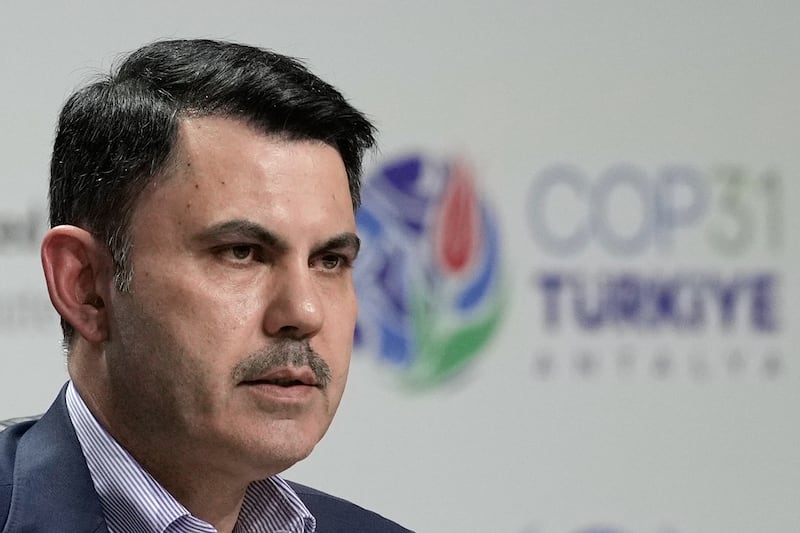
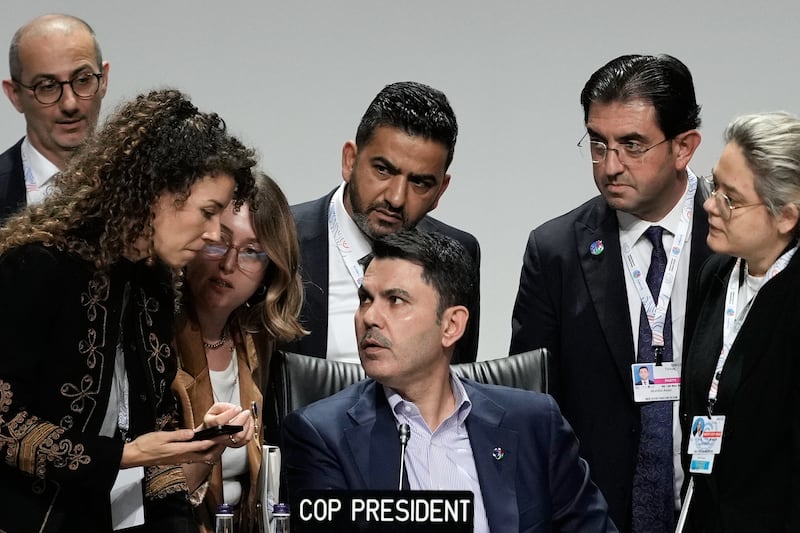
Cop31 summit president Murat Kurum had said earlier on Sunday that there would be no new draft of the deal.
Multiple countries and negotiating blocs have said they could not accept the version of the text put before them.
“There will be no new text from now on. We will not be carrying out work on a new text in an environment where there is no consensus,” Kurum said.
RM Block


On Sunday morning, Minister for the Environment Darragh O’Brien said the EU could not support the draft outcome as it did not mention fossil fuels.
Speaking on behalf of the EU at the summit in Turkey on Sunday, O’Brien said its member states formally object to the draft report.
“It fails to meet the moment, the moment that our world faces, the crisis that our world faces. We express profound disappointment with the final draft of the Cop31 cover decision or Antalya pact.”
The newest and possibly final agreement at this year’s United Nations climate talks has come under scrutiny for its omission of the words “fossil fuels”, the chief cause of global warming, or specifically to call for a move away from polluting coal, oil and gas.
In Ireland, the Green Party welcomed the decision of EU countries and small island states to reject the draft.
“Sometimes ‘no deal’ is better than a bad deal. An agreement that failed to call out the role that fossil fuels play in driving climate change would have been absolutely pointless,” said party leader Roderic O’Goman.
Friends of the Earth Ireland described the failure to secure a deal as “shameful”. Of carbon capture, chief executive Deirdre Duffy said: “Rich countries ... are banking on all of these risky and unproven technologies so that fossil fuel giants can continue to pollute.”
Action Aid Ireland also condemned the outcome but held back some of its criticism for Europe. “While the EU’s standing up to a text weak on fossil fuels has helped its reputation in this space, its climate leadership is in question,” said chief executive Karol Balfe. “The success of climate negotiations cannot be judged on carbon dioxide alone. Until wealthy polluting countries can stop seeing climate finance as a zero-sum game, climate talks will fail in their job of keeping humanity safe from rising temperatures.”
The failed draft from Kurum, the Turkish environment minister, was released in the early hours of Sunday.
He gave negotiators only about three hours to make objections or request changes before the draft is presented to what may be the summit’s final meeting, where countries will either accept, reject or express their reservations about the agreement.
Addressing the summit, O’Brien said: “At a point where the world urgently needs action to avert disastrous levels of global warming, the draft cover decision falls well short.” He said it did not respond to the science and “risks deepening the chasm between global commitments and the action required to correct the overshoot and bring 1.5 degrees back to within reach.”
The EU cannot accept a decision that “does not even mention fossil fuels which is the key driver of climate change, and we will not accept negotiating backward in time, and we will not accept a Cop that greenwashes fossil fuel”, the Minister told those still gathered on Sunday.
In a joint statement issued by O’Brien and EU climate commissioner Wopke Hoekstra, they said they were very disappointed.
“The cover decision was not supported because the interests of a few were allowed to obstruct the ambition needed by many. Consensus cannot mean the lowest common denominator. We cannot endorse a decision that greenwashes fossil fuels.”
Several nations have made serious objections to the draft, which needs near-unanimous consensus for approval.
The proposal does include a specific goal on supporting technology that captures carbon pollution and stores it, which is hotly debated and backed by the oil industry.
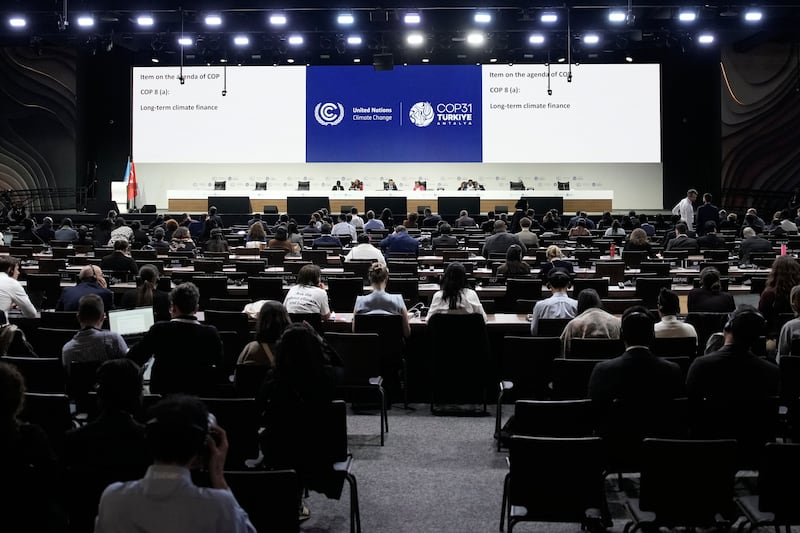
The draft went public at 3am local time in Turkey. The conference was scheduled to end on Friday and is now in double overtime.
O’Brien told RTÉ Radio on Sunday that a global climate conference not recognising the biggest contributor to climate change was “unconscionable”.
He said the Arab group of countries was “particularly opposed” to the insertion of language around fossil fuels, saying he had held frank and direct talks with Saudi Arabia, a country, he said, that had exhibited “far too much influence” over the talks.
Extreme weather, the Minister noted, had led to 40,000 excess deaths across Europe, damaging forest fires and drought. “We don’t deny the science, there are some who do,” he said.
“We got no compromises, at every single stage. At every stage we were ignored.”
He described the draft agreement as a “complete and utter fudge” and said in some instances “the presidency (of Cop) didn’t listen”.
“We had to speak the truth on this. I could not, on behalf of the European Union, accept a text which was deficient.”
He said the conference needed a “reset” – “We’ve continued to heat ... but the level of ambition has reduced.”
Panama had vowed to formally object to a final agreement that does not put a cap on oil production, acknowledge failing goals to limit warming, and beef up finance for nations to adapt to climate change, among other demands.
[ Cop31: Five big themes Opens in new window ]
Panamanian environment minister Juan Carlos Navarro said the talks were being held hostage by a “petroleum mafia” and need to be reformed.
Alden Meyer, of the think tank E3G, said fossil fuels were unmentioned in Cop final decisions for more than 25 years, until the “transition away from fossil fuels” was agreed to in Dubai in 2023.
“It would be a real setback if we come out of here with no signal that we were serious about what we agreed to do three years ago,” he said.
The proposed Cop31 final agreement references the Dubai agreement, but key words – fossil, oil, coal or phase-out – do not appear anywhere in the 10-page text.
The draft does include supporting the highly-debated process of carbon capture and storage, with a specific goal of capturing, reusing and storing one billion metric tons of carbon. The proposal is aimed to help industrial polluters, who cannot easily switch to renewables, find a way to capture their carbon dioxide emissions and bury them.
Carbon capture and storage could be used as an excuse to continue investing in fossil fuels, climate experts have warned.
Rachel Cleetus, of the Union of Concerned Scientists, warned: “Fossil fuels are the root cause of climate change and there is no plausible pathway to limit climate overshoot without rapidly phasing them out.”
Turkey’s cornerstone electrification goal is included in the draft agreement.
It calls for countries to increase the share of electricity in the total final energy consumption from about 21 per cent today to 35 per cent by 2035. This would need nations to commit to measures such as switching transportation – cars, trucks and planes – from gas to electricity and using electricity instead of coal to make industrial products.
Climate activists are demanding the agreement spells out that the electricity should only come from renewable energy, such as wind and solar. They argue that allowing electricity powered by fossil fuels would defeat the goal’s purpose of lowering emissions.
Bill Hare, chief executive of Climate Analytics, said: “Electrification that runs on coal and gas does not limit warming.”
Climate-vulnerable nations want the final agreement to include more details on past pledges to increase financial aid to poor countries to help them adapt to a warmer world.
Previous Cop summits have mentioned tripling funding for this, but never created an explicit financial baseline.
Climate change has intensified disasters this year, like Europe’s deadly heatwaves and Nepal’s devastating flooding.
Harjeet Singh, founding director of the Satat Sampada Climate Foundation, said: “Floods and heatwaves won’t wait.
“Rich countries are offering a conversation instead of cash.” – Additional reporting: Agencies