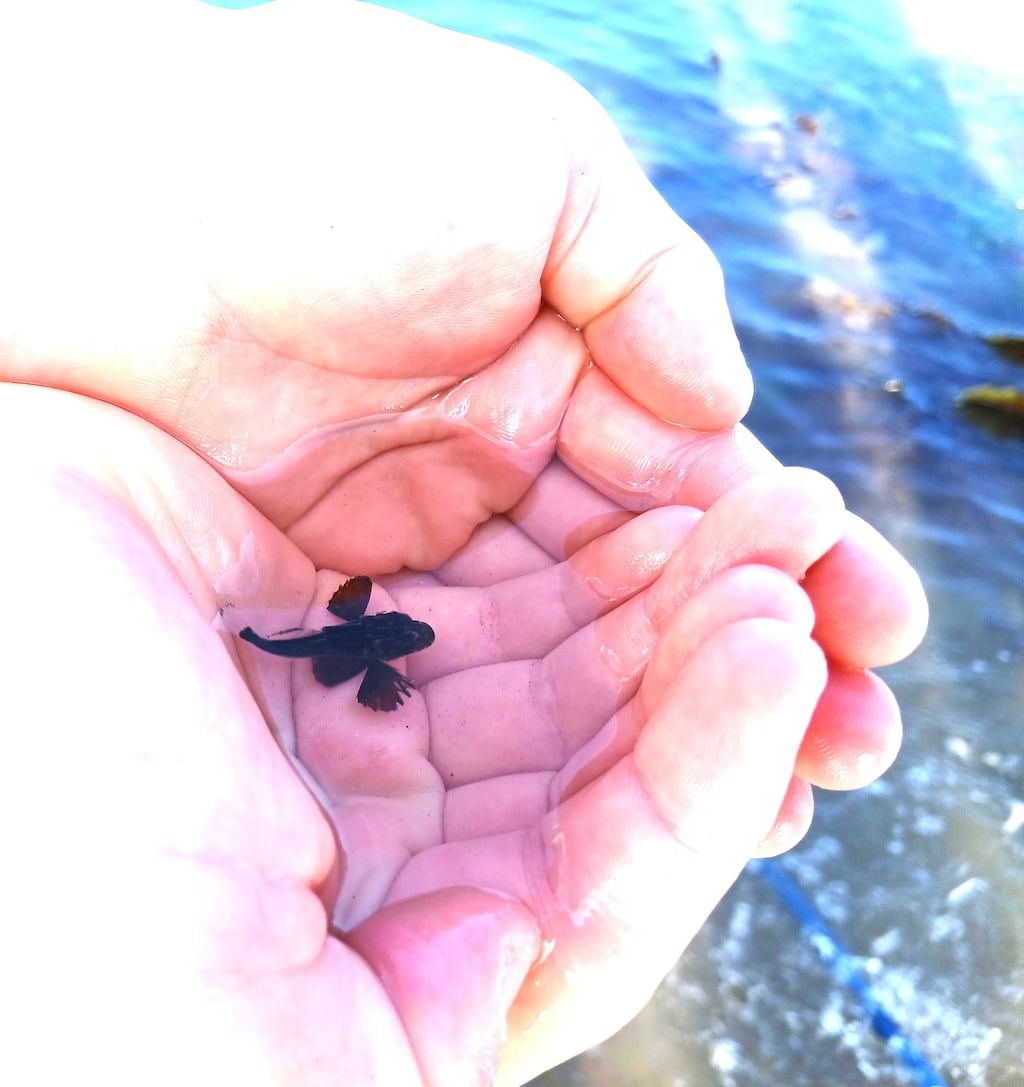

Children on the beach in Skerries caught this recently. They named it baby shark? What was it? Vinny Crossan, Skerries, Co Dublin
Well, it’s not a shark anyway. There are several species of small fish that inhabit rock pools and this is one of them – the rock goby. It is indeed a baby rock goby as they can grow up to 12cm in size – not huge but certainly bigger than this. They are commonly found on rocky shores, and their dark, mottled body provides good camouflage against a background of rocks and seaweeds. The pelvic fins underneath its body can form a fan – shaped sucker to prevent it being washed away by the waves.
We saw this dragonfly land on the pier in Dún Laoghaire and it stayed for about 10 minutes (as if winded) before flying off again. We have never seen one that big before. Kate Levey

This is a woman emperor dragonfly – our largest dragonfly species. Your image shows one that has been around for a while, as its wings have become brownish with age. It has only been established as a breeding species here in the past 25 years, but it is now common in the south and east. It breeds in well-vegetated natural ponds and lakes as well as artificial ponds. It can even tolerate brackish water. It is a ferocious feeder as an adult and can catch and eat other dragonflies and even butterflies as big as the large white butterfly.
RM Block


Our cat recently brought in this rodent. We are not sure of its identity. Colm Quirke

You must live a very sheltered existence. This is a brown rat – a very common pest species. Well done to your cat for catching it and bestowing it on you as a gift. Having a good rodent-catching pet is a much more sustainable way of getting rid of rats than deploying poison. The effective rat poisons being sold nowadays are second-generation anticoagulants (SGARs), which cause the rats that eat them to bleed internally to death. If the rat dies outside its burrow and is eaten by a predator the poison spreads up the food chain, becoming more concentrated. Eighty per cent of our barn owls, whose diet is mostly rodents, have traces of SGARs, according to a Birdwatch Ireland survey carried out a few years ago.
I saw this blackbird feeding his fledgling on my patio where I put mealworms out for robins. I didn’t know the males fed their young. This went on for days, but I never saw the woman feeding the youngsters. Carmel Ni Shúilleabháin

That’s because the poor hard-working woman was back brooding a second clutch of eggs and had her hands full. The male feeds the fledglings on his own until they have learnt to fend for themselves. Then he is back to dancing attendance on herself and the second brood of nestlings. She will help to feed this second lot when they fledge.
I spotted this strange gall on a leaf while walking in Carysfort Park in Blackrock in July. At least four other nearby leaves had the same thing on them, in roughly the same place. What were they? Gerry Bowe, Mount Merrion, Dublin

These were the covers left behind by pupating ladybirds. Ladybirds quickly develop from eggs into larvae, which feed on aphids and grow rapidly. They shed their outer skin four times over 30 days or so as they grow. They then attach themselves to a leaf and shed their final larval skin revealing the pupa. They emerge from this as an adult (pupating) after two more weeks. This one was probably made by the two-spot ladybird.
Please submit your nature query or observation, ideally with a photo and location, using the form below or by email to weekend@irishtimes.com


