

I am standing in an anonymous room in the James Hardiman Library at the University of Galway, where Barry Houlihan, the institution’s archivist, has brought some boxes from storage downstairs.
The contents are spread out on tables and cushions. I am looking down the well of decades, back to an era when people wrote letters, and sent them through the post; to a time when John McGahern wrote his first drafts, in tiny handwriting, in Capital Standard Exercise school copy books, his spare, austere prose that lodged like splinters of wood in the consciousness of those who read it; to a time when one of his seminal novels, Amongst Women, was originally titled The Morans.
Back in 2003 McGahern engaged in an act of what was, essentially, pure philanthropy. He donated his papers to the university. He could have sold them to it, or to any number of American universities, whose acquisition budgets are on a scale far greater than those of most, if not all, Irish universities.
Many writers of note sell their archives. Nobody would begrudge any writer, many of whom start out earning relatively little, the opportunity to monetise their most sought-after asset, as far as academic libraries are concerned.
RM Block


But McGahern, who died three years later, at the age of 71, had strong connections with Galway, where he had taught in the 1980s, and where he had many friends. Long resident in the west of Ireland, he chose the west as the place to give his archive to.
Houlihan has been the university’s archivist for 17 years. Involved over time in cataloguing the extensive McGahern collection, he has now put together an exhibition of McGahern’s work that opens shortly at the university library.
Among the papers that Houlihan has pulled out to show me are some letters. One, which is typed, and dated March 14th, 1961, has the Faber & Faber letterhead. It’s signed, in black ink, by Charles Monteith, a renowned editor whose many famous writers included Samuel Beckett, Philip Larkin, Seamus Heaney, William Golding, Ted Hughes and PD James.
It’s the kind of letter that an aspiring writer who has not yet published a book – as McGahern had not yet done at that point – would all but fall down in a faint after reading.
Monteith’s message reads: “I was very interested indeed in the extracts from your novel which are published in the current number of X. If by any chance you haven’t yet made arrangements for its publication, I would be absolutely delighted if you would give us an opportunity to consider it.”


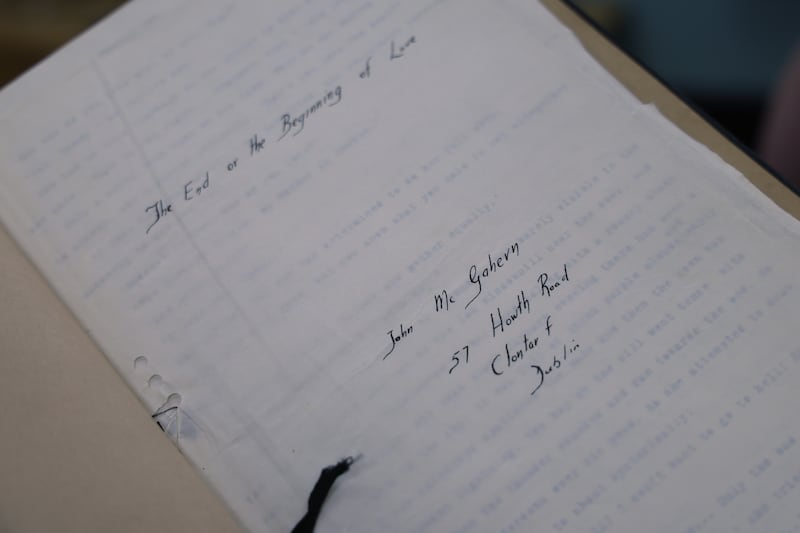
The extracts to which Monteith is referring are from the first novel McGahern wrote, which he called The End or the Beginning of Love. The literary magazine X had published some extracts from it. By that time some extracts from The Barracks, then still a work in progress, were doing the rounds of various editors in London.
Faber offered to publish The End or the Beginning of Love. Astonishingly, McGahern decided it wasn’t good enough. (He went on to rework substantial parts of it into other novels.) But Faber did publish The Barracks, in 1963, and McGahern remained with the publishing house for the rest of his long career.
The draft of The Barracks is Houlihan’s personal favourite from the archive, “because he was so young writing it, yet it’s written with the maturity of a writer who has done it all his life.
“And it says so much of Ireland at the time. There is one line in it that could be straight from Joyce’s The Dead: ‘What’s all this living and dying about anyway?’
“That’s a line that could be about all of John’s writing. But it’s about everything that has lived in the middle between that living and the dying. That’s what is so great about his writing.”
The archive also includes McGahern’s own copy of The Barracks, which he would take to events to read from. It’s not a first edition but an ordinary battered paperback, like the ones most people probably have.


The exhibition, John McGahern: Writer & Archive, will be the first big exhibition the university has put on since the author donated his papers. Trying to distil one writer’s collection into a stand-alone exhibition is probably like trying to work out how the camel can squeeze through the eye of a needle.
How did Houlihan go about the process?
“I wanted to show the journey of each of John’s books as he wrote them,” he says. “I want to show to his readers how he wrote, how he changed and revisited his works. It is really about showing the craft of writing.”
The main text on one of the panels will be a quote from McGahern’s essay Playing with Words that Houlihan considers the quintessence of all his work: “I write because I need to write. I write to see. Through words I see.”
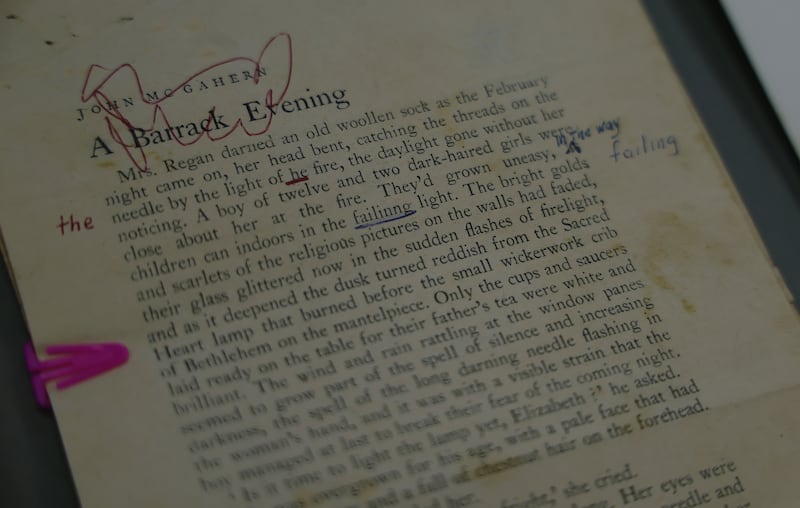
McGahern was constantly revising his work. “I have seen one short story have over 20 drafts,” Houlihan says. To show people how McGahern progressed as a writer, and how the initial manuscript became a published book, Houlihan will take them on a journey.
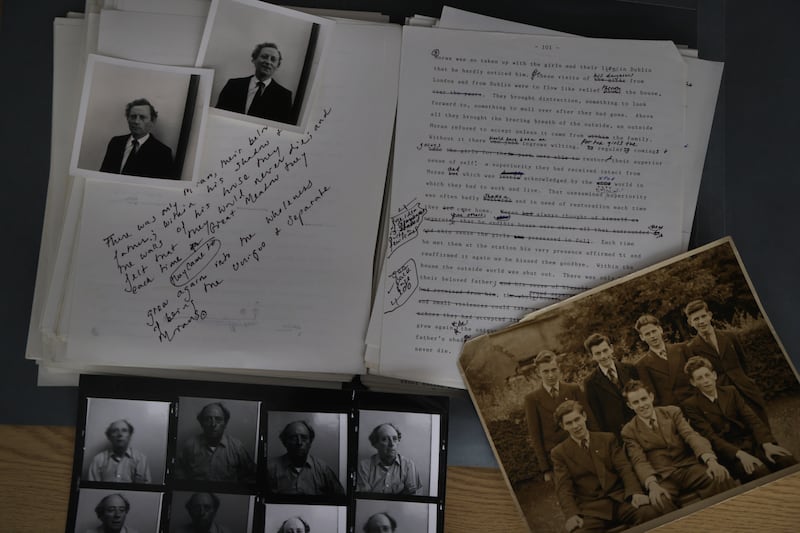
The presentation of each book will start with the first draft in a copybook, then the first typed draft, with more annotations, and then, finally, the published work.

“McGahern always wrote longhand. Everything begins in a copy book. Every draft would be by hand. And nothing would be typed until he was reasonably happy that things were moving in the right direction.”
McGahern wasn’t a typist, so someone else – Houlihan is not sure who – typed up the manuscripts.
On display will be a mix of original pieces from the archives, and some additional digitised pages, to give people a fuller sense of the manuscripts. Most of the items in the exhibition will not have been displayed in public before.
“I’ve chosen quotations from all the books to give people a taste of the writing, and more often than not they are the opening line. He was so skilled at drawing a reader in from the very first sentence.”
One of McGahern’s most famous opening lines is from Amongst Women, his novel from 1990: “As he weakened, Moran became afraid of his daughters.” It didn’t start out like that. An earlier version, which got as far as the typed stage, read, “As he weakened, Moran began to get afraid of his daughters.”
“Looking through the drafts is like sitting next to the writer as they are working,” Houlihan says.
The archive itself is not digitised, so anyone who wants to look at it needs to visit in person. It’s a very popular archive, not only with students and academics but also with readers.
What are they looking for?
“Sometimes they don’t know; they are just happy to explore. Other people are very specific. The Dark” – from 1965 – “is one that always sparks curiosity in people, because there is a sensational story around it: it was banned in Ireland at the time of its publication.”
(The archive shows that McGahern played around with titles for a long time. Before settling on The Dark, it was called The Pit.)
What did Houlihan learn about McGahern?
“How meticulous he was about every word having its place and every word being correct, and the fact that so many drafts were made. He cared about writing. He said a story had to be real, and that is why he wanted people to connect with the work.”
McGahern’s writing desk at his home in Co Leitrim faced the wall, not a window. “He needed to look inwards,” Houlihan says. “So many of his opening lines are about the natural world. The weather is so present. You can almost feel the rain, or feel the heat of a metal railing along by the train station. Or, in the beginning of the memoir, it’s about the soil in Leitrim being poor.”

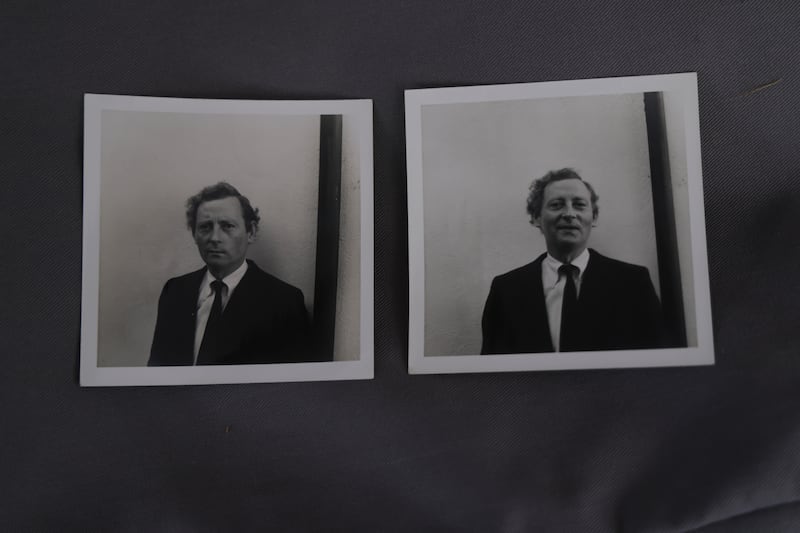

The obvious question to any archivist of writers’ work in 2026 is how to work in a world where handwritten letters, telegrams, hand-edited typescripts, postcards and hard copies of proofs have all but vanished. Will there be anything to archive for future generations of writers?
“The challenge is technology itself. Anything we type nowadays has a track-changes feature, and we just click to accept. And then all those changes are gone. All that work, all the labour of the writer, is invisible. We are left with the book, which is great, but we lose the craft of writing,” Houlihan says.
“Email is a different form of communication. It’s so meaningless. It’s so short. The way writers of McGahern’s era wrote to each other in letters was prose in its own form. They were letters that were crafted, that said something, and were sent with a purpose. Email doesn’t do any of that. Email is a transactional form of communication.”
What kind of response does Houlihan hope the exhibition will incite in those who see it, most of whom will be members of the public and fans of McGahern’s books, as opposed to a purely academic audience?
“That they might see a different side to how the work was written, and ultimately to go back to the books and read them. And fully appreciate what a consummate writer he was. He cared so deeply about the craft of writing.”
John McGahern: Writer & Archive opens at the Hardiman Research Building, at the University of Galway, on Tuesday, September 22nd, and runs until Friday, January 15th, 2027


