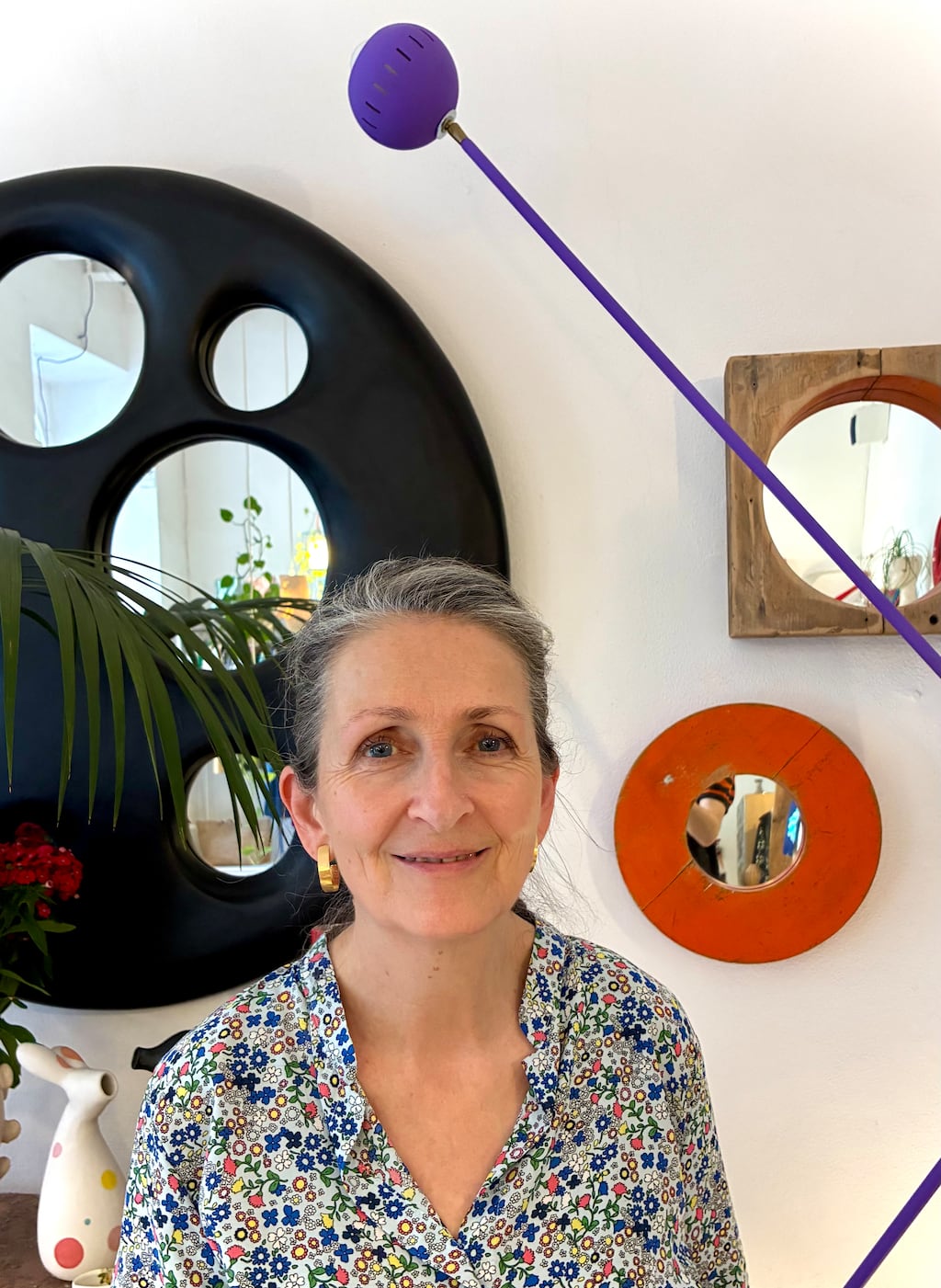
When Marie Darmody completed her fashion degree in NCAD in 1988, she decided, like many other Irish graduates at the time, to move abroad, in her case to Milan, a decision that was to change the course of her life.
From Clontarf, her student summers had been spent in London “as we were enamoured of the London fashion scene“, she recalls, but the city ultimately didn’t hold the necessary attraction to stay. For her, it was too big, too anonymous.
“I had heard so much about Milan and wanted to be somewhere completely new and to have that freedom,” she says.
So she and a friend, another NCAD graduate, Karen Brennan, set off for the Italian city, neither speaking a word of Italian. Initially they stayed in a hotel while they tried to find work, mounting their design ideas on cardboard to display their skills and creativity visually rather than having to discuss them verbally.
RM Block


“The interviews were held mostly silently because of the language problem, but the work was examined carefully. Italians have a problem saying no; they would say call back and we would do so.”
In the end, their perseverance paid off. Darmody’s first job was in knitwear and, subsequently, with a well-known known Italian designer where she remained for five years. It was an experience she describes as very creative and rewarding. She was given a lot of responsibility and took over several of the brand’s lines, one of which became very successful in the US.
“I had had a very formative experience at NCAD and that stood up to me,” she recalls.
She had also met her partner Salvatore whom she was later to marry. “He was restoring furniture and had worked as a window dresser, but was also an electrician and plumber, so he had a great background and was working for a very cool shop in Milan.”
At this point, though her work was satisfying, she was starting to tire of the habitual nature of fashion, so she and Salvatore joined forces to start a business upcycling furniture and lighting.
“It was just at the right time. It took off and we got a lot of publicity and had a lot of success selling to Harrods in London and to Colette (then a high-end design store) in Paris.” Some of their signature funky pieces were exhibited in Dublin for the Crafts Council at the end of the 1990s.
New direction
Flushed by success, the couple took a new direction more fitting to their lifestyle, opening their own shop in Naviglio in the canal district of the city called Salvatore&Marie in 2000.
“It was a natural progression. We took it step by step at the beginning but it has become a great mainstay for us now,” she says. It has also become a well-known destination for interesting and innovative artisanal designs, with furniture which they make themselves as well as glass, hand-painted ceramics, textiles, jewellery and knitwear.
One of the city’s little gems it has been described as a must visit destination in Milan for fashion enthusiasts and a haven for those who appreciate Italian craftsmanship and creativity.
“I love Milan. It is a very vital city and has given me so many opportunities and collaborations – people I have worked with for the past 15 years from Ukraine, from South America, who are good with their hands, so I have a good network and there are great materials here. The city is a kind of crossroads, it has a real edge and great energy,” she says.
Their two sons, Peter and Milo, were born in 2000 and 2003 and although Darmody has praise for the Italian public education system, their sons were transferred to the private sector, the Waldorf Education System (otherwise called the Steiner school) well known for a learning process that engages the head, heart and hands and where the pair thrived.
“It is the kind of place where I would have liked to have gone to school,” she says. Peter has now joined them in the business.
“My husband is from Sardinia and considers himself an immigrant in a way, like me, so neither of us have a close family network in Milan though we keep close ties with Sardinia where for the first 15 years we would spend every summer.”
Food culture is particularly important in Italy, she says, and sitting down at the table three times a day. “It’s more ceremonial here and people have long conversations about what they ate the evening before. When we first came as young graduates, it seemed so strange.”
Having a shop means “you must respect shop times. I enjoy what I do but shop hours are quite restrictive, so I haven’t travelled as much over the years. I try to get back to Dublin at least once a year to see family and friends. Seeing how Ireland is blossoming now is so uplifting, but it is still quite a shock just to see how much it has changed,” she says.
They speak Italian at home – their sons are bilingual. Milo (23) is currently taking a year out but is interested in film and video.
Milan, however, has not changed as much as Dublin.
“It was a conservative city fashion wise at the time I came here in 1988 but now things are not that different stylistically internationally. With a lot of design colleges and schools, it is competitive but still a city of opportunity and still vibrant with little artisan ateliers sprouting everywhere.”


