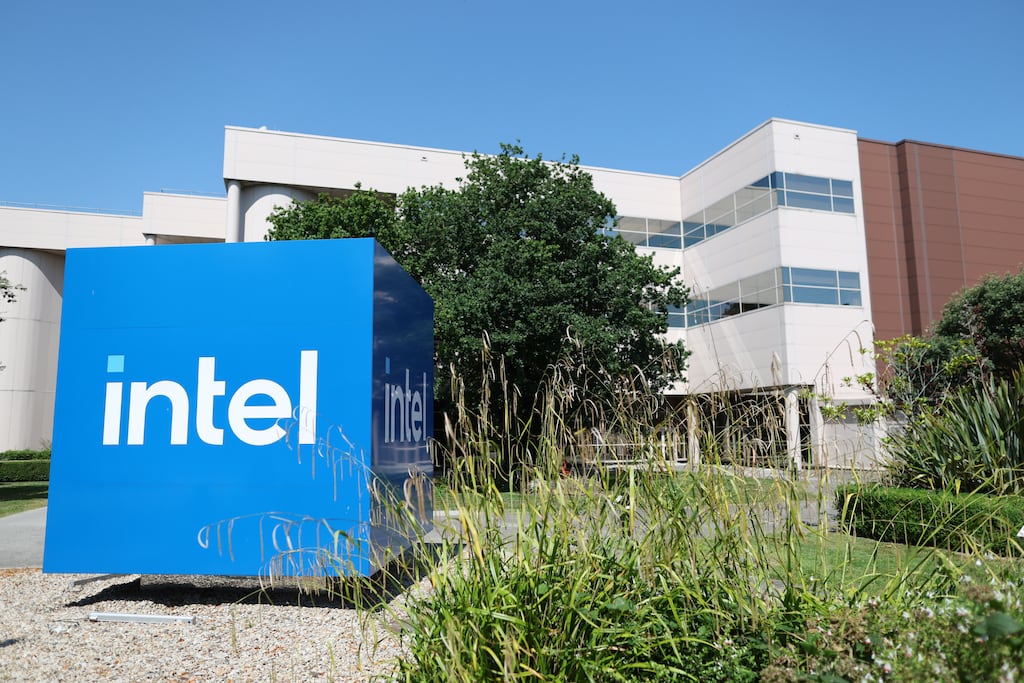
Intel is to invest €5 billion in its Irish operations, creating hundreds of high-tech jobs at its Leixlip campus as the company latches on to demand for next-generation chips to power artificial intelligence (AI).
The investment, which is roughly 30 per cent of the company’s entire capital expenditure for the year, will be used to upgrade its advanced manufacturing capabilities. This will include existing fabrication facilities, the installation of new equipment and the upskilling of staff at the campus.
While Intel did not put an exact figure on how many jobs would be created as a result of the investment, its chief technology and operations officer and general manager for Intel Foundry, Naga Chandrasekaran, said hundreds of highly skilled roles would follow, along with thousands of construction and trade-related jobs.
“Ireland has been a really strong base for Intel for almost 35 years,” he said.
RM Block


“Ireland is our centre of excellence for Intel 3; we are not running Intel 3 in any other Intel manufacturing facilities. The demand for AI is driving a significant increase in the need for Intel 3 wafers. That is where this €5 billion investment is coming in.”
Intel has poured €30 billion into the Leixlip campus over the past four decades. The company expects to have the bulk of the money invested by 2027, with Fab 34 as its focal point.
[ What Intel’s remarkable comeback means for Ireland Inc, and for LeixlipOpens in new window ]
The facility, which opened in 2023, makes products using extreme ultraviolet (EUV) lithography, a process that allows the company to print circuitry smaller and more precisely than before.
Intel 3 products made in Ireland will be for the global market, but Chandrasekaran said the investment would also strengthen Europe’s chip supply chain.
“Intel 3 is the most advanced technology that is manufactured in Europe,” he said. “What this provides is a technology sovereignty within the EU that the EU is targeting, and it provides more output and as a result a supply chain resiliency for Europe.”

How can tech offer solutions for obesity and weight management?
It also marks another step in the turnaround for Intel’s fortunes in recent months. Once the dominant player in the chip market, Intel has seen its market position eroded with rivals such as Advanced Micro Devices catching up and Nvidia capitalising on the AI boom.
Intel, which employs just under 5,000 people in Ireland, announced last year that it would cut more than 20 per cent of its staff globally, with an unspecified number of cuts in Ireland.
[ Intel’s comeback gathers pace with record-breaking advanceOpens in new window ]
However, its fortunes have begun to turn around. The growth of AI is fuelling the latest investment, Intel said, as demand for its chips begins to increase. The €5 billion it is ploughing into the Irish campus will help Intel deliver the Xeon 6 chip, and also support the next-generation Intel Xeon built on its Intel 3 node.
Taoiseach Micheál Martin described the investment as a “powerful vote of confidence in Ireland, our skills base and our position at the heart of Europe’s most advanced manufacturing ecosystem”.
“At a time of rapid technological change and global competition, this expansion strengthens Ireland’s role in securing resilient semiconductor supply chains and reinforces our ambition to remain a global leader in innovation, productivity and sustainable economic growth,” he said.
Chandrasekaran said he expected continued growth in Ireland. “I see Ireland as one of the very critical, pivotal parts of Intel’s network,” he said. However, he highlighted some challenges, including increased electricity costs and the higher cost of construction here.
“We are committed to Ireland,” he said. “We have made four decades of investment and you cannot walk away from it.”
IDA Ireland chief executive Michael Lohan said: “This project demonstrates the value of Ireland’s skilled workforce, innovation ecosystem and stable business environment, while reinforcing Ireland’s leadership in advanced semiconductor manufacturing, supporting both European competitiveness and resilient global supply chains.”


