

There is an Italy that reveals itself only to those who cross it slowly. You meet it in the silence of an abbey reached after hours of walking, in the rhythm of footsteps along an Apennine valley, in the small villages of Lazio where you stop for the night. It is the Italy of the ancient walking routes: five historic routes, once walked by medieval pilgrims, merchants and travellers from across Europe, that traverse the country and converge on Rome, after passing through the Lazio region. Today they offer something increasingly rare: a way of moving through landscape and heritage that is slow, sensory and immersive.

The Via Francigena is the most internationally recognised of Italy’s walking routes, certified as a Cultural Route of the Council of Europe in 1994, the same year as the Routes of Santiago de Compostela. It is based on the travel diary of Sigeric, Archbishop of Canterbury, who in 990 AD recorded the 79 stages of his return journey from Rome in a manuscript today preserved at the British Library. The Italian section runs for about 1,000km in 45 stages, from the Great St Bernard Pass to Rome. Its Lazio leg is among the most evocative of the entire route: the Francigena enters the Tuscia of Viterbo at Acquapendente, on the shores of Lake Bolsena. From there it touches Montefiascone, with its papal fortress; Viterbo, a former papal seat with one of the largest preserved medieval quarters in Italy; Sutri, an Etruscan town with a Roman amphitheatre carved entirely into the tufa rock; and La Storta, the final stop before St Peter’s Basilica in Vatican City.
The Way of St Francis follows two routes that converge on Assisi: the Northern Way, around 190km from the Sanctuary of La Verna, where Francis received the stigmata in 1224; and the Southern Way, around 300km in 13 stages from Rome to Assisi, running entirely through Lazio. The Southern Way crosses the Sabine countryside and reaches the Rieti Holy Valley, the heart of Franciscan spirituality. Within just a few kilometres, four sanctuaries preserve the memory of decisive moments in the saint’s life: Greccio, where in 1223 Francis created the first nativity scene in history; Fonte Colombo, where he later dictated the Rule of the Order; La Foresta, where, according to tradition, the miracle of the grapes took place; and Poggio Bustone, where he received the revelation of the forgiveness of sins. Pilgrims who complete the route receive a certificate, the Testimonium, at the Basilica of St Francis in Assisi.
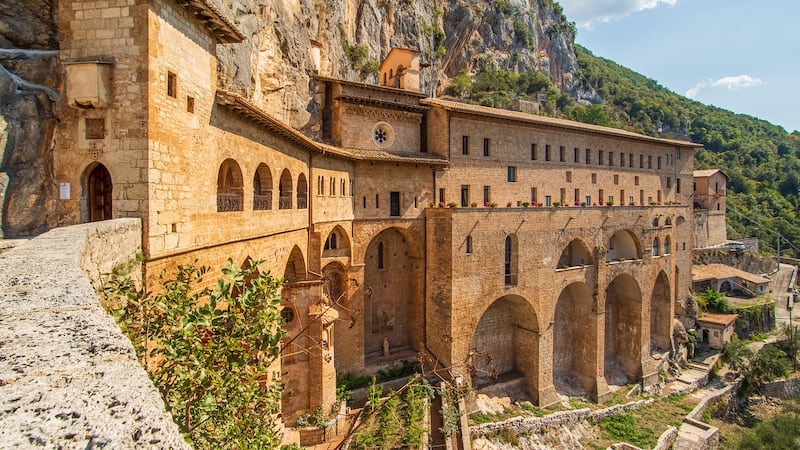
The Way of St Benedict connects the three foundational sites in the life of the founder of western monasticism: Norcia, his birthplace, around 480 AD; Subiaco and Montecassino, both in Lazio. The route runs for approximately 300km in 16 stages between Umbria and Lazio, crossing the Apennine ranges of the Sibillini, Reatini, Simbruini, Lucretili and Ernici. At Subiaco, in the upper Aniene Valley, the Sacred Cave preserves the grotto where Benedict lived for more than 30 years as a hermit. Nearby, the Abbey of Santa Scolastica is regarded as the cradle of Italian printing: in 1465 it housed the country’s first printing press, set up by the German printers Sweynheym and Pannartz. At Montecassino, around 529, Benedict founded the abbey that remains the heart of the Benedictine Order, and where, according to tradition, he wrote the Rule, the text that has shaped European monastic life for 15 centuries. Benedict of Nursia has been Patron of Europe since 1964.
RM Block


The Romea Strata is the newcomer. The Council of Europe certified it in June last year. It reconstructs the network of medieval roads that for centuries brought pilgrims to Rome from central-eastern and Baltic Europe: Estonia, Latvia, Lithuania, Poland, Czech Republic and Austria. Its full development runs to more than 4,700km and touches more than 50 Unesco sites. A sweeping remapping was completed in 2024 by a volunteer network and has redefined the final approach to Rome, granting the Romea Strata its own dedicated gateway into the capital. For the pilgrim setting out from the Baltic, it is here that thousands of kilometres culminate in a uniquely personal finale, forging a distinct identity within the vast tapestry of Europe’s ancient trails.

The Via Romea Germanica was certified as a Cultural Route of the Council of Europe in 2020. It is based on the journey described by Abbot Albert of Stade in the Annales Stadenses of 1236, a dialogue between two friars discussing the possible roads to Rome that became, almost incidentally, one of medieval Europe’s most precise travel records. The Italian section measures approximately 1,050km from the Brenner Pass to Rome. In Lazio, the route joins the Via Francigena at Montefiascone and from that point the two walks become one: together they cross Bolsena, Viterbo – home of the Macchina di Santa Rosa, a Unesco-listed intangible heritage – Vetralla, Sutri, the Veio Regional Park and finally La Storta, the last threshold before St Peter’s. A northern variant within Lazio also touches Civita di Bagnoregio, the so-called “dying town”, perched on a tufa pinnacle in the heart of the Tuscia, one of the most photographed villages in Italy, though it looks utterly different to those who arrive on foot.
Five different routes, one destination – Rome, and before that Lazio, a region that holds in a few hundred kilometres the highest concentration of spiritual and cultural sites in the country. It’s an Italy that takes time to discover and for that reason stays with you longer.
Project funded by the European Union - Next Generation EU «Antichi Cammini d’Italia», PNRR - Mission M1C3 Investment 4.3 Measure 274 - the ITALIAN MINISTRY OF TOURISM is the subject operator, ENIT S.p.A. is the subject agent


