
Twenty years ago, the United Arab Emirates (UAE) was at the centre of a political firestorm in Washington.
A bid by the oil-rich Gulf state to buy up six major American seaports through Dubai-owned logistics company DP World triggered an uproar among US lawmakers.
Two of the hijackers who carried out the 9/11 attacks just five years earlier had come from the UAE. Alleging it was a financing hub for al-Qaeda and a “persistent counterterrorism problem”, some in Congress warned of a dire threat to US security if the UAE was allowed to run strategic ports.
It did not matter that the UAE had been the only Arab state to deploy troops to support the US war in Afghanistan, and the Bush administration had backed the ports deal. The outcry forced DP World to back out of the sale.
RM Block


It also proved a watershed moment for the UAE – and its relationship with the United States. In Abu Dhabi, Sheikh Mohamed bin Zayed al-Nahyan, then the UAE’s powerful crown prince known by his initials MBZ, convened his advisers for an emergency meeting. The “crisis” had revealed that most Americans had a fundamental misunderstanding of the UAE, MBZ told his advisers. It was time to fix that.
And they did. Two decades later, MBZ is the UAE’s president – and the Gulf state has come to be seen by US politicians and military commanders as one of the US’s most capable allies in the Middle East, with the admiring nickname of “Little Sparta”. On July 28th, the US military announced it was working with the UAE on accelerating the development of “military artificial intelligence”.
Beyond military ties, Abu Dhabi has busily leveraged the $1.7 trillion (€1.47 trillion) it manages in sovereign wealth funds and state-backed businesses to invest heavily in the US – and in president Donald Trump’s family.
The Republican-controlled Congress is no longer so alarmed by investments in areas sensitive to US national security. Trump recently granted the Emiratis access to some of the US’s most advanced computer chips – just months after an Emirati royal invested $500 million in the Trump family’s cryptocurrency business.
As for MBZ, who decided it was time for a strategic reset, “His Highness is a warrior,” Trump said in June, adding that the UAE is a “fantastic country”.
[ The United Arab Emirates’ delicate balancing act with IranOpens in new window ]
How the UAE, an absolute monarchy, came to win over Washington is seen by friends and foes alike as the ultimate case study in how to run a government public relations campaign in the US.
It has not always been plain sailing. The US angered the Emiratis with its tacit embrace of the 2011 Arab Spring uprisings that threatened the status quo in the Middle East, and its decision to sign the 2015 nuclear deal with Iran.
Most recently Trump’s war with Iran has tested the limits of MBZ’s influence, as the UAE became the main target for Iranian retaliation; the volleys of Iranian missiles and drones raised questions about the country’s image of stability and the viability of its ambition to be a global tech hub.
The Emiratis realise “they have reach, they have access, they have influence”, says Barbara Leaf, who was US ambassador to Abu Dhabi from 2014 to 2018, and then the top US diplomat for the Middle East. “But when it comes down to it, they didn’t get a vote on a war that started on their doorstep, and for which they have received the lion’s share of attacks.”
If anything, however, this has reinforced the view in Abu Dhabi that it should intensify the relationship. It made a strategic bet on its partnership with the US and closer ties with Israel. Officials say it intends not just to stay the course but to strengthen the bond.
Cash leverage
When Trump hosted his 80th birthday party on the White House lawn this summer, there were just two ambassadors who attended the “ultimate fighting” spectacle: the UK’s Christian Turner and the UAE’s Yousef al-Otaiba.
The former adviser to MBZ, who was educated at the city’s Georgetown University, was sent to Washington in 2008 to present to Americans a different UAE from the one they thought they knew. Aided by a small army of high-level lobbyists, he did just that.
A principal lever was cash. The UAE has spent more than $270 million in Washington over the past 10 years alone, according to OpenSecrets, which tracks money in US politics. Together with its Gulf neighbours Saudi Arabia ($422 million) and Qatar ($269 million), it ranks among the top 10 spenders in the world.
It has also funnelled money to some of Washington’s most prominent think tanks, from the Atlantic Council to the Center for Strategic and International Studies and Rand, among others; hosted scores of international conferences and conventions; and even before Otaiba’s arrival it launched a bilateral US-UAE business council.
But it is Otaiba himself who has been the most influential factor with his gift for navigating Washington politics, officials say.
“Otaiba has been relentless in wining and dining to successfully cultivate cheerleaders in both parties” of American politics, says one former senior state department official. “It’s jarring how many former officials and congressional staff have put their names on glowing op-eds extolling the supposedly mutually beneficial US-UAE relationship,” the official adds.
MBZ has made only one official state visit to Washington, in 2024, to meet then president Joe Biden, but officials say Otaiba has led the UAE’s strategic makeover in the US with a sophistication that its Gulf neighbours, including Saudi Arabia, are trying to emulate.
While the gruesome 2018 murder of a prominent journalist by Saudi agents landed Riyadh in diplomatic disfavour for a few years, Otaiba was busy selling an image of the UAE as a comparative beacon of modernity and promise; home to the moderate and business-friendly Dubai; a seemingly liberal oasis in a conservative Muslim part of the world.
Otaiba has encouraged US policymakers to visit the UAE, led the embassy’s outreach to Congress, think tanks, universities, schools and the media, and hosted parties for Washington elites.
During Trump’s first campaign, he also became close with Jared Kushner, the president’s son-in-law who would become one of his most influential advisers on the Middle East.
But the UAE and Otaiba’s most successful coup to date was the country’s 2020 decision to become the lead signatory of Trump’s landmark Abraham Accords, normalising ties with Israel in a move that dazzled the American political establishment and brought about a sea change in the US perception.
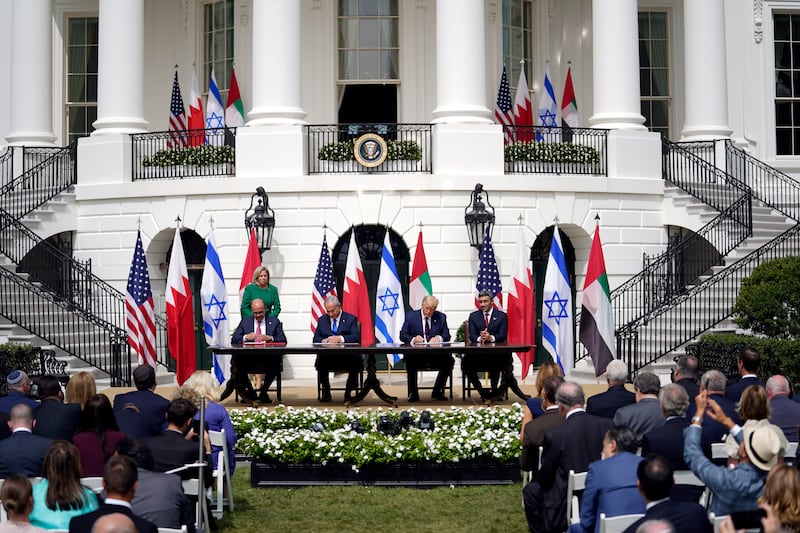
“They could read the tea leaves and see what mattered to the US, and knew that Israel was a way to get in with the Trump folks,” says the former state department official. “Closer ties with Israel was like a gigantic gaping backdoor around the criticism they were facing.”
For MBZ, closer ties with the US meet a range of strategic goals, people close to the ruling family say: to diversify the economy beyond a reliance on petrodollars; to become a global AI hub; and to chart a path outside the shadow of regional powerhouse Saudi Arabia.
“They have long looked at Israel and Singapore as sort of the models: small countries, small populations – that have global impact, politically, diplomatically, in economic terms, militarily, and so forth,” says Leaf, the former ambassador to the UAE.
Crypto purchase
Twenty years after the UAE failed to acquire major US seaports, it has gradually acquired stakes in an industry that is far more valuable.
“It’s scary how much our AI industry is tied to Emirati money,” says one senior Biden administration official who has worked closely with the UAE.
State-backed investment vehicles such as Abu Dhabi sovereign wealth fund Mubadala and MGX, chaired by the UAE’s national security adviser and brother to the president, Sheikh Tahnoon bin Zayed al-Nahyan, have launched expansive partnerships with tech companies such as OpenAI and xAI. They have also secured a controlling stake in chipmaker GlobalFoundries and large minority equity investments in chipmaker Cerebras Systems and data centre developer Aligned Data Centers.
Last September, MGX struck a deal with the US government to receive a 15 per cent stake in TikTok US.
The investments helped convert the US-UAE relationship from one measured in the post-9/11 era by co-operating to fight “bad guys together” to one where they co-operate economically, says one Emirati official.

“In the post-Iran world, it’s going to be both,” the official adds, calling it a “hybrid”. In the US defence industry, it’s not just “what we are buying; it’s what we are building. And the data centres we are building ... We’re investing with Microsoft, Nvidia, BlackRock and OpenAI,” the official says.
Tareq Alotaiba, the Emirati ambassador’s half-brother and a former Emirati official, compares the UAE’s strategic investment strategy to one developed for a “small car jumping into a race where there’s a lot of larger cars that are ahead of us”.
“In the early days, it was just, ‘We’re going to throw a bunch of money at things that look good,’” he says. But as the Emiratis grew to understand Silicon Valley, they became “sophisticated investors, and they know where the right deals are, where the promising technology is”, Alotaiba adds.
Jacob Helberg, the Trump administration’s top official for economic diplomacy, said this year that Emirati investments in US chipmakers had made the UAE a critical underwriter of the tech industry.
“They invested in GlobalFoundries,” he told members of Congress. “They brought Cerebras almost back from the dead, and Cerebras today is a crown jewel of American technology.”
But a new high for Abu Dhabi came with the US commerce department’s decision to authorise advanced chip sales to the UAE, and remove related export controls. Ambassador Otaiba hailed the chips deal as a “milestone” built on “sustained engagement”.
[ Irish in the Gulf: Is the Dubai dream over?Opens in new window ]
Democrats, however, saw it as something else: Arizona congresswoman Yassamin Ansari called it “perhaps one of the largest and most obvious corruption schemes in US history”.
The outrage stemmed from the purchase by Sheikh Tahnoon’s MGX of a 49 per cent stake in the Trump family’s crypto business, World Liberty Financial, shortly before Trump’s inauguration last year.
MGX later purchased $2 billion in World Liberty’s stablecoin to invest in crypto exchange Binance, “a deal that effectively handed World Liberty $2 billion in cash”, says Chris Van Hollen, a Democratic senator who has repeatedly questioned administration officials about the exchange.
A UAE-based fund calling itself the Aqua 1 Foundation also bought $100 million worth of digital tokens issued by World Liberty.
The Emiratis say the investments were private business decisions, with no connection to Emirati political ambitions or the subsequent US-UAE chips agreement. A World Liberty spokesperson said its stablecoin was merely the means of payment for MGX’s investment and it would be “wholesale untrue” to call it a cash handout.
US national security officials and lawmakers had warned for years that allowing Emirati access to advanced chips would make the US’s most sensitive technology vulnerable to being obtained by its greatest global competitor, China, which has close trade and tech ties with the UAE.
The Trump administration and the UAE say they have taken measures to protect the technology. But some former officials and lawmakers are sceptical.
“The UAE has crafted a relationship with the United States that is very much to the benefit of the UAE, but much to the detriment of US foreign policy and our national interests,” says the former state department official. “If you actually dig into it, all the stuff about the benefits to the US of the UAE relationship is amorphous, intangible vapour,” the official adds.

Sudan links
The UAE’s diplomacy and investments have paid off in more subtle ways too. It has long avoided consequences for the kind of behaviour that US politicians view less charitably when displayed by others: conducting joint military exercises with China, for example, or allegedly supplying the Rapid Support Forces, a Sudanese militia accused of war crimes, with weapons that Democratic lawmaker Sara Jacobs says are “literally enabling a genocide”.
US secretary of state Marco Rubio did last year say the UAE is “openly supporting an entity that is carrying out a genocide” in Sudan – an allegation that the UAE denies. But lawmakers have consistently voted against congressional efforts to block arms sales on the grounds that the UAE is a strategic ally.
It has also escaped serious reprimand for its role as a hub for illicit Iranian financing. This was so central to the Iranian regime’s survival before the start of the war that Trump this year remarked that the UAE was “like the banker for Iran”.
A Financial Times analysis of Iran-related treasury sanctions found that the UAE was the second most frequent country mentioned behind China, despite Abu Dhabi’s traditional hawkish stance towards Tehran. Of 1,573 entities and individuals under sanctions who have ties to a country outside Iran, 22 per cent have citizenship, addresses or corporate registrations in the UAE.
[ The field marshal remaking Pakistan’s place in the worldOpens in new window ]
“The UAE has a lot of influence here in Washington – too much influence,” says Van Hollen. “So they have got away with things that other countries couldn’t.”
For all its influence, the UAE was not able to keep the US and Israel from launching the war against Iran this year.
Yet since it began, the Gulf state has taken the consequential decision to intensify its ties to Washington and Israel, even launching scores of its own air strikes against Iran.
Emirati officials say the reliable stream of US weapons and support throughout the war – supply chain bottlenecks aside – is a testament to their deepening value in the relationship.
“I think our performance in the war, our co-operation and co-ordination with the US, has really elevated us or singled us out,” argues one Emirati official. “It has shown we are competent, that we know what we’re doing.”
The UAE has also drawn closer to Israel, and in May withdrew from the Saudi-led Opec, further endearing itself to Trump, who has long hated Opec’s influence on oil prices. Saudi Arabia is no longer the “800lb gorilla” in the room that it was when Trump visited the Gulf just last year, the official adds.
Some experts predict the focus on the US and Israeli links, at the expense of Arab regional alliances, will backfire. In doing so, the UAE “risks surrendering strategic autonomy to those countries”, says Andrew Leber, a Middle East expert at Tulane University.
Also some Democrats believe the UAE’s day in court is coming, should the party win back control of Congress in November’s midterm elections, which could pave the way for congressional investigations.
Jacobs, the Democratic lawmaker, says the US must be “seen to be holding our partners and allies to the same standards as everyone else”.
The UAE is a “significant US partner in the region”, she adds. “But we still need to be honest about how their actions are directly undermining US priorities and causing harm.” – Copyright The Financial Times Limited 2026


