

It is the mundane items you find in any home that catch your eye in the pile of rubble: a kitchen tablecloth, hand-held vacuum cleaner, the wire frame of a charred mattress, a smashed television set, an intact ceramic bowl and a bedside drawer.
The apartment block on Dehtiarivska Street in central Kyiv was recently struck by a ballistic missile, destroying one side of the residential building.
That barrage saw more than 100 missiles and 600 drones launched at the Ukrainian capital, one of the most intense bombardments since Russia launched its invasion 4½ years ago.
Eight days ago another massive ballistic missile attack shook the city. More than 40 missiles struck Kyiv in less than an hour, killing an 89-year-old woman and injuring several other civilians.
RM Block


Frustrated by Ukraine’s heavily fortified eastern defences, Russia has ramped up attacks on Kyiv and other cities.
Iskander ballistic missiles and cheap, Iranian-designed Shahed drones are being used to devastating effect to overwhelm Ukraine’s stretched air defences. More Ukrainian civilians were injured this May than any month since April 2022.
People in Kyiv are tired. “It’s hard, all is broken,” Lesia Mazanik, who lives a couple of minutes’ walk from Independence Square in the heart of the capital, told The Irish Times. “It’s not normal life. People are stressed.”
Lambada, her seven-year-old Dachshund, a “dog of the war”, hates the air raid warnings, particularly the loud Soviet-era sirens. “I’ve never left Kyiv since the full-scale invasion,” she said.

Her dog doesn’t do well in the underground bomb shelters, so they take cover in an interior alcove of her apartment building during attacks. The advice is to put two walls between yourself and any windows.
“My close friends who live in Odesa, they lived four years through the war, but now they say it is unbelievable. They are bombed constantly,” she said.
[ Why Ukraine is targeting Russia’s answer to AmazonOpens in new window ]
It is not one-way traffic in the sky. Ukraine has had success deploying long-range drones to hit oil refineries, ports and logistics hubs inside Russian territory, bringing the reality of the war closer to Moscow. The campaign has put a squeeze on Russia’s supply of petrol and fuel.
The strategy has been particularly effective in occupied Crimea, where Ukraine wants to make Moscow pay a higher and higher cost to govern the peninsula it annexed in 2014.
This is a feature of what Jamie Shea, a former senior Nato official, describes as the “war of the rear”, where Russia and Ukraine are both focused on pushing the economy and society of the other closer to breaking point.
Shea, who served as Nato’s deputy assistant secretary general for emerging security challenges, said Russia was still gaining yards on the battlefield but had been unable to punch through Ukraine’s “Maginot Line” of heavily fortified eastern defences.
However, Shea, a former British official, said there was no sign of Ukrainian forces being able to muster a significant counterattack. “Manpower reserves are really drying up,” he said, which was a real concern.
The success of Ukraine’s “middle strike” drone campaign has exposed previous hesitance by western allies to arm Kyiv’s forces to launch longer-range missiles as a real misstep.

Ukrainian president Volodymyr Zelenskiy had been frustrated by Germany’s refusal to provide Taurus missiles to hit targets deep in Russian territory.
Russian president Vladimir Putin had warned that facilitating long-range missile strikes would be viewed as an escalation that amounted to Nato’s direct participation in the war.
The Biden administration had also insisted on limiting Ukraine’s use of donated missiles to hit Russian forces in Ukrainian territory they were occupying, restrictions that were lifted only in late 2024.
The strategy of western allies during that earlier period of the conflict has been criticised as one that provided Ukraine with enough help so that it didn’t lose the war, but never enough to support to push on and try to win it.
In the trenches that make up the front line, Ukraine’s army continues to make Russia pay a steep price for slow, grinding gains over the last year. In recent weeks they have recaptured some territory, according to Ukrainian officials.
[ How Volodymyr Zelenskiy’s ham-fisted sackings sparked street protests in KyivOpens in new window ]
Last year Russian forces advanced on average 13.2 square kilometres a day. The rate of daily forward progress dropped to below three square kilometres in the first four months of this year, according to the Washington-based Institute for the Study of War.
Drones do most of the fighting and killing several kilometres either side of both armies’ positions and in the no-man’s-land that lies between.
Previous assessments the Ukrainian government shared with European officials said Russia was suffering between 30,000 and 35,000 casualties a month, but has been replenishing its ranks by at least the same number of new recruits.
Ukraine has set itself a goal of inflicting 50,000 casualties a month, to push the number killed or seriously injured beyond levels whereby Russia can source new troops.
Drones, rather than conventional missiles and artillery, account for about 80 per cent of Ukraine’s successful strikes on the battlefield, according to the government. Though military commanders say conventional methods of warfare remain an important feature of the fighting.
“Russia’s war against Ukraine has entered a new phase, one defined less by territorial gains than by intense technological competition,” Andriy Zagorodnyuk, a former Ukrainian defence minister, wrote recently in an article for the Carnegie Endowment for International Peace.

Technological leaps forward were measured in “months, weeks, or days in some cases”, rather than years, said Zagorodnyuk, who served as defence minister from 2019 to 2020.
Word quickly filters back from the battlefield to Ukrainian engineers, to make changes and design improvements. “The decisive advantage lies with those who can shorten the loop between combat experience, technical adaptation and redeployment. As a result, ultra-fast adaptation becomes a paramount requirement for survival,” Zagorodnyuk wrote.
One consequence of the skies being filled with drones is that Russia has started deploying small units of handfuls of soldiers to infiltrate gaps in the vast front line and attacking Ukrainian positions from multiple directions, rather than throwing waves of troops against their defensive lines head on.
The extent to which Ukrainian forces can rely on drones to fight the brutal war was the cause of the spectacular falling out at the top of the government and military command, which destabilised Ukraine at a time when it should be pressing a narrow advantage.
Zelenskiy dismissed his popular, 35-year-old defence minister, Mykhailo Fedorov, who had been a proponent of doubling down on drones and technology. The philosophy brought him into conflict with Oleksandr Syrskyi, the old-school commander-in-chief of the armed forces.


The Ukrainian president initially sided with Syrskyi, but public protests forced him to about turn and replace the top general with Mykhailo Drapatyi, a military leader more open to innovate, in order to quell the discontent that had poured out on to the streets of Kyiv and other cities over Fedorov’s sidelining.
It is not the first time infighting has stymied the Ukrainian side, a serious mark against Zelenskiy’s ability to get everybody to pull in the same direction.
“Both politically and militarily in a war, having a united team really matters and that’s a weakness for Ukraine,” said Shea, the former Nato official. “You can’t win a war if you’re changing your defence minister every five minutes, or your chief of staff. He’s no Churchill when it comes to organising a team around him,” he said of the Ukrainian president.
Zelenskiy has an international constituency to tend to as well as his domestic one.
The wartime leader is running what seems like a never-ending diplomatic marathon on the international stage to secure the help from allies he says is needed to force Putin towards peace negotiations. It is a simple equation: pressure Russia, supply Ukraine.
The huge flow of financial aid and weapons from the United States dried up when Donald Trump returned to the White House.

The stop on aid from Washington means European countries, including the UK and Norway, plus other allies such as Canada and Japan, provide practically all of the financing that keeps Ukraine in the fight.
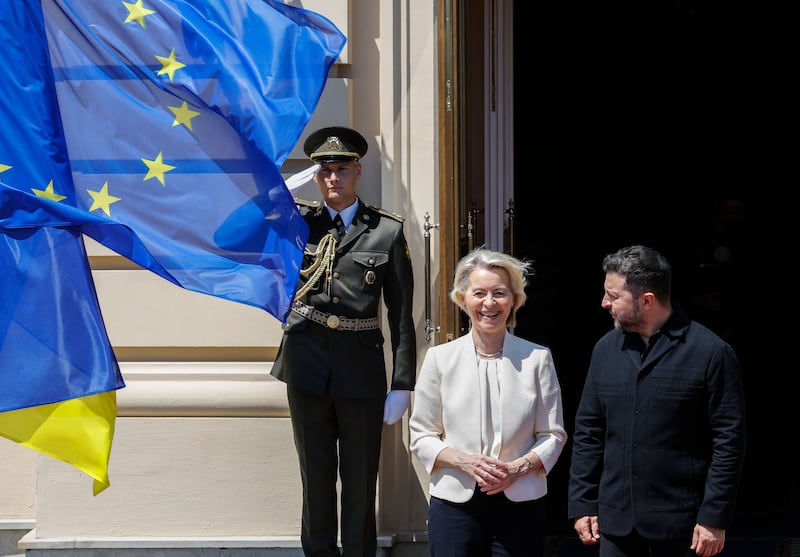
A €90 billion loan EU states agreed to borrow against the bloc’s budget has gone a long way to shoring up Ukraine’s financial position for this year and the next.
EU governments may not be able to repeat the trick a second time though when Kyiv begins to run short of funds again in a year or so.
Germany and other fiscally cautious states are ideologically opposed to the EU taking on common debt as a bloc. It’s also becoming harder and harder for governments to find spare funds in national budgets to set aside to buy weapons for Ukraine.
The Trump administration’s war in Iran created another headache for Zelenskiy.
Tehran’s retaliatory strikes on US-aligned Gulf states and American military bases in the region has seen a queue form to buy up air defence protection. Ukraine had already been in dire need of more Patriot batteries to shoot down drones and missiles launched at its cities and infrastructure.
[ Why Crimea has become so important in the Ukraine conflictOpens in new window ]
The Strait of Hormuz closure gave Putin a boost, too, by hiking up the price Russian oil and gas could command on the market, helping to refill the Kremlin’s war chest.
In Brussels, diplomats from the EU’s 27 governments spent weeks negotiating the union’s 21st package of sanctions, a process that revealed surprisingly tense divisions in Europe’s approach to pressuring Moscow.
The sanctions are intended to make it harder for Russia to keep fighting, by cutting off the supply of key materials entering the country and limiting revenue Moscow receives from the sale of oil, gas and other products.
Greece fought against a proposal to bar European companies from shipping Russian liquefied natural gas (LNG) to other parts of the world for sale in the latest sanction package. Athens wanted to protect Greek shipping firm Dynagas, which transports Russian LNG from the Arctic region.
Germany and Portugal pushed back against a proposed ban on imports of Russian cod and Alaskan pollock, because their domestic fish-processing industries rely on the stock. Two countries with big tourism sectors, France and Italy, resisted an EU-wide ban on travel visas for former Russian soldiers.
The end result was a hollowed-out sanctions package.
One European Commission official said the easy targets were all exhausted in the 20 previous rounds of economic sanctions drawn up since the start of the war.
New options put on the table were more likely to pinch certain member states and hurt European industries. EU states have to decide where their threshold for pain lies and whether further sanctions will do enough harm to Russia to justify the economic knock to European businesses, the senior source said.
European leaders won’t get much sympathy complaining to Ukraine about pain thresholds.
On Dehtiarivska Street in Kyiv, a red and white tram ferrying people about their day passes by the site of the bombed apartment block. The sight of rubble and shelled buildings has become a depressingly familiar part of everyday life in the capital.


