Thousands feared dead as Venezuela is struck by massive back-to-back earthquakes

Scientists warn of widespread destruction after buildings collapse west of Caracas

Rescuers search for victims in a collapsed building following an earthquake in Caracas. Photograph: Manaure Quintero/AFP via Getty Images

Two powerful earthquakes have struck Venezuela, killing at least 32 people and injuring 700 more after dozens of buildings collapsed into piles of shattered concrete and steel in and around the capital Caracas.

A magnitude 7.2 earthquake hit about 160km west of Caracas, followed ‌less than a minute later by a magnitude 7.5 magnitude tremor, according to the US Geological Survey (USGS).

The USGS, using predictive modelling to estimate the death toll, said it would most likely run into the thousands, with a substantial probability of exceeding 10,000.

Video footage showed emergency workers scrambling over the pancaked debris of a collapsed building in the capital ​as night fell, while distraught relatives sought help for loved ones believed to be trapped. Several dazed survivors were taken away, some on stretchers.

“When we went downstairs, the scene was like a horror movie,” said Maria Alejandra, a resident from a nearby building.

“We had to climb over the rubble and everything. The building superintendent with the baby and all the neighbours coming down. But from that building, I only saw that one family got out.”

A damaged building in Catia La Mar, La Guaira State, 30km northwest of Caracas. Photograph: Federico Parra/AFP via Getty Images

Interim president Delcy Rodríguez said initial casualty figures do not include those from worst-affected La Guaira state, near Caracas and home to the city’s airport, which had been closed.

“Dozens of buildings have collapsed, and we ​are currently carrying out very intense rescue efforts to save as many lives as God allows us to save,” she said in an appearance on state television just before 1am local time on Thursday.

“I also want to say that this is a true tragedy. From here, we send our message of solidarity, and to those families ⁠who have lost loved ones, we reaffirm our condolences and our support in these difficult hours.”

Many Venezuelans were at home when the earthquakes struck during the afternoon on a public holiday.

“There was a very loud crash. Things fell in the house, ‌jugs inside ‌the ​refrigerator. I’ve never experienced anything like it,” said Coro Martinez (56), who lives in eastern Caracas.

Rescue workers search through the rubble of a collapsed building in Caracas. Photograph: Ariana Cubillos/AP

Aftershocks continued to rattle the capital into the early hours of Thursday.

Rodriguez said the country was focused on rescue efforts, including the arrival in the coming hours of rescue crews from other countries, as she thanked leaders including US president Donald Trump.

Trump said in a post on social ⁠media the US was ready, willing and able to help in the disaster.

“The two major earthquakes that just hit ​the great people of Venezuela are both massive in scale and have left a devastating number of deaths,” said Trump, who ordered ​the capture of Venezuelan president Nicolás Maduro in a violent raid in January.

Three people were killed in the Baruta district in Caracas after two buildings collapsed, the district mayor said on social media. One person was killed and four buildings had completely collapsed, Gustavo Duque, the mayor of Chacao district in ‌the capital told journalists.

“We have buildings, homes and houses which have collapsed and we are taking ​care of things with everything we have available in terms of security, civil assistance,” interior minister Diosdado Cabello said on state television.

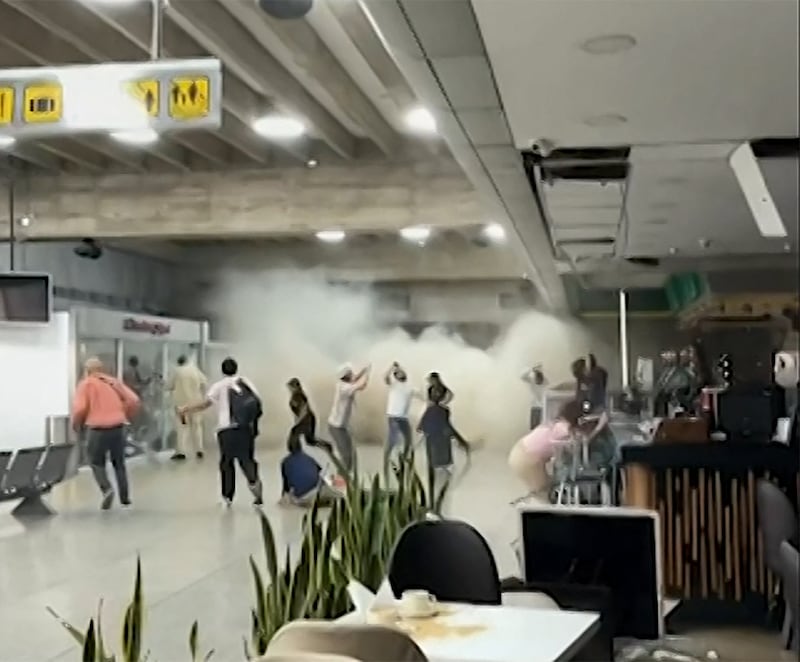
Wilmer Azuaje, a former Venezuelan lawmaker, captured the moment at Maiquetia Airport as the earthquake hit, sending masonry and ⁠clouds of dust falling.

“Everyone, the situation we’re experiencing here is serious. A high-magnitude earthquake. Look at how everything ended ⁠up,” he said while videoing the scene.

A tsunami warning was issued but ​swiftly cancelled after the danger passed.

Residents across Caracas, which was also hit by a deadly magnitude-6.3 earthquake in 1967, rushed to evacuate as buildings shook.

“As soon as it started, we began hearing people screaming,” said Astrid Ramirez (41), apublicist in western Caracas. “Everyone was running down the stairs.”
Maria Romero, an 80-year-old pensioner in southern Caracas, said police helped her get out of her home. “This earthquake was horrible, even worse than the one in 1967,” she said.

Another resident, a 41-year-old office worker who declined to be named, said she received an earthquake alert on her phone just before the shaking intensified.

“As I picked it up and started listening to what it was saying, I first felt light shaking. Then, in less than two seconds, everything started moving.”

Leaders from countries including El Salvador, the Dominican Republic and Brazil offered support and sympathy, while the US state department said it was in touch with Venezuelan authorities and mobilising assistance.

Rodriguez, who has been running the country since the US ousted Maduro, said she has instructed the foreign ministry to co-ordinate the aid offers.

A screen grab from images published on the official Instagram account of Wilmer Azuaje allegedly shows parts of the Simon Bolivar airport collapsing. Photograph: AFP via Getty Images

The US embassy in Caracas said it was closely monitoring the aftermath of the earthquake and urged citizens in the country to seek secure shelter.

Venezuela lies in a seismically active zone where ‌the Caribbean Plate meets the South American Plate.

An estimated 30,000 ⁠people were killed when a powerful earthquake caused widespread destruction in the cities of Merida and Caracas in 1812, according to the USGS.

At Caracas’s Hospital de Clinicas, staff were asked to double up on the night shift to help treat the injured, a worker there said. Classes were cancelled for the rest of the week as authorities began to take stock of the damage.

Venezuela’s oil infrastructure did not immediately appear to be affected by the ‌tremors. Civil protection authorities in Maracaibo, near the large oil hub of Lake Maracaibo, said there were no injuries reported and a worker at the El Palito refinery near Morón – the epicentre of the earthquake – said there had been no damage there.

UK oil firm Shell, which is evaluating developing gasfields in Venezuela, said all its employees ​in the country are accounted for with no injuries.

One source noted that extended loss of power could hit crude output levels until the service is restored. Venezuela’s oil ministry, state-run oil company ​PDVSA and its main foreign partner, Chevron, did not immediately reply to requests for comment. -Reuters

  • Understand world events with Denis Staunton's Global Briefing newsletter

  • Join The Irish Times on WhatsApp and stay up to date

  • Listen to In The News podcast daily for a deep dive on the stories that matter