Main Points
- Two Irish passengers who were onboard hantavirus-hit MV Hondius have landed in Baldonnel after a repatriation flight on the Government jet
- The Irish evacuees will quarantine in a HSE facility on arrival home
- US plan not to keep their citizens in mandatory isolation on their return from ship is criticised by Spanish minister
Key Reads
- Explainer: What next for Irish passengers on board MV Hondius?
- Jennifer O’Connell: If MV Hondius isn’t the start of a hantavirus pandemic, it might prove the end of something else
That concludes today’s live coverage.
Read our full recap of Sunday’s developments.
[ Two Irish passengers from hantavirus-hit cruise ship return homeOpens in new window ]
The two Irish people caught in the hantavirus outbreak are Ann Lane, a former personal assistant to former president Mary Robinson, and her friend.
Lane spoke to Conor Lally earlier this week.
Also this evening, British passengers evacuated from the MV Hondius arrived in the UK after being repatriated from Tenerife.
A chartered Titan Airways flight transported the passengers from the Canary Islands, landing at Manchester Airport.
The 20 British passengers, who were tested for hantavirus before getting on the flight, will be taken to isolate at the UK’s initial Covid quarantine site at Arrowe Park Hospital on the Wirral, Merseyside.
In a post on X, UK foreign secretary Yvette Cooper said: “Thank you to all those who worked around the clock to get passengers from MV Hondius back to the UK by special flight this evening with public health protections in place.
“The UK has worked with Spain, South Africa, the Netherlands and the WHO to co-ordinate safe returns.” – PA
The Government jet has just landed at Baldonnel airfield in Dublin.
Open-source flight data showed the aircraft touching down at the headquarters of the Air Corps just after 9pm.
The final two flights to evacuate passengers from the cruise ship will depart on Monday afternoon, Spain’s health minister said on Sunday evening, adding 94 passengers had been evacuated so far.
One flight from Australia will carry six passengers and another from New Zealand will take 18 passengers, with both flights also taking passengers from other countries which did not send their own repatriation flights, officials have said. – Reuters
What is the guidance of the WHO and ECDC for hantavirus?
The WHO has recommended an isolation period of at least 42 days for those infected with the virus.
People can become infected if they come into contact with rodents carrying the disease, or rodents’ urine, droppings or saliva.
There is only one known strain of the virus, the Andres strain, capable of spreading between humans, though this is rare.
Symptoms can be similar to influenza or Covid and may include:
- headache
- dizziness
- chills
- fever
- myalgia
- nausea
- vomiting
- diarrhoea
- abdominal pain
The ECDC advises that it can take up to two to eight weeks for symptoms to appear.
It also says “the rodent that carries Andes virus is native to South America and not found in Europe, so it is unlikely the virus would spread to local rodents.”
HSE medics travelling on Government jet
The Department of Health has said that HSE medics are accompanying the Irish passengers on-board the Government jet.
“Both passengers will isolate for a period of time in a HSE facility, in line with European Centre for Disease Prevention and Control (ECDC) and the World Health Organisation (WHO) guidance,” the department said in a statement on Sunday evening.
“The return of passengers and crew from MV Hondius has been carefully planned and guided by public health authorities to ensure safety for everyone – these measures protect communities while respecting the dignity and wellbeing of those returning home.”
Hantavirus evacuation is Defence Force jet’s first medical operation
Sunday’s return flight from Ireland to Tenerife is the first medical evacuation operation that the Defence Forces’ recently acquired Dassault Falcon 6X aircraft has taken part in since its delivery late last year.
The Defence Forces said on Sunday evening that the aircraft, which was acquired in December 2025 for €53 million plus VAT, has mostly been used for ministerial transportation to date.
The 6X is a “strategic reach” aircraft with a range of more than 10,000km.

One of five French passengers who were on a cruise ship hit by a hantavirus outbreak showed symptoms during a repatriation flight on Sunday, French prime minister Sebastien Lecornu said on X. – Reuters
The Government jet carrying two Irish citizens who were evacuated from the MV Hondius has left Tenerife en route back to the State.
Open-source flight tracking data showed the aircraft heading north, parallel to the west African coast shortly after 6.10pm Irish time on Sunday.
US passengers to be flown to Nebraska for assessment

The 17 Americans who were onboard are to be flown to Nebraska on a special chartered flight, the US authorities have said. Nebraska is home to the national quarantine unit and the Nebraska bio-containment unit.
Staff from the US Centers for Disease Control and Prevention (CDC) are to interview the passengers and assess their level of risk.
“If they weren’t in close contact with someone who was symptomatic, then we’re going to deem them low risk,” CDC director Jay Bhattacharya told CNN on Sunday.
“If they were in close contact, we’re going to deem them medium or high risk. At that point, we will offer them alternatives,” he said.
These would include “an offer to stay in Nebraska if they like, or if they want, to go back home and [if] their home situation allows it, to safely fly them home without exposing other people on the way,” he said.
Passengers who choose to go back home will be put under the “auspices of their state and local public health agencies, with the CDC support all the way,” he said.
On Saturday, a CDC official told reporters on a call: “We are not quarantining anybody,” according to ABC, adding that: “It is not recommended to test people that do not have symptoms.”
It is reported the UK will also offer their nationals the option of self-isolating if they are believed to be healthy after a 72 hour period of quarantine.
Sunday evening recap
An Irish Air Corps jet stands on the tarmac at Tenerife Sur-Reina Sofia airport on Sunday.

British passengers from the Hondius have been evacuated from the vessel, as they prepare to be flown home to isolate at the UK’s initial Covid quarantine site.
A chartered Titan Airways flight was scheduled to evacuate the British citizens on Sunday afternoon, with the plane’s passengers then to be taken from Manchester Airport to isolate at the UK’s initial Covid quarantine site.
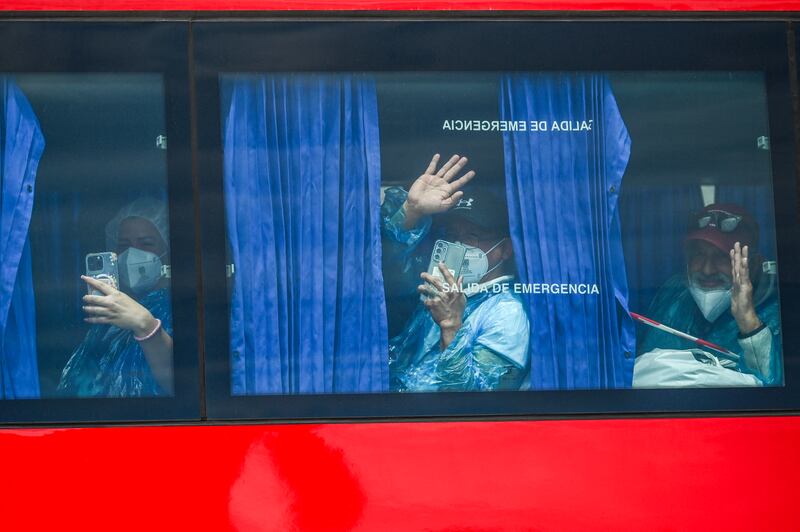
While they were being bussed from the port to Tenerife South Airport, some passengers waved and gave thumbs up while clad in blue PPE as they passed watching media.
Some 22 British nationals were taken to shore – with 20 to get on the repatriation flight and two dual-nationals to head elsewhere. – PA
Spanish and Canadians passengers are now off ship, says Spanish ministry
Translation: 23 passengers from Spain, France, and Canada have already disembarked from the MV Hondius. This is how the evacuation of the 14 Spaniards looked, seen from the @guardiacivil drone.
HSE will do whatever is required to look after Irish passengers, says Minister for Justice

Asked about today’s events in Tenerife and the expected repatriation of the Irish passengers, Jim O’Callaghan said “the Minister for Health and the HSE are keeping a very close eye and respect to this”.
“It’s very important that we follow whatever the expert medical advice is in respect of this. I must say I’m comforted by the fact that all the experts indicate that this is not a pandemic on the same way that Covid-19 was a pandemic.
“And I know that Jennifer Carroll MacNeil, and indeed, the HSE will be putting in place, whatever is necessary to ensure that we get the Irish people back to Ireland in the safest way possible.
“Obviously when they arrive back here, it’s essential that they isolate for a lengthy period of time.”
Irish passengers said to be ‘safe and well’ ahead of planned transfer

Minister for Public Expenditure Jack Chambers has said the two Irish passengers on-board the MV Hondius are “safe and well” ahead of their expected return to Ireland later today.
“They are due into Ireland later this evening,” he told RTÉ’s This Week programme on Sunday afternoon “and they’ll be isolated and in quarantine for about five weeks”.
“I understand they are safe and well but will be following strict protocols when they return to Ireland to protect broader public health.”
Irish passengers expected to leave ship this afternoon

The two Irish passengers on-board the MV Hondius are expected to leave the ship this afternoon before returning home on the Government jet.
It is expected they will be taken to a HSE facility for further tests and quarantine.
The process of taking passengers of the ship has been ongoing for several hours now with those from Spain first to depart. French, British, Dutch and Canadian citizens were to be among the next groups moved with those from Ireland, Turkey and the United States after that.
Asked earlier about the suggestion that the United States will not keep their citizens in mandatory isolation during the recommended six week quarantine period but will rather allow them to self-isolate at home once they have been assessed, Spanish secretary of state for health Javier Padilla said that while there was a certain amount of co-ordination between countries, each government was free to take what measures it felt appropriate.
“I don’t think it’s best practice from a clinical point of view,” he said, however.
More than 300 personnel involved in evacuation, says Guardia Civil
Translation: The Civil Guard has participated in the transfer of the occupants of the MV HONDIUS from the port of Granadilla de Abona to Tenerife South Airport. The operation has involved more than 300 personnel, including air resources, several vessels from the maritime service, NRBQ specialists, GRS, and citizen security units #Hondius
Evacuation going to plan, says minister

The Spanish minister for health, Mónica García, has said the evacuation of the MV Hondius is going to plan and in accordance with a rehearsal previously run.
She said all of the passengers of have been found to be asymptomatic, but will be tested again. After the Spanish passengers are taken to a hospital to Madrid the plan is that they will be retested in seven days.
There will be five French nationals on the flight to France with 14 Britons, four Canadians and 26 Dutch internationals as well as the two Irish, all among those to be evacuated to their respective countries over the coming hours.
“We are meeting expectations,” said García. “We can be proud of what we are doing here. We are delivering.”
The ship, meanwhile, is to be refuelled tomorrow morning before proceeding to the Netherlands with the remaining crew of about 30 on-board.
At the same quayside press conference Dr Tedros Adhanom Ghebreyesus, director general of the World Health Organisation said again that there is no need for wider public alarm.
“This is not another Covid,” he said. “The risk to the public is very low and they should not be scared, they shouldn’t panic.”
First plane carrying Hondius passengers set to depart Tenerife

The Spanish passengers have been boarding the plane that will take them to Madrid.
The airport is just two miles away from the port with little potential for traffic disruption along the way, it is said.
The French passengers on-board are due to be next to leave.
Spanish passengers first to be taken from ship to airport
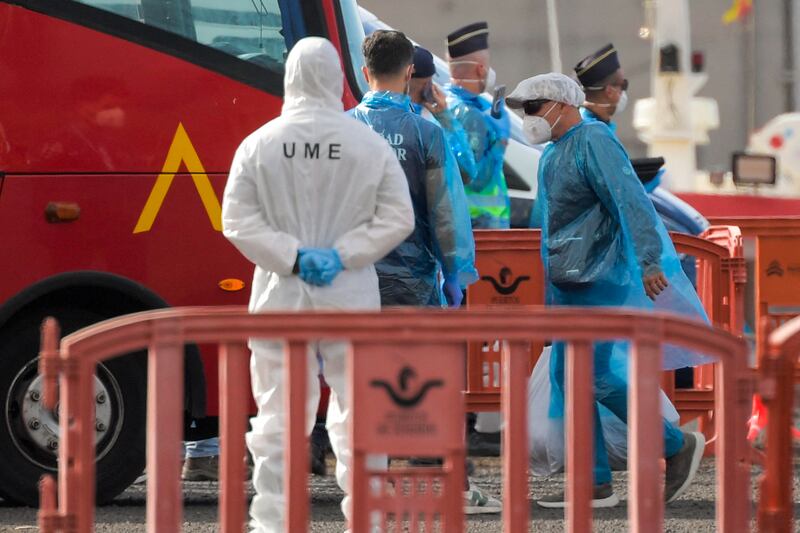
Spanish passengers have been making their way off the MV Hondius in blue plastic ponchos, helped by medical teams in hazmat suits.
They were taken from the ship to the dock in a small boat and then straight on to a coach destined for the airport only a couple of miles away.
All of the Spaniards are to be flown to Madrid where they are due to arrive in midafternoon after which they will be taken for isolation and, where required treatment.
Ship sits in solitude
The Spanish Civil Guard have posted video on X of the MV Hondius in the port of Granadilla.
Planned monitoring essential to control outbreak but further spread highly unlikely, says public health expert
The lengthy period of close monitoring planned for passengers after they leave the ship for repatriation is absolutely essential, Daniel López Acuña, adjunct professor of the Andalusian School of Public Health and a former Senior Official of the World Health Organisation told the BBC World Service on Sunday morning.
“It is essential to the epidemiologic control of this outbreak to ensure proper quarantine over a period of up to six weeks of the people on the ship,” he said.
“They may not have any symptoms right now, but they may develop the disease because of this long period of time, they may have been in contact with some of the people, the eight people so far that have been affected and have died or are hospitalised or are in very critical condition. Let’s remember that this particular strain produces a disease has a case fatality rate of between 30 to 40 per cent.”
He said that while transmission between people is possible it would almost certainly require persistent close or intimate contact and accident transmission from this point would was not expected given the precautions being taken.
Disembarkation begins
A first group of passengers, all Spanish nationals, has begun to disembark into a small boat from the cruise ship which was hit by a hantavirus outbreak and is headed to Tenerife’s Port of Granadilla, Spain’s health ministry said.
The passengers will be transported directly from the port in military buses to the airport and evacuated by a Spanish government plane to Madrid where they will taken to hospital and quarantined, officials have said. – Reuters
Isolation
While nobody on-board the vessel has symptoms, passengers and crew have been confined to their cabins in the last few days to help halt the spread of the virus, which is only transmitted through very close contact. They will each be screened for hantavirus, which can cause flu-like symptoms leading to respiratory arrest and death, in some cases.
They are being asked to isolate for 42 days from their point of potential exposure, which for most of the passengers will be many days ago.
Authorities have sought to make clear that the virus, though serious, would not result in another pandemic.
However, the director general of the WHO, Dr Tedros Adhanom Ghebreyesus, was asked at a press conference in Tenerife late on Saturday night whether allowing passengers to travel all over the world and relying on them to self-isolate with no oversight could cause further outbreaks. “Based on our assessment, what you have said is not going to happen,” he told the media. – The Guardian
British plan
A specialist British army team and medical personnel have been parachuted on to the British overseas territory of Tristan da Cunha with medical aid and equipment after a British national who lives on the South Atlantic island disembarked with a suspected case of hantavirus.
Six paratroopers, a Royal Air Force consultant and an army nurse parachuted, while oxygen supplies and medical aid were dropped on to the remote island, which is normally only accessible by boat.
The British ministry for defence said it was the first time medical personnel had been parachuted in to provide humanitarian support.
Remaining UK passengers who are evacuated from Tenerife will be taken on a charter flight to Arrowe Park Hospital on the Wirral, a peninsula near Liverpool. The facility is relatively isolated and was used as the UK’s first Covid quarantine site. – PA
Order of operations
Countries including Belgium, France, Germany, Ireland, the US, UK and the Netherlands confirmed on Saturday they had sent planes to evacuate their citizens aboard, though local government officials in the Canaries said not all planes had arrived by Sunday morning.
Passengers will not leave the boat until their allocated evacuation plane has arrived, Spanish officials said.
Passengers from the Netherlands will be the next group to leave the vessel, and their plane will also transport passengers from Germany, Belgium and Greece, Spanish Health Minister Monica Garcia said on Sunday.
After that, passengers from Turkey, France, the UK and US will be evacuated, the minister added, speaking to reporters at the port of Tenerife.
“The final flight of the operation is departing from Australia ... It is the most complex flight and is scheduled to arrive tomorrow afternoon,” Garcia said, adding that the final flight would pick up six people from Australia, New Zealand and Asian countries.
Ireland was not mentioned specifically by Garcia.
Thirty crew members will remain on board and sail to the Netherlands where the ship will be disinfected. – Reuters
Department of Health statement
Here’s the full Department of Health statement:
“The situation with regard to the MV Hondius is evolving and is being monitored closely by the Department of Health (DoH) and the National Health Protection Office (NHPO) in the Health Service Executive (HSE), working with international partners including the European Commission, European Centre for Disease Prevention and Control (ECDC) and the World Health Organisation (WHO), EU Member States and also our colleagues in Northern Ireland.
“We understand that the cruise ship MV Hondius is currently expected to dock in Tenerife early on Sunday 10th May. We understand that the two Irish passengers are currently well. Public health protocols will be followed once the ship has docked with regard to certification and assessment of the health of passengers. This will be overseen by the ECDC and the Spanish authorities.
“Repatriation plans have been put in place by the Irish Government to transfer the two Irish passengers directly from Tenerife to Ireland upon disembarkation, contingent on their health status. On arrival in Ireland, they will be safely transferred to a HSE facility. They will need to quarantine for a period of time, in line with ECDC guidance and will be actively monitored during this time. If they become symptomatic, they will be assessed and treated as appropriate.
“The EU’s Emergency Response Coordination Centre has arranged for a Medevac aircraft to be available in Tenerife for any passenger that becomes symptomatic and needs medical evacuation. In the event that one or both of the Irish passengers becomes symptomatic before disembarkation, they will be medically evacuated on this aircraft.
“Both the ECDC and WHO have classified the corresponding risk to public health from Hantavirus at the lowest level provided for within their respective assessment frameworks.
“The National Incident Management Team of the NHPO has been stood up and is co-ordinating the public health response to ensure optimal patient care and safety for those affected by this Hantavirus outbreak, and to protect broader public health.
“DoH is working closely with colleagues across Government and in the HSE and our European partners to ensure the safe repatriation of the Irish passengers, critical care pathway and adherence to ECDC guidelines.”
How it works for the Irish passengers
The Spanish authorities said yesterday that Ireland was among the countries sending a plane to evacuate its own citizens.
We asked the Department of Health yesterday evening for an update on how things would world.
In short, the Irish passengers of the MV Hondius will first face public health protocols and then will be returned to Ireland, by a specialist European Medevac plane if they have become symptomatic.
When they get back to Ireland, they will be taken to a HSE facility to quarantine for a period.
Evacuation begins
Spain has begun the evacuation process of passengers from the hantavirus-hit cruise ship anchored near Tenerife on Sunday with health officials boarding the boat to conduct a final check and begin disembarking passengers, Spain’s health ministry said.
The first group of passengers, who are Spanish nationals, will be taken back to shore on small boats and immediately transferred into sealed buses to the local airport where they will fly back to Madrid on a Spanish government plane, government officials said, emphasising they will have no contact with members of the public. – Reuters


