

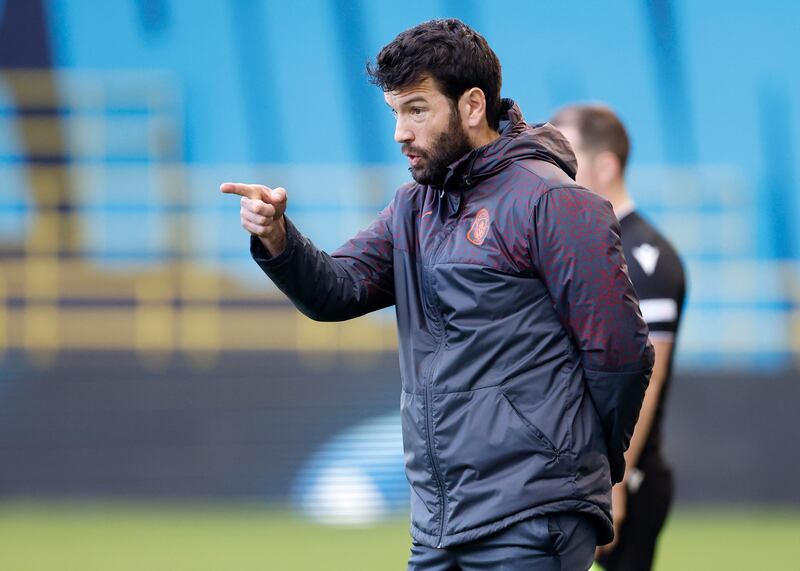
Brian Barry-Murphy is a bundle of twitching energy and he is chiefly excited about Jack Moylan, whom Cardiff City signed a day earlier.
He raves about him in a familiar manner until he says something I don’t often hear from enthusiastic managers. “His story is important.”
Moylan’s story is rejection at Bohemians before he salvaged his career under Damien Duff at Shelbourne, from where he went to England to fire Lincoln to a 103-point promotion season in League One. He was then capped at senior level for Ireland.
In this Barry-Murphy sees resilience and the right type of character to fit into a Cardiff dressingroom brimming with untested potential.
RM Block


The importance of Brian’s own story unspools across our conversation in a hotel adjoining Cardiff’s training base.
He is preparing for the club’s return to the Championship, having been promoted with the second-youngest squad in League One.
But he is the Son of the Father and he has already seen up close the benefits of trusting youth. Brian was playing football with Cork City when Jimmy was managing the Cork hurlers. These were the revolution years and Cork were among the deposed aristocrats, so after three-straight truncated summers, Jimmy threw in six debutants and nine players under the age of 22 to the Munster semi-final against Waterford in 1999. They won and went on to win a first All-Ireland title in nine years.
“I picked up a lot from him without realising it,” says Brian. “There was a lot of talk about the manager-player relationship being cold, but I saw the opposite. He was always someone who the players could speak with and share ideas.”

Brian has taken the same principle into football management. He doesn’t want his players calling him gaffer and he is a true coach: he is wearing a tracksuit and when he sat down he put a stopwatch on the table. It isn’t running.
His daily demand is that each of his players is “obsessed” with improving, the means of which are explained in an unwritten covenant.
“Our work with the players is about stripping the game back to its purest form,” he says. “What are the simple things we have to improve to make sure everyone is improving?
“Say if a player wants to improve your number of goals, we show him how and we commit to that individual training plan,” he says. “So there is a big investment from us to him. We hope he sees the value in that, and then there are certain things he has to do for us as a team. You can’t have one without the other.”
This means of working leaves no room for equivocation on anybody’s side, including his. “If you don’t back up your actions or live by the words you say, then the relationship is finished,” he says.
The most challenging part of maintaining this co-operative style of management is the fact that only 11 players can start the next game, so somebody has to be disappointed. A coach spoke at a recent FA course he attended about having a kind of formula to explain team selections, but Barry-Murphy would struggle to reconcile this with the meaningful relationships he wants to cultivate with players. He adds this is a process made more difficult by an Irish Catholic education.
“The hardest decision is always who plays and who doesn’t play, and those decisions affect players really hard,” he says. “Coming from where we come from, we feel emotion, or guilt. It’s in our upbringing, isn’t it? When you disappoint people or can’t quite give people what they want, it’s harder for us than most nationalities.”
We talk a little more about guilt. He says he carries some from his playing career but only identified it years later, because he wasn’t there for his three younger sisters when he left Cork at the age of 20 to play in England.
It was later in life he realised he subconsciously drifted to play football because there was less pressure in a sport in which he wasn’t instantly identified as Jimmy’s son. In football and in England, he could go under the radar even if, as he says today, he loved GAA more than football at the time. Not only was his father Cork’s greatest GAA icon since Christy Ring, but his maternal grandfather, Mick Kenefick, won two All-Ireland hurling titles with Cork in 1942 and 1943, the second as captain.
“Maybe if I thought about it more and understood the responsibility I would have stayed and played GAA,” he says.
I ask him whether he left out of any sense of fear of failure, and whether it was perversely easier to swim in English football’s deep waters than be seen to have tried and not succeeded in living up to the Barry-Murphy name in Ireland.
“I couldn’t say that, I’d just be saying it for the sake of it,” he says. “I remember thinking, I can play this sport and go and earn a living and it was just something I wanted to do.”
A fear of failure did take root during his playing career in England. He joined David Moyes’s Preston and they instantly came to the precipice of the Premier League, losing the playoff final in Cardiff. Things were never as good again. He signed for Sheffield Wednesday and learned that professional football is more often about survival than expression. The club were cycling through managers, marooned at the bottom of the second tier and booed by their fans every week.
“I would sit in the dressingroom before games with a friend of mine, Michael Reddy from Thomastown, and we’d speak about the pressure we were under. It was just about getting to the end of the game. I saw then the negative cycle of pressure on performance. We never played properly. It was, ‘Let’s just get through this, okay, phew, another week over’.”
When he was released by Sheffield Wednesday, he was confronted by a classical theme of the Irish emigrant experience. Do I stick it out over here or do I risk going home and being deemed a failure? He quotes a line from a Christy Moore song, Missing You, written by Cork man Jimmy MacCarthy.
“‘And I’ll never go home now because of the shame/Of a misfit’s reflection in a shop window pane.’
“I had a choice, do I go back and play in the League of Ireland, or do I stay here and become a journeyman player?”
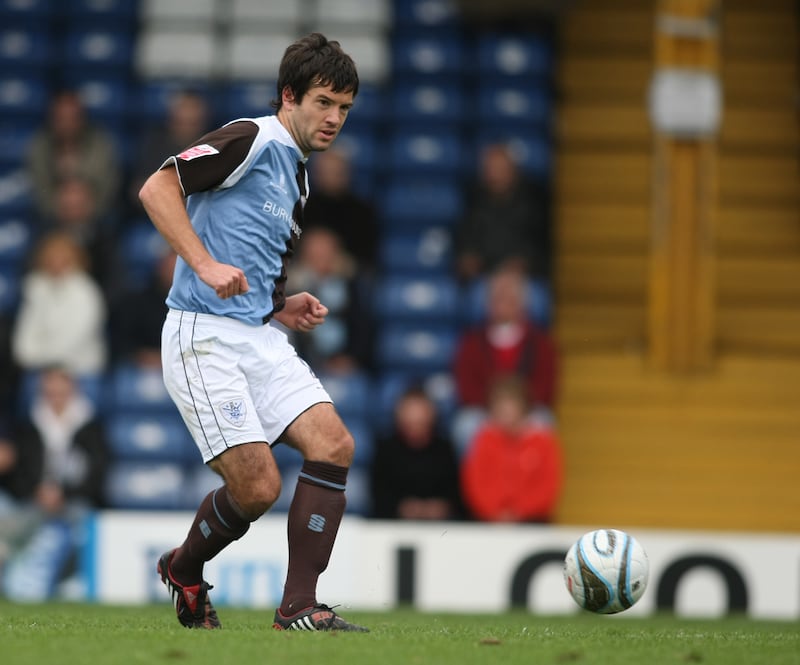
He stayed in England, playing with Bury and then Rochdale, where he finally learned the virtue of imperviousness to the opinions of others.
“I was able to play the best football of my career at the end. Which is a shame, really. In the reserve team I played centre back, and I would take the ball from the goalkeeper and build from the back in a manner that was perceived as risky, but I just didn’t care. Ironically, when I was taking the most perceived risk I never made a mistake, because my mind was free.”
He wished he had these lessons when he was young, so the opportunity to pass them on to the next generation fed his interest in coaching. He joined Rochdale’s staff and was then parachuted in as manager, from where he made a surprise move to Manchester City’s academy, succeeding Enzo Maresca and coaching ethereal talents like Cole Palmer and Morgan Rogers.
There entered the second ‘He’ of his story. Barry-Murphy apologises at one point for name-dropping and says there was a period last season when he resolved to stop talking about him. But really, when you have had three years’ worth of daily access to Pep Guardiola, it would be indecent to resist the influence.
“One thing I’ve logged in my journal: you always want to please him. Whatever way he puts you under his spell. My job was to supply academy players for training and help with the training idea every day, but you want to make it the most perfect thing ever so that he is pleased; that he will bring this thing together and at the end of it you feel you’ve contributed.
“We won the treble. I say we: Man City won the treble, the part I played in that was really minimal. But at the time I felt as if I felt so involved in the preparation for the [Champions League] final. I saw everything, he was telling me the detail of the training and telling me, ‘This is what it has to look like’ and if there was a day it wasn’t perfect or how he wanted it, you felt you had let him down and you were going home not thinking of anything else.”
Barry-Murphy often refers to Guardiola simply as “him” and at one point delightfully calls him “the big fella”.

Guardiola’s chief allergy in life is complacency – Barry-Murphy says Guardiola believes the human tendency is to relax – and he is a man of extreme consistency: his final training session of a season looks very similar to the first session of the following preseason.
Just don’t mistake consistency for inflexibility. Contrary to perception, Barry-Murphy learned at City that possession is not the whole of the law. Having never worked with attackers of the calibre of Palmer and Rogers before, he realised they demanded the ball much more quickly and had little truck with team-mates circulating the ball for the sake of control.
“When I was a younger coach, I would have been very defensive in these interviews about our way of working and our way of playing,” he says. “But Guardiola would say, ‘Why do you spend so much time talking about the way that you work or the way that you play when you lose games? Nobody cares, you’re wasting your time’.”
Cardiff had the highest average share of possession in League One last season but his players are empowered to play quick, direct passes to attackers when it’s the right option. Plus, says Barry-Murphy, he knows Cardiff fans don’t want to watch slow-paced build-up, and his job is to give them a team they are excited to see.
I’ve come to realise that everything about how Barry-Murphy works at Cardiff – the dynamic with his players, the details of the coaching, the ambition of the style – is a response to his understanding of what shaped him. He has raked through his life and found in coaching a means of expressing its lessons.
“Our experiences bring us to where we are today and you hope the players can feel the same thing,” he says.
“I speak to [Ronan] O’Gara a lot about this. In Ireland in the 1980s, 1990s, it was very difficult to see a future that hadn’t been done yet. There were no rugby coaches who had gone to Racing or to the Crusaders in Christchurch. We always talked about – not proving people wrong – but that there were things to be done; [fulfilling] dreams is a bit cringey, but of daring to do what hadn’t been done before.”
Then he laughs and tells his Welsh press officer that he’s painting bleak landscapes about an Irish childhood.
When I ask Barry-Murphy whether one of those things he would like to do is to manage Ireland, he insists he hasn’t thought about it. Instead he imparts one last lesson from Guardiola.
“If we were playing a minor team in the Carabao Cup, he would go into more detail than he would for a Champions League quarter-final against Madrid because, I think anyway, firstly he wanted to be clear in his own mind that he did the work, so he could tell himself he hadn’t been complacent.
“Secondly, he wanted the players to know that the fulfilling thing in life and sport is to give it everything you have. That we all do this work step-by-step and then if we reach whatever, great, but if we don’t then we can get up the following morning and do it all again. One day at a time. I love that feeling as it is so easy to get distracted in football, and in life.”


