The opening rounds of the United Rugby Championship campaign see Leinster visit two of South African rugby’s most celebrated grounds with less than glorious new names.
Ellis Park, the venue for last weekend’s defeat to the Lions, was the site of the 1995 World Cup final, Nelson Mandela famously sporting a Springboks jersey when presenting the Webb Ellis Cup to his compatriot Francois Pienaar. Round two brings the province to Kings Park, a ground forever etched into Irish rugby lore by Ciarán Frawley’s match-winning drop-goal back in 2024.
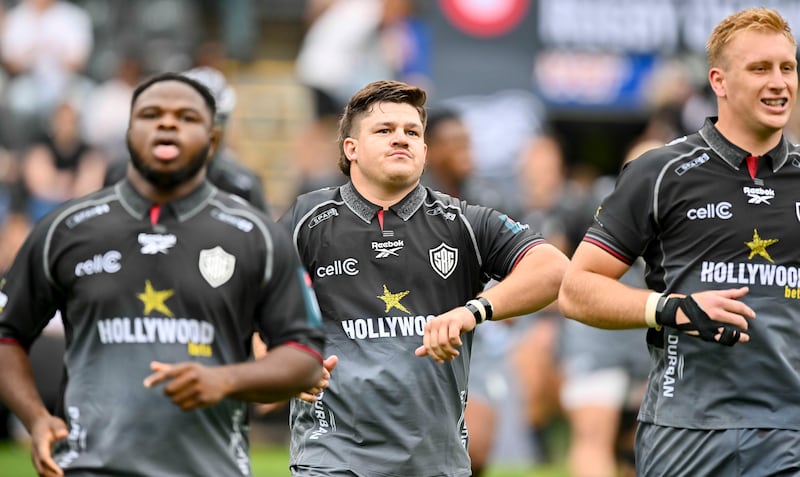
Technically speaking, these names are no longer the correct nomenclature. Since 2023, the Durban venue has been known as Hollywoodbets Kings Park thanks to an agreement with a betting company that extends to naming the team the Hollywoodbets Sharks. Similarly, as of a deal announced in July, the team that beat Leinster last weekend is called the 10Bet Lions. They play their home games at 10Bet Ellis Park.
Although team-naming rights partnerships are not new (Leinster beat the Fidelity SecureDrive Lions in last season’s URC knockouts), such gambling-themed franchise titles are “unprecedented in the world of sport”, according to Darragh McGee, an academic researcher in the field of gambling sponsorship.
RM Block


Betting partnerships themselves are also no novel phenomenon. Even if Premier League football clubs have agreed to ditch betting companies from the front of their shirts, the league is awash with jersey sleeves and pitchside hoarding featuring gambling partners. Staying in the UK, multiple county cricket teams have partnerships with Dafabet, an Asian bookmaker. Across the pond, all four major sports leagues – the NFL, NBA, NHL and MLB – have official betting partners. Add to that list a host of individual North American franchises.
By contrast, gambling sponsorship within rugby has been conspicuous by its absence. These South African examples stand out simply by having any sort of relationship with betting operators. In Europe, professional rugby union has largely avoided such partnerships – with a handful of exceptions.

The Ospreys sport Quinnbet on their playing shorts. In 2018, Leicester Tigers announced a similar arrangement with LeoVegas lasting two years. In France, Toulouse have a partnership with OlyBet, while both Ligue Nationale de Rugby (Top 14 and ProD2 organisers) and the Federation of French Rugby have signed deals with Betclic.
Compared with other sports, these examples are limited. At domestic level, rugby has well-known money problems. In the UK, multiple clubs have disappeared under financial pressure, in theory creating a scenario where cash-strapped organisations are prime candidates to hold their noses and take whatever deals they can get. When sports with a larger share of the viewing market are taking on gambling companies as sponsors, the obvious question is why not rugby?
The answer depends on the appetite of both sides, the sponsor and the team accepting the cash. In Irish rugby, there is next to no desire to be seen partnering with the betting industry.
Provinces and the IRFU alike get approaches from companies but they are quickly rebuffed.
Ulster, for instance, recently changed their shirt and stadium sponsor. The club is understood to be comfortable partnering with healthcare company Affidea for multiple reasons, among them avoiding negative attention after receiving criticism for their relationship with Kingspan (in 2024, a report on the Grenfell fire found that the Irish building materials company “knowingly created a false market” for its insulation that was used in the tower. Kingspan expressed their sympathy to families of the victims, acknowledged “wholly unacceptable historical failings” and said their product was not the principle reason for the fire spreading).
“It’s been a set trend over the years from generation to generation that gambling is just not right for Irish sport,” says Colm Roche, a strategic sponsorship consultant. “It comes down to the market and the fans themselves, if gambling is accepted.
“If you look at Ireland as a sporting nation, sport is built from the community up, steeped in culture, history, from kids to clubs to schools to international level. From a betting brand perspective, it would have a negative effect on that pathway and be seen as a step backwards. Irish rugby in particular has always stayed away for that reason.”
[ Generation gamble: the invisible addiction crisis gripping Ireland’s teenagersOpens in new window ]
Rugby is not alone within Ireland. In 2018, the GAA introduced a blanket ban on sponsorship from gambling companies. The FAI opted not to pursue gambling partners, albeit this does not apply to League of Ireland clubs. Shamrock Rovers sport NetBet on their jersey sleeves as the club’s responsible gaming partner.
On the flip side, how keen are the gambling companies?
Many operators question the viability of rugby itself. The sport lacks cultural relevance in the two biggest markets targeted by bookmakers, Asia and the US. The white-label companies – lacking a local presence and mostly targeting Asian bettors – that sponsor Premier League clubs are unlikely to be keen on rugby considering the sports their target audience consumes. Rugby doesn’t have the numbers.
According to McGee, assistant professor at the University of Bath and author of Imitation Games: How Gambling Hijacked Sport, rugby punters are less likely to be profitable customers than fans of other sports. Although rugby has worked hard to break out of its private-school stereotype, education and class are nonetheless factors in all this.
[ Imitation Games by Darragh McGee: Football in the grip of a gambling addictionOpens in new window ]
“With education comes a degree of critical consciousness about the traps that lay in wait for all of us,” McGee says. “Economic literacy allows people to see through gambling and its extractive mechanisms.
“Gambling firms will have analysed and profiled this very carefully and decided that the rugby market is small. If they thought it was profitable, they’d be there.”
One gambling industry figure pointed to the lack of time spent on their rugby product compared with other sports. “The reason some sports are big gambling sports is they’re on all the time,” they sayyid. “Look at darts, table tennis, esports. There isn’t as much televised or organised rugby.”
As a result, most websites don’t offer significant in-play markets on rugby matches. You’d struggle to place a bet on the number of rucks hit by James Ryan in a single match, whereas you can wager on the number of corners in a Premier League contest. “In-play is much more immersive, impulsive and profitable,” says McGee. “In-play is designed to eventually move fans into the online casinos which are the most profitable, addictive and harmful.”
Another wrinkle is the impending laws regarding gambling sponsorship within Ireland. In 2024, the Gambling Regulation Act was signed into law. Section 159 of the act makes it clear that any company licensed by the Gambling Regulatory Authority of Ireland (GRAI) cannot sponsor a team where children are members or a public activity that appeals to children.
Professional sport, almost by definition, is a public activity appealing in large parts to children. There is an argument that, by buying season tickets, children can become members of the teams they follow.
The GRAI has made clear, however, it cannot police events hosted overseas but broadcast within Ireland, for instance this weekend’s Leinster clash with an opposition that is a walking gambling ad.
Even within the State there are limitations. The advertising and sponsorship provisions in the Gambling Regulation Act have not yet come into effect. The GRAI has said that, once they do, the relevant obligations “will only apply to gambling operators who are licensed by the GRAI”. In other words, if a betting company does not provide activities to punters in Ireland, they do not require a GRAI license and these rules do not apply.
According to the GRAI licence register, Hollywoodbets is not a licensee in Ireland. However, the parent company of 10Bet, Blue Star Planet Limited, is. Once the advertising rules come into effect, this leaves open the scenario where one current South African team, which of course will play in Ireland, has a sponsor that falls under GRAI rules while the other does not. Quinnbett, the Ospreys’ shorts sponsor, is also licensed by the GRAI. Without confirming which operators would or would not fall foul of the regulations, the GRAI said that “any potential breach will arise for consideration after section 159 has been commenced and on a case-by-case basis.”
Within Ireland, as with everywhere else, the main factor in all of this is money. At the provincial domestic level, Irish rugby pulls in more revenue than other comparable professional sports. Attendances and television viewing figures are higher, leading to better sponsorship and broadcast deals. This puts rugby in a financial position to say no when betting overtures come.
There is a sense within Irish rugby that any gambling offers have not brought sufficient value to offset the reputational damage within the respective fanbases. In theory, that stance could be tested by a bigger chequebook.
“What if gambling companies do want to make a serious play, and the money is just so much better than what is there now, giving the chance to improve our team significantly?” asks one rugby marketing figure.
As things stand, that question does not appear to have been seriously asked. Leinster won’t be playing at the PaddyPower arena anytime soon.
[ Increasing irrelevance of betting shops a growing problem for racing’s financesOpens in new window ]
However, examples from further afield show that, due to a range of factors, it doesn’t take a great deal for self-congratulatory exceptionalism to succumb to the reality of the bank balance.