

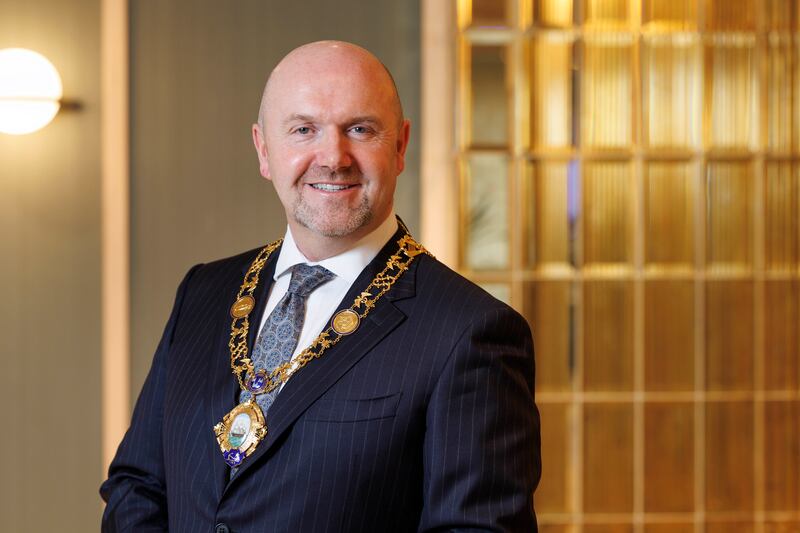
Ireland needs to translate its infrastructure ambitions into action, and quickly, according to Dublin Chamber president David Kelly. “I speak plainly and I call it as I see it,” he says. “The population of the Greater Dublin Area is set to grow by 25 per cent by 2042. That’s less than two decades away and the idea that we can survive with the congestion we have today in that environment is absurd. We can’t build houses today because we haven’t got water and electricity for them. It’s just not acceptable.”
This will be a core theme for his presidency in the year ahead, he continues. “It’s all about delivery. The time for talking is over.”
While energy infrastructure and security are close to his heart in his role as chief executive of Gas Networks Ireland, he says the issue is much broader than that. “It’s about water, airports that aren’t capped, major transport projects like MetroLink and much more, and that we get out of our own way to deliver them.”
All of this must be viewed through a competitiveness lens. “We need to be aware of the danger of complacency. There’s a real risk that we’re basking in the success that we’ve had since the 1950s with our industrial policy. But we heard what Mark Carney had to say at Davos about the rupture in the global system. We’re now competing against places that we’d never thought we’d be competing against. We’re competing against rural locations in the US that Donald Trump is promoting as a destination for manufacturing.
RM Block


“If we don’t deliver on infrastructure, we will see companies leaving Ireland,” he says. “We’ve already seen data centre projects that were set to come to Ireland going to places like Milan, Madrid, Santander and other locations that are very keen to have the business. We’re genuinely very lucky to have such buoyant tech and the pharma sectors but, especially with the way the world is changing due to AI, a lot of that ecosystem and the jobs in it could be at risk if we don’t do the right thing and build the infrastructure to support it.”
The establishment of the Accelerating Infrastructure Task Force was a very welcome development. “It focused on things that the Chamber certainly will be very supportive of,” he says. “It’s about simplifying regulation. It’s about the speed of decision. It’s about making the judicial system fit for purpose from the point of view of pace.”
He notes that Taoiseach Micheál Martin referred to the challenges presented by judicial reviews in his speech to the Chamber AGM in February. “Frankly, it’s very easy to stop a project. But we live in a democracy. If there is a problem with a project, people should absolutely be able to call it out. Unfortunately, nimbyism is alive and well. But the greater good should prevail.
“Let’s be honest, nobody wants an airport on their doorstep, and nobody wants a wastewater treatment plant on their doorstep either. But we need to acknowledge the fact that these are the unfortunate realities of a modern economy. We have got to build plant, whether it’s drinking water, wastewater, electricity pylons, airport capacity, road infrastructure, public transport in the form of rail. These are all necessary requirements for a modern economy.”
There are signs of progress, however. He considers the results of the recent legal challenge by residents of Dublin’s Dartmouth Square to be “quite telling”.
“The way that was managed was a testament to the effectiveness of the MetroLink team. They sat down, they mediated and they got a deal and the project is moving on to a new phase.”
That came at a price, but one Kelly believes was well worth paying. “At the end of the day, we’re taxpayers and we don’t want our hard-earned money being spent on the wrong thing. But when you think about the cost of a delay to a project like this, it would cost a heck of a lot more than this solution did.”
He points to the Greater Dublin drainage project as another example of progress. “The Ringsend wastewater treatment plant is absolutely maxed, and North Dublin has needed a second sewage plant for well over a decade. Again, mediation took place and a solution was found to allow the project to move on.”
Of course, there are naysayers who contend that major projects like MetroLink are not needed. “I don’t accept their arguments. We were told we didn’t need the port tunnel because certain heavy goods vehicles can’t go through it. We were told we don’t need a tram system because we have buses. We were told that Terminal 2 would be a white elephant and nobody would use it – look at it now, it’s maxed. Frankly, I’m tired of those arguments. We need to realise that we’re a capital city, we have a region that’s going to grow like Billy O, thank God. And thank God we have an economy that’s flourishing with jobs being created. But if we don’t get this stuff built, that’s all at risk.”
That makes the Accelerating Infrastructure Task Force all the more important. “It is an absolutely critical initiative. And Jack Chambers’ sponsorship of it and the Government’s sponsorship of it are very welcome.”
He also welcomes the increased emphasis being placed on energy security by the Government. “It was very good to see Helen McEntee launch the maritime security initiative with the UK and with France to protect both subsea cables and subsea gas infrastructure; 50 per cent of our electricity comes from gas and we are critically dependent on that subsea infrastructure.”
Another aspect of competitiveness that requires attention is access to finance for enterprise. “This is particularly important for home-grown enterprises. Many Irish start-ups and scaling firms continue to struggle to secure the private investment they need due to the limited incentives for entrepreneurs and risk takers which result in essential capital being diverted elsewhere.”
He welcomes the Taoiseach’s expressed willingness to revisit the capital gains tax (CGT) rate. “Dublin Chamber has for a long time advocated for a more competitive CGT regime – one that rewards entrepreneurial risk and encourages early-stage investment. If Ireland is serious about building a stronger, more self-sustaining indigenous enterprise base, then improving incentives for investment and risk-taking must be a central priority.”
Looking ahead to Ireland’s forthcoming presidency of the Council of the European Union he says it presents an opportunity to take a leadership position on competitiveness. “We’re the only English-speaking country left in the EU and it’s a real opportunity for us to demonstrate that we are that bridging country between Berlin and Boston. That old narrative is very valid. American companies employ 245,000 jobs in Ireland while our membership of the European Union is absolutely core to our economy. We are very proud Europeans, and I think this is a real opportunity for us to set out our stall as brilliant bridge builders. The Taoiseach’s trip to the Oval Office demonstrated the access we still have and how Irish America is still on this president’s mind.”
It also provides an opportunity to showcase Ireland’s other strengths. “It can be our shopfront to the rest of the world. But I won’t lie to you. I am apprehensive about that number of heads of state in our little capital city and all the challenges with infrastructure that we have day-to-day. They’re going to have to lock down the core of the city at times. That won’t be easy for business owners and for people that commute to work in the city centre, but the sacrifice will be worth it.”
He says Dublin Chamber and its members will continue to advocate for delivery and “act as a constructive partner to Government, holding it to account to deliver for a better Dublin and Ireland. The Chamber has never been in better health and Mary Rose Burke and her team do a brilliant job on advocating for the Greater Dublin Area’s business agenda. I am looking forward to an exciting year ahead. We will continue to push for competitiveness and delivery – not in theory, but in practice. Because the future of Dublin, and Ireland, will not be decided by what we say we intend to do. It will be decided by what we actually build.”


