

Following a mixed reaction to the Leaving Certificate maths paper one on Friday, students this morning resumed their exams with the second maths paper at 9.30am. Irish paper one followed this afternoon, beginning at 2pm.
Key reads
- Leaving Cert: ‘It requires a lot of mental energy to sit a full exam paper’
- Last-minute advice ahead of the Irish exams
- 10 tips for parents supporting an exam student this month
- Sign up for our Classroom to College newsletter
That’s it for our live coverage today, we will be back tomorrow morning for Irish paper two and biology in the afternoon.
Our full Irish paper one review by Peter McGuire will be published on the site later this evening.
The Irish exam papers have now been published online.
Higher level paper one is here.
Ordinary level paper one is here.
Foundation level is here.
Irish paper one: Relief as many - but not all - predicted topics appear
Peter McGuire has this initial reaction to Irish paper one:
Predicted topics largely appeared in this year’s higher-level Irish paper one, according to early reaction from teachers.
“The paper was fair, accessible and contained many of the topics students and teachers had expected to see,” said Stephen Doyle, Studyclix.ie subject expert and a teacher at Moyle Park College.
Doyle said that the essay titles focused on familiar and relevant themes including the Irish language and culture, the things that bother people most in society today, international news stories, the climate crisis and online safety.
“These were broad topics that allowed well-prepared students to draw on current affairs, personal experiences and material they had studied throughout the year,” he said.
Danielle O’Connell, an Irish teacher with TheTuitionCentre.ie, said that there was a sense of relief among students as “An Ghaeilge agus an cultúr Gaelach – ag dul ó neart go neart?” (The Irish language and culture - going from strength to strength?) appeared as one of the five essay options.
“The question invited candidates to agree or disagree with the proposition, offering a broad and accessible topic that many students would have welcomed,” said O’Connell.
“The focus on Irish language and culture provided ample scope to discuss both traditional and contemporary aspects of Irish life.”
It wasn’t all smooth sailing, however, with the omission of the topic córas oideachais (the education system) surprising both teachers.
“It was widely predicted by teachers and students in advance of the examination,” said O’Connell.
“The reappearance of a climate-related essay topic, following a similar question in 2025, may also have caught some candidates off guard.”
Students who preferred creative writing were also well catered for, Doyle said.
“The story titles based on ‘meas’ (respect) and ‘bíonn siúlach scéalach’, a proverb meaning ‘he who travels has stories to tell’, offered plenty of scope for imagination and personal interpretation.”
Doyle said that the ordinary-level paper was fair, manageable and accessible for students.
“Candidates were required to answer two questions from sections A, B, C and D, giving them plenty of choice.
“The composition section offered familiar and relatable topics, including writing a blog about an important person in their life, their favourite pastime or a wonderful holiday. The story-writing section was also student-friendly, with two open-ended starter sentences giving students lots of freedom to develop their ideas.”
Section C asked students to write a letter or email about their new home and local area.
“It used vocabulary that most students would have been comfortable with,” said Doyle.
“In Section D, students could write a dialogue about phones in schools or a discussion between two friends with different opinions on a Netflix show, both topics that were highly relevant to young people.”
Anna Hughes, a teacher at the Institute of Education, said the aural exam started with familiar vocabulary from recognisable scenarios, but got more challenging in the final stretch.
“Those who had religiously practiced the past listening tests will find a lot of very familiar vocabulary as the examiner reimagines scenarios from previous years,” she said.
“Those familiar with their numbers, months and names will be able to pick out the pertinent answers across the different pieces and dialects.”
Cuid B and cuid C became more challenging, as expected, and some students may have been thrown by the word “árachas” (insurance), Hughes said.
Don’t forget to sign up to our Classroom to College newsletter, where we bring you all the latest education and exam news.
Click here to add your email address to the list.
Irish paper one has now started, with students at higher, ordinary and foundation level all taking the exam this afternoon.
We will have the exam papers and reviews for you shortly.
Students leave maths paper two ‘much happier than they left paper one’
Niall Duddy, ASTI subject representative and a teacher at Presentation College, Athreny, said on Monday that it was a tale of two higher-level Leaving Certificate maths papers.
“They weren’t deliriously happy coming out of paper two, but much happier than they were with paper one,” he said.
Aidan Roantree, a maths teacher at the Institute of Education, said that the paper was challenging, but more approachable than the first, while Eoghan O’Leary, maths teacher withTheTuitionCentre.ie, said that paper two offered more opportunities for students to demonstrate what they knew.
Read Peter McGuire’s full paper review here.
Ordinary level paper ‘fair, modern and thoughtfully designed,’ teacher says
Meanwhile maths paper two at ordinary level was a “fair, modern and thoughtfully designed paper that rewarded understanding over memorisation,” maths teacher Jean Kelly said.
The paper allowed students to “engage with their lives through a mathematical lens,” Kelly, a teacher at the Institute of Education, said.
The paper felt like a bridge between project maths - which emphasises real-world applications of maths - and the upcoming papers that future students will face under new Leaving Cert reforms, which emphasise modelling, reasoning and real-life problem-solving.
While some scenarios seemed novel the maths were short, snappy, without lengthy procedural problems, she said.
Students would have “initially found the contexts unfamiliar but those that stayed, sat there, stayed calm and used their maths will have found themselves rewarded,” Kelly said.
Topics were blended together throughout the paper, meaning students needed to move naturally between topics in every question.
For example in Section B there was a question that used gaming as a way to examine a mixture of line and circle, appearing together for the first time as a long question.
“Elsewhere a question on a reality TV show contest mixed trigonometry, sectors and the trapezoidal rule while statistics was covered via the guise of music festivals.
“Students needed to follow the story to find the maths,” Kelly said.
Maths paper two ‘more survivable’ than paper one
Video analysis on the higher level paper from Maths teacher Aidan Roantree at the Institute of Education is here.
He says it was “more survivable than paper one”.
“Students entering today’s exam will have been anxious after Friday’s paper but will leave feeling that they performed better. They were not given a free ride as most questions involved some sting, and not always in the tail,” he said.
In section A, the short questions started on familiar ground, but began to get more challenging with a question on coordinate geometry.
“This question’s difficulty is not apparent at first glance and will only reveal its sting once students have gotten into it,” Roantree said.
“This became a trend for other questions too as the familiar starts gave way to novel challenges. ”
In section B, Roantree said that the introductory sections of question seven, on trigonometry, were approachable.
“But the move into counting techniques in the final stretch will have pushed students’ comfort zones.
“The single most approachable question in this section was question eight, a mix of correlation with minor elements of trigonometry and probability.”
No matter which three questions out of four a student chose, at least two will have had a tricky part, said Roantree.
“The challenges themselves were not minor but in the scheme of the exam as a whole they constituted a minor portion. This is perhaps most notable in questions nine and ten. The former begins with a reassuringly structured task but ramps up to the trapezoidal rule in a manner that will catch many out.
“Similarly, question 10’s (a) and (b) parts will be familiar but (c) novel and one of the least approachable questions on the paper. But in spite of these, students’ reactions to the Section B questions will likely have been favourable both now and on reflection.
“Students will feel better about this paper when compared to paper one, but that does not diminish the reality of the challenges presented here,” Roantree said.
The Leaving Certificate maths papers have now been published on the State Examinations Commission website.
Higher Level paper two is here
Ordinary Level paper two is here
We will have paper reviews ready shortly.
And incase you missed it, here’s Jen’s Conversations with Parents podcast on how to deal with Leaving Cert stress:

Leaving Cert stress? A psychologist, a guidance councillor and a parent share their advice
It’s said when someone in the house is sitting the Leaving Cert, the whole house is sitting the Leaving Cert. And with the State exams almost upon that’s a lot of people feeling the stress.But fear not because Conversations with Parents is bringing you a special episode with an expert panel to help parents and students navigate the whole experience in the least frazzled way possible. Yes, we’ve made our panel publicly relive their own Leaving Cert trauma for the heck of it.Jen talks about LC survival with guidance counsellor and founder of Find My College Course, Donnchadh O’Mahony, psychologist Malie Coyne and former Leaving Cert student Conor Pope, who is now experiencing the fabled exams as a parent for the first time.
Advice on parenting at exam time
Jen Hogan spoke to child and adolescent psychotherapist Colman Noctor about parenting at exam time.
His his eldest son is sitting the Junior Cycle exams, and he admits to being a little “apprehensive” about the whole thing. “Not in terms of the outcome. I genuinely don’t really care for the grades,” he explains.
“Whenever I go in to a parent-teacher meeting, I don’t care what they’re doing in terms of maths, English and Irish. It’s who are they playing with? Are they enjoying themselves? Do they look happy? Do they have friends? And so when it comes to this stuff, I would much prefer him to have a few pals, looking forward to Transition Year.
“The context of all of that stuff helps me not to lose sight that this is a tiny part of the education process and the whole journey. From my knowledge of what a balanced human being looks like, I don’t in any way overestimate the academic achievement. I’ve seen too many academic high-flyers who are miserable and anxious and sad and lonely.”
You can read the full piece here.
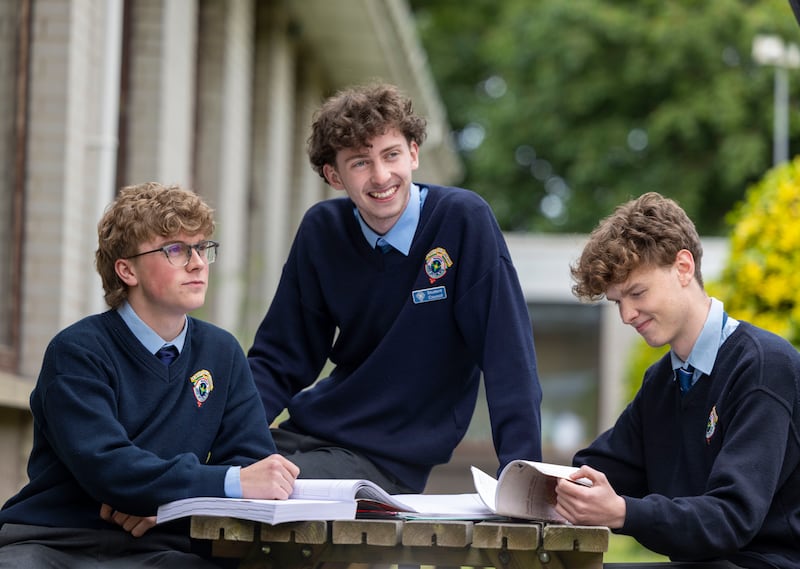
Some lovely photogrphs here from Ardscoil Rís Secondary School on Griffith Avenue in Dublin 9. Our photographer Tom Honan visited after maths paper one on Friday evening.


Last-minute tips ahead of the Leaving Cert Irish exams
Hugh Gallagher, author and Irish teacher at Stepaside Educate Together Secondary School, spoke to Jen Hogan ahead of today and tomorrow’s exams.
He said it’s better to stick to simple, accurate sentences when writing answers, as opposed to more complex ones, where mistakes can occur.
Students also shouldn’t be afraid of a long question in the listening comprehension, and when it comes to the reading comprehension, Gallagher advises students to underline the question words.
“Who, what, where, when, why. And then go to the piece and highlight the sentence with those words. Check back then before you write your final answer to make sure that you’re only including the information that was asked for.”
You can read the full piece here.
Leaving Certificate students are sitting maths paper two right now, with the exam due to end at 12 noon.
There were mixed reviews on Friday’s maths paper one at higher level, with quite a few of you getting in touch over the weekend to say how difficult it was.
Of particular concern was a question relating to the tuning of a piano, which certainly put my head in a spin just reading it.
Niall Duddy, ASTI subject representative and a teacher at Presentation College Athenry, said this question struck a bum note. “I don’t want to make a song and dance about it, but students had trouble tuning into the question,” he told Peter McGuire.
You can read Peter’s full paper review here.
Hopefully today’s paper will leave students feeling more calm. Peter will have a full review once the exam ends this afternoon.
This evening we move on to Irish paper one, between 2pm and 4.20pm. We will have a paper review for this, too.
Please get in touch with any thoughts by email, niamh.towey@irishtimes.com.


