

Key reads
- Leaving Cert: ‘If I don’t do good, then it maybe sets a tone for the rest of my siblings’
- The Leaving Cert according to a guidance counsellor: ‘Their brains have been working so hard ... they need to get fresh air’
- 10 tips for parents supporting an exam student this month
- Sign up for our Classroom to College newsletter
That marks the end of week one of Leaving Cert 2026.
Well done to all of you who have gotten through some of the toughest papers of the exams.
I will leave you with some advice from Brian Mooney on what you can do this weekend to make sure you’re well prepared going into next week.
I hope you all get some rest, and I will see you back here on Monday for maths paper two.
Leaving Cert maths, paper one: Exam strikes the right tone, teachers say
The overriding reaction from students leaving examination centres on Friday afternoon was one of relief, a teacher has told Peter McGuire.
Eoghan O’Leary, head of maths at TheTuitionCentre.ie and a maths teacher at Kinsale Community College in Cork, said that one of the more unusual questions on this year’s higher-level maths paper one asked about the maths of tuning a piano.
“Candidates were asked to determine the frequency of musical notes relative to concert A. It was an appropriate metaphor for the examination as a whole: neither too high nor too low, this year’s first maths paper appeared to strike the right tone.”
“Initial feedback from students and teachers suggests that the paper was fair overall. It provided accessible entry points for students across a wide range of abilities while still containing sufficient challenge to differentiate between levels of attainment.
Algebra, calculus and sequences & series featured prominently throughout the paper.
“Students who had neglected sequences and series in particular may have found themselves under pressure, as the topic appeared in multiple questions and could not easily be avoided,” said O’Leary.
O’Leary said that students who had prepared across the breadth of the course were generally well rewarded, while those who had focused on a narrower range of topics may have found the paper more challenging than expected.
“Question one, based on algebra, was generally regarded as an accessible starting point and allowed students to settle into the examination.
“Later in the paper, question seven on differentiation focused on one of the most heavily anticipated topics on paper one and was welcomed by many candidates.”
Every year, some students inevitably leave any exam worried about the difficulty of particular questions, but the marking scheme is always adjusted to account for the level of difficulty.
“Question five on number systems proved more challenging for some students than many might have expected,” said O’Leary.
“But when marking schemes and solutions are published in the coming days, some candidates may conclude that the question was less difficult than it appeared at first glance.”
O’Leary said that not every question struck the right note immediately with students. “Question eight, based on an exponential function, was a topic that many candidates expected to encounter. However, the presentation of the question was somewhat different from what students were accustomed to seeing. While the underlying mathematics was relatively familiar, the context and format may have caused some candidates to pause before recognising the approach required.”
Questions six and ten were among the most unusual and abstract questions on the examination, said Mr O’Leary, but they could be left aside as students had an element of choice.
Speaking with his colleagues, O’Leary said that many teachers felt the paper rewarded students who had developed strong problem-solving skills rather than those relying solely on memorised procedures.
“The contextual nature of several questions reflected the continuing emphasis on mathematical literacy and problem-solving within the Leaving Certificate course,” he said.
The maths exam has now ended, and the papers are available to view online.
Higher level is here
Ordinary level is here
Foundation level is here
Poem written by Junior Cert pupil’s mother appears in his English paper

A lovely story here from Dara Bradley in Galway:
A Junior Cycle pupil in Co Galway got quite the surprise this week when a poem written by his mother, and inspired by him, came up in the English paper during this year’s State exams.
Envoi in Chalk, written by Emily Cullen, a poet in residence at the University of Limerick, appeared in section D of the higher-level English examination paper.
Chosen as Poem of the Week in The Irish Times in December 2019, it was inspired by her son, Lee Davison, now 15, who sat the exam at Coláiste Éinde in Salthill.
Cullen said when she collected her son from school after the exam on Wednesday he looked “very happy”.
“He said, ‘Mam, it went great. You won’t believe it, but the poem you wrote about me came up. The one about the chalk’. It was just a surreal moment, priceless really,” she said.
Lee was not sure whether to reveal the poem’s origins when answering the question. “He decided that the person marking his paper might not believe him, so he answered in the third person,” Cullen said.
Envoi in Chalk was written in 2019 by the poet when her mother was still alive but in hospital. The Co Leitrim native said she took inspiration from her son, who was then aged eight.
Cullen recalled how she had beckoned Lee in for dinner at their Rahoon home when she saw he had written a message, “The world is great”, with chalk on a pavement.
“I just thought, ‘Wow’. I was having one of those days where nothing was going right. I came in and the poem wrote itself. They’re very rare because most poems take a good bit of revising and redrafting, but that just came out,” she said.
After the exam, Coláiste Éinde deputy principal Seamus Kelly said it was a “lovely coincidence”.
“The message Lee chalked on the pavement and the message of the poem is so positive and life-affirming, a young boy’s view of the world that gives us all a lift,” he said.
Cullen did not know her poem – which featured in her third poetry collection, Conditional Perfect, by Doire Press – would appear in the Junior Certificate exam. It was “an incredible feeling” to learn it featured on the paper, she said. “It’s a poem that has a bright message in these dark times and it’s all thanks to Lee.”
Peter McGuire’s full geography review is here now, just as maths paper one kicks off. We will have reviews on that for you in the evening.
Spare a thought for the parents of those winging it
One reader and parent, Lucy O’Reilly from Dún Laoghaire in Co Dublin, wrote to us this morning asking we spare a thought for those whose children are winging it.
“All the coverage of studious students, worried about this paper and that poet, spare a thought for the parents of those who have decided to wing it.
“My youngest decided months ago that he doesn’t need to study as the course he wants requires low points (and an interview). So he’s done zero revision since his mocks. I’m so anxious I’m eating Kimberley, Mikado and Coconut Creams for breakfast!”
It sounds like A) a great breakfast and B) a pretty cool kid to me.
Geography was ‘fair, well-balanced and student friendly’
Geography has just finished up, and the first reviews are in.
My colleague Peter McGuire has this first take:
Students sitting the Leaving Certificate geography exam were happy with a paper that rewarded preparation while avoiding unexpected questions, teachers have said.
“The higher-level paper was fair, well-balanced and student friendly,” said Stephen Doyle, teacher at Moyle Park College in Clondalkin, Dublin 22 and an expert reviewer for Studyclix.ie.
“The short questions followed a familiar structure that gave students a comfortable start to the exam.”
All Leaving Cert exam papers should pose some questions to differentiate the H1 student from their classmates. In this year’s paper, that challenge came in the human geography elective.
“Undoubtedly, the human geography elective section was the only section of the paper that may have caused some difficulty for some students,” said Dan Sheedy, principal of TheTuitionCentre.ie.
Doyle, meanwhile, said that some questions in this section were more specific than in previous years.
Mapwork, aerial photographs and graphs featured prominently throughout part one of the paper, which was consistent with previous years.
Doyle said that students may have been caught off guard by a question asking about the formation of sedimentary and metamorphic rocks, as many had focused their revision on igneous and metamorphic rocks.
The physical geography section, however, delivered on widely-anticipated topics.
“Expected topics such as karst landscapes, erosion, constructive plate boundaries and human interaction with surface processes all appeared,” said Doyle.
“The weathering question was quite specific, focusing on the role of temperature in physical weathering, and may have challenged some students.”
Sheedy said that many candidates will have turned immediately to the optional geoecology section upon receiving the paper.
“They will have been pleased to find questions on the characteristics of a biome and the impact of human activity on soils,” he said.
The regional and economic geography sections covered familiar ground across Irish, European and continental regions.
“Topics such as cultural regions and a 20-mark question on the European Union and Eurozone were also highly accessible and are unlikely to have posed significant difficulties,” said Sheedy.
“The EU theme continued into the economic geography elective, where reliable and familiar topics such as multinational corporations appeared. While this section was perhaps slightly more demanding than in previous years, students were still presented with questions they could approach confidently.
In the short questions, a question on isostasy stood out as a more demanding inclusion.
“It was an excellent, albeit challenging, question, but it added an extra layer of depth to this section,” said Sheedy.
Overall, both teachers offered a positive verdict.
“Students are likely to have left the examination feeling very pleased with both the content and structure of the paper,” said Sheedy.
Doyle agreed, saying the exam “provided plenty of opportunities to demonstrate both their geographical knowledge and skills, while containing very few major surprises.”
At ordinary level, the picture was similarly positive.
“The questions were accessible, covered familiar topics and gave candidates plenty of opportunities to demonstrate their knowledge,” said Doyle.
“Overall, it was a fair and manageable paper.”
The geography papers have now been published on the State Examination Commission’s website.
Higher level part one is here.
Higher level part two is here.
Ordinary level part one is here.
Ordinary level part two is here.
Advice for parents from a career consultant

Petrina Mitchell’s two children are sitting the Leaving Cert and Junior Cycle exams respectively.
Having students sitting both exams requires a different kind of support, she says. One that is reflective of age and maturity and the type of people they are.
She’s conscious with her Leaving Cert student of a need to encourage breaks. “You’re kind of going, ‘maybe we might go for a run, or go to the gym, or take a break’. You’re reminding [him] of that.”
Whereas, she explains, with her Junior Cycle student, it’s about continued support and motivation. “You just have to go with the child that’s in front of you,” she says. And sometimes support looks like “cajoling”.
Read her full interview with Jen Hogan here.
‘Sensible’ degrees are overrated
In today’s Opinion section, professor of cultural and creative industries at Queen Mary University of London Aoife Monks is arguing for the importance of arts degrees.
“During this anxious first week of the Leaving Certificate, with the minds of students and their families turning to their degree choices, it’s worth remembering that even ancient Greek philosophers couldn’t tell what practices and skills would prove to be valuable in the future. In the face of artificial intelligence (AI), we can’t even tell what skills are going to be useful in five years’ time," Monks writes.
“This is why it’s so concerning when Irish educational policy narrows its priorities to emphasise only the most apparently “useful” skills and jobs."
You can read the full piece here.
Photographer Fran Veale was in Belmayne, Co Dublin yesterday evening where students of the Educate Together secondary school were reflecting on the English paper.



So how was English paper two yesterday? ‘No curveballs,’ the teachers tell us
Our reporter Jack Brady spoke to Siobhán O’Donovan, a teacher at the Patrician Academy in Co Cork, who said students will be “very happy” with the exam overall as they faced “no curveballs”.
“I don’t think anyone had any big problem with the exam,” O’Donovan said.
“Its lovely to see them coming out happy,” she said, adding that it’s not always the case that you see students coming out of the exam hall with a smile on their face.
Liam Dingle, a teacher at the Institute of Education, said the appearance of poets Paula Meehan and Elizabeth Bishop would have given students a “little moment of triumph” before taking on the exam.
You can read the full paper review here.
If I fail maths, do I fail the Leaving Cert?
The short answer is no. There is no pass or fail system in the Leaving Cert.
If you fail maths, you will receive zero CAO points for the subject and likely won’t use it as one of the six subjects you count for CAO points.
Some college courses have a minimum requirement in maths, so you if you fail the subject you won’t be able to access those courses even with the right points.
But many courses do not have that requirement, and it is worth checking that before finalising your CAO choices if you feel it didn’t go well for you.
With the right college course selection, and six other strong subjects, it may not affect you at all.
‘I’m worried most about maths’
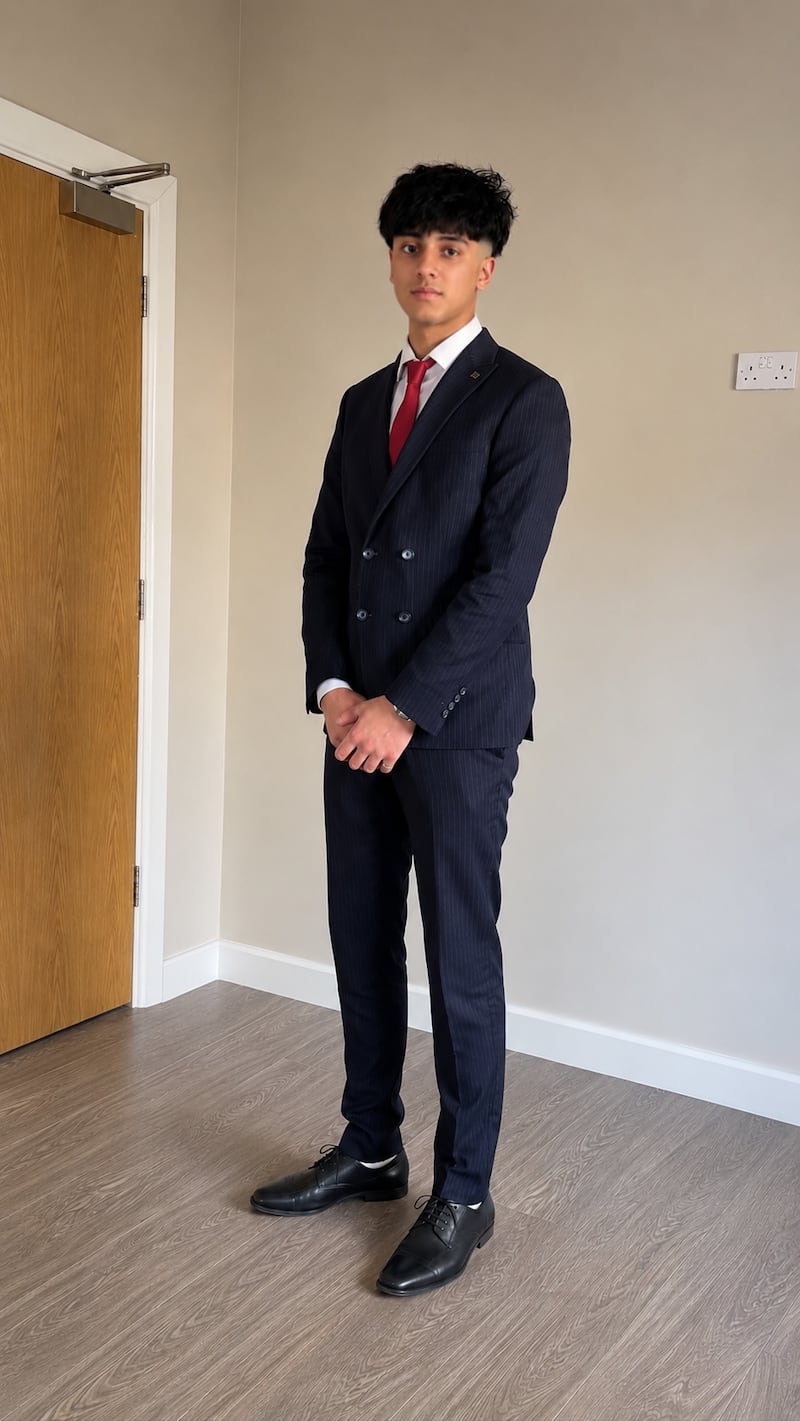
Seventeen-year-old Momin Bari from Dublin spoke to Jen Hogan today about his hopes for the maths exam.
He’s hoping to study either economics and finance, or commerce and is studying seven higher-level subjects and one at ordinary level.
Business and history are his favourite subjects. He’s worried most about maths. “I’m doing higher-level maths for the bonus points. Other than that, I’d probably do ordinary level. But those extra points really mean a lot.”
He has been taking grinds in maths, which has helped with his confidence. “Before, I was pretty weak, but you need to put in the hours obviously if you want to get better.”
So how many hours is Bari putting in? “I’d say anywhere between six to 10 hours” per day, he says. “I make sure I wake up early, and I’m sleeping well and eating well,” he says.
Read his full story here.
Today will see students face geography and maths paper one as the first week of the Leaving Certificate exams comes to a close.
After almost 3½ hours of English paper two yesterday, students may understandably be waking up a little groggy this morning.
Well, they have algebra to look forward to in maths paper one, along with differentiation and integration.
It’s not all bad though, because by 4.30pm this evening you will be through the bulk of the two core subjects, English and maths, with the weekend to prepare for maths paper two.
If you have any questions, thoughts or feedback, please email me, niamh.towey@irishtimes.com.
Good luck.


