A 27-year-old man who had his leg mauled by a blue shark off the coast of Co Waterford has said he feared for his life following the attack on Tuesday.
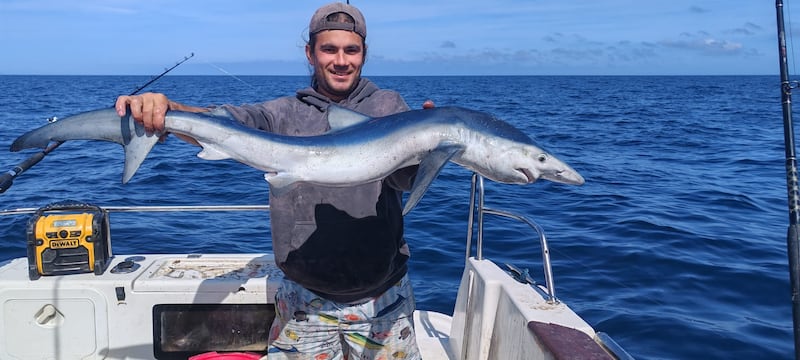
Experienced angler Sebastian Achim was fishing with four others some 6.5km from Ram Head, Ardmore, when a shark − caught by Achim some time earlier − lunged for him on the deck of the boat and bit his calf, causing significant injuries.
“I thought, ‘I’m not going to make it’. I was trying to stay strong to not scare the other crew,” Achim said, speaking to The Irish Times on Wednesday from Cork University Hospital.
Achim, who is from Romania and lives in Dungarvan, fishes regularly, describing it as his “passion”. Tuesday was his first time fishing for blue shark, something he said he wanted to do for “a very long time”.
RM Block


Blue sharks can grow to 3m in length and are present in Irish waters between June and October, according to Inland Fisheries Ireland.
“We fished for a few hours. Everybody – the rest of the crew – caught their own shark. I finally managed to land my own, I got a 1.5m blue shark,” Achim said.
The crew was preparing to release Achim’s catch back into the water when it attacked him, he said.
“I was like a metre away from the fish. I was just admiring my catch ... the fish just lunged at me. It got my leg.
“He managed to bite into my calf, and the bone, and ripped a part of the calf and he took it with him. I started bleeding instantly.”
Achim said he attempted to stem the flow of blood using a rope. He said a significant amount of blood gathered on the boat’s deck.

RNLI units from Ballycotton and Youghal and the Irish Coast Guard responded to calls for help from the crew aboard the vessel.
Achim said he was unconscious when he was winched from the boat by the Coast Guard crew. “The helicopter helped a lot ... it’s probably the reason why I’m still okay,” Achim said.
He said no one was at fault for the incident – not even the fish. “It could happen to anyone,” he said.
Achim said he will have to stay in hospital for at least a few days. He said he hopes the incident raises awareness.
“Myself, I will stop fishing for [blue shark], because I got my lesson. I got my shark anyway ... but I’m not telling anyone to stop, just to be more careful,” he said.
Ballycotton RNLI was requested to launch by Dublin Coast Guard at 4.16pm to assist a 5m pleasure craft with five people on board, approximately 6.5km off Ram Head, Ardmore.
The call formed part of a co-ordinated response involving Ballycotton RNLI, Youghal RNLI and Irish Coast Guard Helicopter Rescue 117.
Ballycotton RNLI’s all-weather Trent-class lifeboat, The Austin Lidbury, was launched at 4.30pm.
It said there were “calm sea conditions and good visibility” and the lifeboat arrived on scene at approximately 5.10pm.
Youghal RNLI and Rescue 117 were already at the casualty vessel.
Both lifeboats remained on standby while the casualty was winched from the vessel by Rescue 117 and transferred for emergency evacuation to Cork University Hospital.
The remaining members of the group did not require assistance, and the casualty vessel subsequently returned safely to Dungarvan. Both lifeboats were then stood down.
Ballycotton RNLI returned to harbour at approximately 6.15pm, where the lifeboat was refuelled before the volunteer crew continued with their scheduled weekly training session.
Coxswain, Eolan Walsh said the man sustained an injury on his lower leg. He said the group was out on a “pleasure fishing trip”.
Walsh has been involved with the RNLI for “30-something years” and said it was the first time he had tended to an incident where someone was bitten by a shark.
However, he said he was aware of a man who was bitten by a shark in 2018 off the coast of Co Cork.
Walsh described the rescue as “a well co-ordinated multi-agency response” with Ballycotton RNLI, Youghal RNLI and Rescue 117 working together to ensure the man received “urgent medical assistance as quickly and safely as possible”.
“Our crew were pleased to be able to support the operation and remain on scene while the casualty was transferred for emergency treatment and we wish the casualty a full recovery,” he said.
“Incidents such as this are a reminder that conditions at sea can change quickly and that anyone heading offshore should make safety a priority.”


