
As Dublin’s sky dimmed into twilight at about 7pm on Wednesday evening, nearly 94 per cent of the sun vanished behind the moon, marking the deepest partial eclipse Ireland has witnessed since 1999.
It wasn’t total – and we won’t see such a deep eclipse in Ireland again until 2090 – but even a 94 per cent eclipse changes the sky in ways worth understanding.
It is an astronomical coincidence that the moon’s diameter almost exactly matches the sun’s diameter as seen from Earth.
This means that during an eclipse the moon can completely block the intense light from the sun’s visible surface, allowing its extended outer atmosphere – the corona – to be observed directly.
RM Block


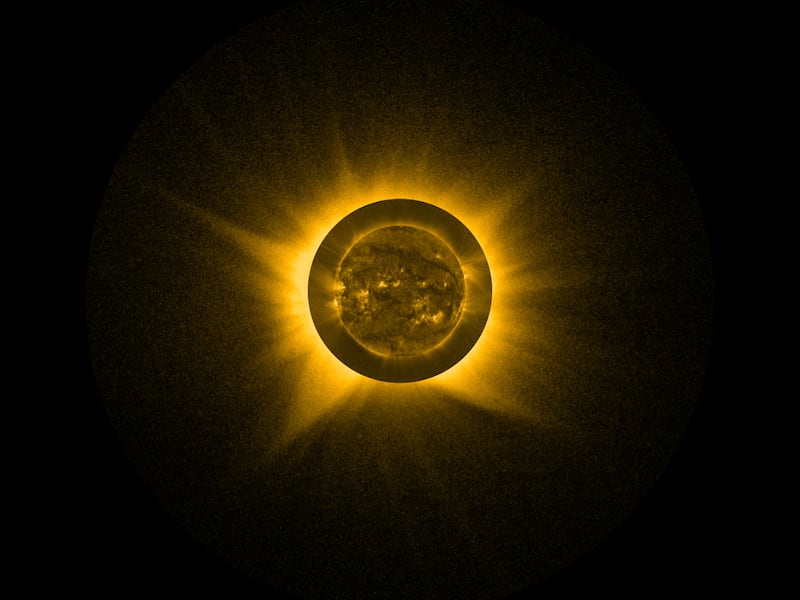

The phenomenon is both a spectacular astronomical event and a genuine opportunity to learn more about our nearest star.
The solar corona is about a million times fainter than the sun’s surface. Observing it under normal circumstances requires specialised equipment known as a coronagraph, a telescope designed to create a kind of artificial eclipse within its own optics.
[ How animals behave in a solar eclipse is extraordinaryOpens in new window ]
Such instruments were first invented in the early 20th century, and today astronomers still build and launch coronagraphs into space to study the corona in great detail. An example of this is the PROBA-3 mission of the European Space Agency.
Even though we can create artificial eclipses with advanced optics on modern spacecraft or from the ground, a real solar eclipse gives astronomers a rare chance to point their equipment at the sun and capture images of the corona with exceptional sensitivity and resolution.


Yesterday evening, a team of scientists from the Dublin Institute for Advanced Studies, Trinity College Dublin and Technological University Dublin took a flight with the Irish Air Corps to capture images from the air.
Such an effort isn’t just in pursuit of beautiful images. It helps address one of the longest-standing unsolved problems in astrophysics: the coronal heating problem.
By analysing the light from the sun’s surface, we know it sits at a temperature of around 5,500 degrees. That may sound extreme, but it’s nothing compared to the corona, where the outer solar atmosphere can exceed one million degrees.
Exactly how the solar corona reaches such extreme temperatures remains an unsolved mystery.
It’s a bit like walking away from a fire and having your surroundings get hotter rather than cooler, and the same puzzle applies to many other stars, not just our sun.
Explanations range from constant, small-scale bursts of energy across the solar surface known as nanoflares, to magnetic waves that carry energy from the surface deep into the star’s atmosphere.
Both coronagraphs and observations during eclipses help improve the spatial and temporal detail with which we can study the solar corona.
That makes an eclipse not only a spectacular cultural event, but an opportunity to deepen our understanding of the sun, of stars, and of our place among them in the universe.
Eoin Carley is a senior data scientist at The Irish Times. He has a PhD in physics from TCD and previously worked as an astrophysics research scientist at both TCD and DIAS


