One of the big points of contention around deer management in Ireland relates to the fact that, in the absence of any census, no one can be sure of the size of the population – but it is assumed to be growing.
Reports of road traffic incidents involving deer, and related insurance claims, are increasing year on year.
Anecdotally, farmers are reporting issues around degraded crops, eaten or trampled by deer, in areas where once there were none. Biodiversity is taking a hit, with forests suffering from deer “overbrowsing” in certain woodlands, halting the development of saplings.
The number of deer being culled each year in Ireland is growing, as is the number of licensed deerstalkers and the number of Section 42 permits (to shoot deer outside of hunting season) being issued. According to the Irish Deer Commission, a record 78,000 wild deer were culled between February 2022 and February 2023, up from 55,000 in the previous 12-month period.
RM Block


One of the people facilitating that rise is Ronan Gorman, chief executive of Country Sports Ireland (CSI), a national representative body for country sports that offers training courses for prospective deerstalkers.
“Deer do need to be managed,” he says. “And it’s incumbent on all of us that we do that efficiently in terms of culling the right animals and achieving a sustainable population, but also doing it in a way that is as humane as possible.”
A humane shot is one that “will kill the deer quickly and cleanly”, Gorman explains. A deerstalking course covers shooting accuracy and practical safety, initially offering a broad presentation on deer management followed by a written assessment.
[ Ella McSweeney: Deer pressure - I need a licence to cullOpens in new window ]
CSI also teaches courses on deer hunting and “large wild game meat hygiene”, which enables successful learners to provide deer carcasses to regulated food establishments.
“When you gralloch the deer, as we call it, cleaning it out, you do that in a way that doesn’t contaminate the carcass,” Gorman says. “You transport it and store it in the right way. That course is a mandatory requirement if you want to supply carcasses to an approved game-handling establishment. You have to be a trained hunter to do that.”
A deer management strategy group was established in 2022 by the Department of Agriculture, Food and the Marine, with support from the National Parks and Wildlife Service (NPWS).
It conducted a public consultation in December of that year, drawing more than 1,500 respondents. Some 86 per cent of them suggested deer culling as a main solution to deer management issues, with better land management practices (78 per cent) and a successful venison market (70 per cent) also favoured.
Representatives for the strategy group appeared before an Oireachtas Joint Committee on Agriculture and Food in recent weeks. They mentioned those potential solutions, as well as scope for more co-ordinated thinking on the topic and improved data collection around the deer population and the constraints facing Ireland’s market for wild venison.
The strategy group’s chair, Teddy Cashman, noted that improved data collection would “close the traceability loop” for venison, unlocking market opportunities and making it easier to get the product on shelves.
Venison also needed “suitable game-handling and storage facilities”, Cashman said. In areas with higher deer populations, these facilities could improve preservation of deer carcasses and allow a hunter to amass more viable venison in one sitting. Funding has been approved for five refrigerated larders to store carcasses in such locations, he added.
Cashman said he was told at the time of the strategy group’s formation in 2022 that there were 600,000 deer in Ireland, “plus or minus 200,000”. He said we knew “the numbers increased dramatically over the Covid period because there was very little hunting done”.
Gorman says a reliance on anecdotal information is akin to “feeling our way in the dark a bit” in managing deer population. He agrees, however, with the “widespread perception” that the number is rising.
“We see a diversity of people [on deerstalking courses],” Gorman says. “We see a lot of farmers, for example, who are taking matters into their own hands in terms of going and acquiring skills and knowledge to manage deer sustainably on their own land.

“We also see a number of people who don’t traditionally come from a country sports background but are very much into a way of living that is sustainable and ecological. They think they can play a part in managing wild deer populations, but also when they harvest an animal, they can consume high-quality, low-input, organic, healthy meat with no food miles.”
Gorman believes culling is the only form of deer management that could be widely effective. The “only other method that merits any consideration” is fencing, he suggests, but adds that, on a wide scale, it would be too expensive.
One option, which did not receive much consideration at those recent Oireachtas committee meetings, is the reintroduction of an apex predator for wild deer.
“There is a perfect solution for all of this, and that is the reintroduction of the wolf,” says Killian McLaughlin, founder of Wild Ireland, an animal sanctuary in Donegal devoted to native species Ireland has lost over the years.
In 2019, former Green Party leader Eamon Ryan famously called for the reintroduction of the wolf to Ireland; the Department of Culture, Heritage and the Gaeltacht poured cold water on the suggestion.
Apex predators such as the wolf never overpopulate, McLaughlin says, as they are intrinsically linked to their prey and their numbers must fluctuate in tandem. He says wolves are more effective hunters of deer than humans, as they will catch weaker, sick deer.
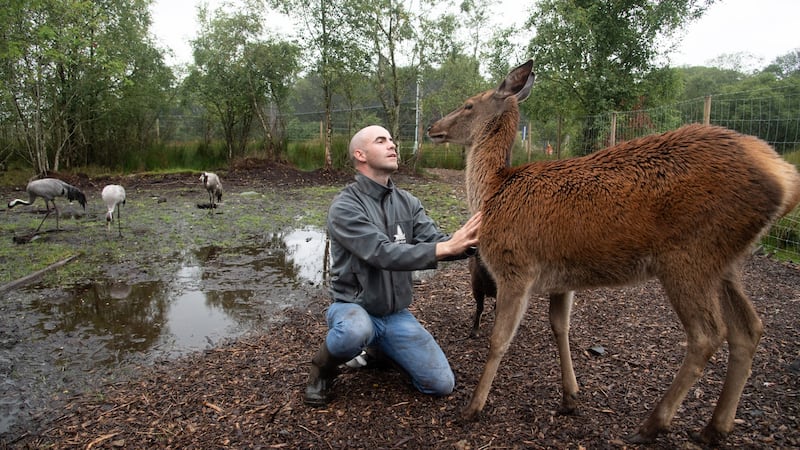
Gorman says the reintroduction of wolves is a “pipe dream”, and that the number of deer in Ireland is such that “a handful of wolves here and there is going to have a negligible impact”.
“Secondly, in areas of Europe where there are still small populations of wolves, they roam over massive ranges that are not heavily populated,” Gorman says. “In Ireland, we haven’t had wolves in nearly 400 years. The landscape has changed dramatically. There’s not many wild areas left any more. Not many of them would be capable of having wild wolves there without substantial impacts and conflicts.”
McLaughlin acknowledges there would be some loss of livestock with wolves back in the picture, but argues that potential threat is overblown and measures could be put in place to counteract it, such as sheepdogs and better fencing.
“People say we don’t have the habitat for [wolves] here, yet we have the habitat for we-don’t-know-how-many deer,” he says. “If there’s a habitat for deer, there’s a habitat for the wolf because it’s the exact same habitat. If we have a carrying capacity for deer, we equally can have a carrying capacity for wolves.”
In the last year, the sika deer was declared an invasive species in the European Union, with member countries directed to eradicate or control their respective sika populations. McLaughlin says it is vital to remind people that deer are not vermin, and that they play a vital role in our ecosystem.
“They’re very important in opening up forests and allowing light into the understorey,” he says. “That’s where you get your butterflies and all the insects we rely on for pollination.”