

An electric car owner who was refused permission to keep a charging arm on the street outside his home has said he is frustrated at being punished for being a good citizen.
He is one of a number of Dublin householders who installed on-street chargers and are now hoping to dodge planning enforcement while they wait for the Government to review regulations preventing them doing it legally.
Another electric vehicle (EV) owner has lodged an appeal with An Coimisiún Pleanála, which is due to make a decision on the case next month. Her appeal is against a refusal by Dublin City Council to issue her a declaration that a charging arm is exempted development, meaning it would not require planning permission.
The man who sought planning permission from the council but was refused last month has been trying to retain his charging arm for the past three years.
RM Block


His house is in one of the city’s redbrick Victorian neighbourhoods with gardens bordered by wrought-iron railings that are an architectural feature subject to conservation rules.
Permission to remove railings to create off-street parking is generally refused on architectural conservation grounds and because replacing pedestrian gates with vehicular access would result in the loss of an on-street parking space.
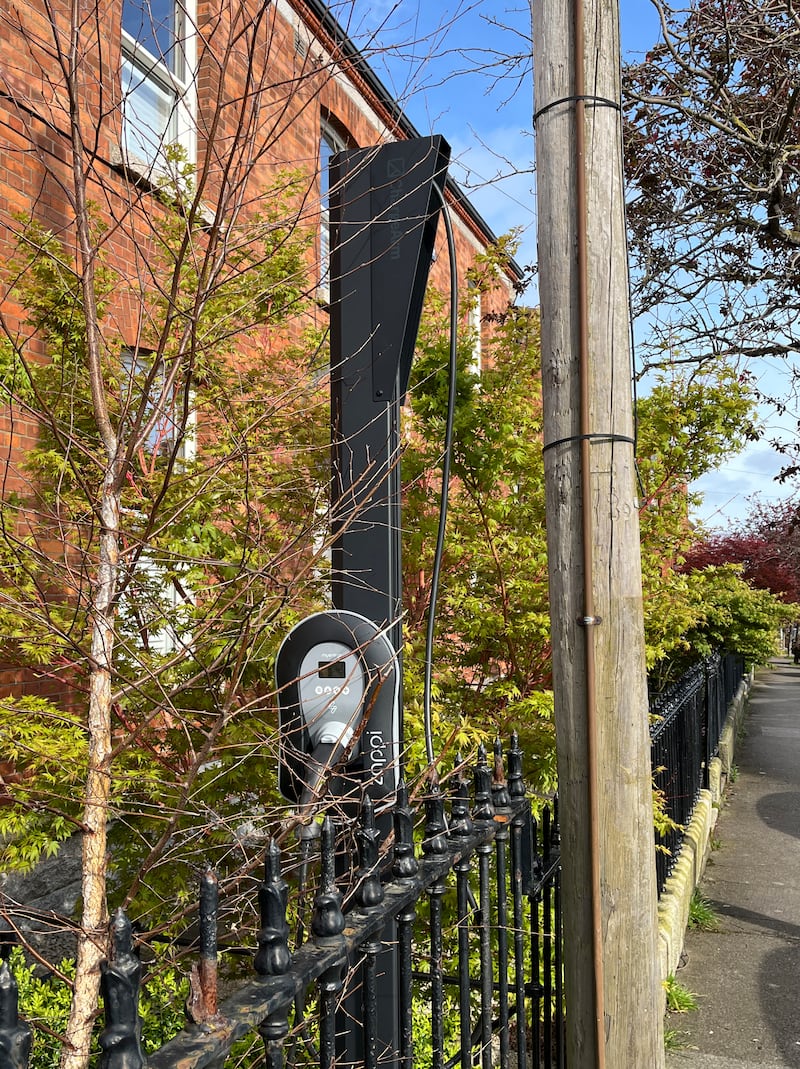
The man, who asked not to be named, said his only option was to install an EV charging arm, a unit with a pedestal inside the railings and a retractable gantry and power cable that reaches across the footpath – above head height – to his car parked on the street.
EV charging arms are readily available in Ireland although the uncertainty over their planning status has left suppliers reluctant to talk about the level of sales.
In the planning report from Dublin City Council, the planner says the gantry is “slender and the black finish is considered consistent with character of the area”.
“The structure does not appear to require the removal of architectural features typical of the area (wrought iron railing) and if required, can be removed without loss of the existing fabric.”
However, the council’s Transportation Planning Division swayed the decision to a refusal.
“This division has serious concerns with the provision of private EV charging which relies on the public road outside the control and ownership of the applicant,” it said.
It cites the council’s EV strategy as saying: “EV charging requirements for users without off-street parking will be provided by neighbourhood charging led by the council.”
The homeowner says there is no neighbourhood charging.
“There is so little in terms of public charging infrastructure around us and even if there was, they’re expensive and designed for short top-ups. You couldn’t spend hours getting a full charge,” he said.
“It’s very frustrating. We thought we were being good citizens and we want to play our part but if we have to take our charger down, we’ll have to get rid of the EV and buy a petrol car.”
Dublin City Council late last year identified 10 sites where clusters of public chargers are to be installed. It acknowledged the difficulties for EV owners and said it will be working to identify further sites.
Tens of thousands of period homes in Dublin have no driveway where they can park their car off-street and charge on private property.
New developments with higher densities and fewer gardens are also creating challenges for EV owners.
It emerged last week that residents in Adamstown who installed charging posts on individual parking spaces may have to remove them because the spaces are technically public space.
Matthew Sealy, chair of the Irish EV Association, said EV owners in Ireland should have a “right to charge”.
This was the policy in other EU countries and it opened up many varied options for charging.
[ Ireland needs to get serious on EV charging infrastructureOpens in new window ]
“It’s not a massive issue at the moment here, but it will become bigger and it’s something that needs to be solved,” he said.
The Department of Transport acknowledges the problems in its draft EV charging infrastructure strategy for 2026-2028, which has just completed public consultation.
“At present, cross-pavement charging is not permitted in Ireland due to private wires legislation [that prevents private power cables being laid in public areas],” it says.
“Legislation to amend the private wires legislation and allow this to happen is currently being drafted by Government.”
But the charging option highlighted in the draft is one that runs cables from homes to on-street parking spaces through narrow channels in footpaths dug, sealed and maintained at the homeowner’s expense.
It references a pilot project under way in Northern Ireland since last October to develop the procedures and protocols for such installations.
EV owners in the Republic fear this option could become bogged down in protracted procedures and heavy costs.
[ Concerns over electric car chargers and the risk of over-paymentOpens in new window ]
In a separate legislative review, the Government is considering expanding the list of developments that can be classified as exempt from needing planning permission.
Minister of State for Planning John Cummins, in reply to a question from Green Party leader Roderic O’Gorman last month, said there had been “significant progress on the review of exempted development regulations” and the updated list would be “forthcoming across 2026”.
Sealy said he was hopeful a greater range of charging options would make the list.
“I think we’re moving towards more options becoming available but we’re not there yet.”


