
A Co Donegal student has won a prestigious environmental prize for developing a biodegradable plastic that breaks down safely but also gets rid of existing microplastics.
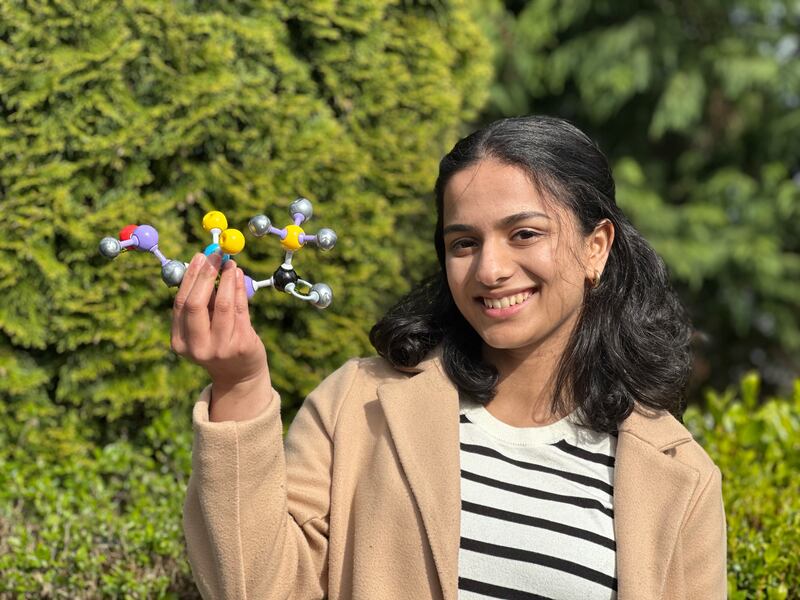
Arya Satheesh, an 18-year-old Leaving Certificate student in Loreto Secondary School in Letterkenny, was the winner of the Earth Prize 2026.
There were some 4,000 entrants from around the world, with seven regional award winners. Satheesh will share in the total of $100,000 (€84,000) in funding given to the winners.
She aims to put her share of the prize, worth about €12,000, into developing her project further.
RM Block


She said winning the prize was a “dream come true. This is just the beginning, and I hope it can become a scalable solution that makes a real difference”.
Satheesh was born in Kerala, India, and moved with her family to Ireland when she was in fourth class.
She said she had not been interested in science until transition year. “I found a way that I can learn science other than reading text books. I am doing all sciences at school now,” she said.
“TY changed my life. I found reading textbooks and not seeing it in real life very hard. My main interest is in biology.”
Satheesh entered the Biological and Ecological Sciences category with her project titled Eco Purge: Biodegradable Plastic with Enzyme-Driven Microplastic Degradation. It involved embedding a specific type of enzyme within plastic, including microplastics, as it is formed so that the enzyme can break it down rapidly to avoid discarded plastic building up in seas and on land.
Eco Purge is a biodegradable plastic that breaks down safely while releasing catalysts that help remove existing microplastics from the environment.
Wheras most solutions are limited to trying to reduce plastic use, Eco Purge goes a step farther by helping clean up the tiny plastic particles that are already polluting oceans, soil and even our food and water.
Satheesh was inspired by an earlier project monitoring water quality that revealed a key problem: microplastics could be detected but not removed.
She explored how plastics break down and developed a plant-based plastic that can carry special enzymes.
By embedding these enzymes inside the material, they remain stable and are released gradually as the plastic degrades, allowing them to continue breaking down microplastics in different environments such as water, soil and compost.
Now developed into a working prototype, Eco Purge has already been used in collaborations with researchers at University College Dublin, where the BiOrbic Bioeconomy Research Centre is based, and Atlantic Technological University Letterkenny.
With support from the Earth Prize, Satheesh plans to develop real-world products such as packaging and compost bags, making it easier to tackle microplastic pollution on a larger scale.
She did a previous project for SciFest, the second-level science competition in Irish schools, on a smart water monitor.
“Eventually I came across a limitation in that project and [found] that microplastics were a big issue. There was no filter at that time that could filter microplastics from drinking water,” she said.
“I went on researching about plastics and I wanted to know why there was no filter. I went into how microplastics are formed and solutions to get rid of it.
“One of the solutions I found was that it could be recycled and the other one was that we could use an enzyme to breakdown microplastics.”
Currently only 9 per cent of the 450 million tonnes of plastic produced every year gets recycled.
The enzyme that breaks down the plastics is expensive to produce in small batches, so she is working on a project to be able to scale up production.
“I will use half the money to do that. If that doesn’t work, I will use the other money to fix it,” she says.
She plans to apply for colleges in biotechnology in the UK and also to Trinity College Dublin. She is not likely to be short of offers.
The Earth Prize is run by The Earth Foundation, a non-profit organisation based in Geneva, Switzerland, founded during the School Strike for Climate in 2019.
Public voting for the global winner opens on Monday April 18th, the day after the final regional winner is announced. You can cast your vote on the Earth Prize website: www.theearthprize.org/vote.


