
Main Points
- Met Éireann says daytime temperatures will be in excess of 27 degrees during the week before climbing towards 30 degrees on Thursday.
- The highest temperature recorded today was 27.9 degrees in Co Cork.
- The heat dome has pushed temperatures above 40 degrees in parts of western Europe this week
- The record for the hottest ever June day in the UK was broken today with temperatures soaring above 36 degrees
- France recorded its hottest day ever on Tuesday
- It is now time to look at mitigation measures to cope with warmer temperatures, academic warns
Key Reads
- News report: Soaring temperatures continue to break records across Europe
- From sunscreen to staying cool: how to keep yourself and your family safe in the heat
- ‘Bathers should take care’: Swimmers advised to avoid some spots in Dublin due to rainfall
- In pictures: Europe swelters in heat dome
That is all for this evening.
Enjoy the good weather tomorrow and good night.
Parts of France and Italy come under red alerts
Météo-France placed 72 departments – home to more than three-quarters of the population of mainland France – under red alerts for extreme heat on Thursday.
The city of Paris said it was launching a “level 4 heatwave plan” that included measures such as keeping most parks and gardens open all night and extending the hours of municipal swimming pools.
Outreach teams were also being deployed to contact people living on the streets, it said in a statement.
Across Italy, 16 cities including Rome were under red alert for heat.
Construction workers and delivery riders were told not to work between 12.30pm and 4pm.
In the Netherlands, an extreme heat warning led to the cancellation of outdoor sports, scaled-down public transport and the shortening of school days, while local authorities in Switzerland offered free daytime cinema screenings in air-conditioned theatres. - Guardian
Read about those enjoying a summer’s day out at the Forty Foot

Anne Vella, who lives in Sandycove, Dubin, brought her Maltese terrier, Sophie, along to the Forty Foot on Wednesday for some fresh air, writes Jack Brady.
The retired midwife says “seeing people so happy” was the highlight of times like these and she believes most are “much friendlier” when the weather is warmer.
“The only thing that makes me unhappy about the sunny days is the mess that people leave behind on the beach,” she says.
For the full article, read here.
What will the weather be like on Thursday?
According to Met Éireann, Thursday will be hot and humid.
It will mostly be a dry and sunny day, apart from a few patches of drizzle in the northwest early in the day.
Later in the day, thunderstorms may develop, most likely in the west and northwest.
Highest temperatures will range from 25 to 31 degrees and may possibly reach higher in some places, with hottest temperatures across the midlands and west.
On Thursday night things will take a turn as heavy showers and possible thunderstorms are likely to develop with a chance of spot flooding and frequent lightning.
It will be a warm and humid night with lowest temperatures of just 17 to 20 degrees.
Europe warming at more than twice the global average
The World Meteorological Organisation said that Europe is warming at more than twice the global average which makes prolonged heat episodes increasingly likely. - Reuters
Why is Ireland so warm this week?

Behind this spike in temperatures is a “heat dome” hovering above the land mass, writes Stephen Conneely.
The phrase “heat dome” has only come into use relatively recently and “isn’t a traditional meteorological term”, according to Matthew Martin, a forecasting meteorologist at Met Éireann.
He said it was commonly used “to refer to a slow moving area of high pressure” that “usually develops above large, continental areas”.
He explained that this high pressure builds over several days and restricts air from rising higher in the atmosphere, trapping and condensing heat closer to Earth’s surface.
This is a double-edged sword, as air this close to the ground is unable to form clouds, allowing prolonged and direct sunlight to further heat the landscape.
It is a “short, sharp blast of hot weather” that has an accumulative effect over time, said Martin. “The nature of a heat dome is that it’s getting hotter and hotter each day.”
Martin expects the temperatures to begin to decline by the weekend. Wednesday and Thursday will be the hottest of the week.
For the full article, read here.
Some photographs of Dublin in the sun


Hundreds of thousands of poultry die in French heat

Extreme heat in France has killed hundreds of thousands of poultry, overwhelming carcass collection services and prompting authorities to consider on-farm burial in the two biggest poultry-producing regions, agricultural organisations said.
The losses come as Western Europe is gripped by a record heatwave that has killed dozens of people, closed schools, knocked out power supplies and forced farmers to harvest grain at night. - Reuters
UK weather record for June broken for a third time today
A new record temperature of 36.1 degrees for June has been recorded in Gosport, Hampshire, the Met Office said, breaking Wednesday’s previous records of 35.7 degrees and 35.8 degrees.
Met Office science manager Amy Doherty said: “If confirmed, a new June daily temperature record would be significant, especially following on the heels of the recent records set in May.
“The new record provides further evidence that temperatures previously considered extreme are becoming increasingly common as a result of human-induced climate change.”
Temperatures could rise even higher on Thursday, the Met Office said. - PA
New UK weather record for June broken just hours after being set

Earlier today, the record for the hottest ever June day in the UK was broken with a temperature of 35.7 degrees recorded at Charlwood, Surrey.
However, an even higher temperature of 35.8 degrees was recorded later today at Wiggonholt in West Sussex, according to The Guardian.
The previous record high was 35.6 degrees in Southampton, during the 1976 heatwave.
Here’s a RTÉ report from the 1976 heatwave from Colm Connolly. Worth watching until the end.
No record temperatures in Ireland on Wednesday
The highest temperature on Wednesday was 27.9 degrees at Moore Park in Co Cork, followed by 27.7 degrees at Oak Park in Co Carlow.
The highest temperatures of the week are likely on Thursday. The temperature will see 27 degrees in Dublin, 29 degrees in Offaly and Mayo and 30 degrees in the midlands.
It could reach as high as 30 degrees in the midlands with a possibility of 31 degrees. The highest temperature this year was the 28.3 degrees recorded in Dublin on Tuesday.

That was the summer of ‘76
The current heatwave is happening almost 50 years exactly after the first of two heatwaves during the summer of 1976.
From June 27th to July 6th, 1976, there was a heatwave across Ireland, defined as five days in a row when the average temperature is above 25 degrees.
The highest ever June temperature before this week was 32.5 degrees recorded at Boora, Co Offaly, on June 29th, 1976. It was also the highest temperature recorded in Ireland in the 20th century.
There was a second heatwave in August of that year, which lasted 14 days from August 14th to 27th.
Back then there was no talk of climate change, but the long, hot summer remains the driest on record in Ireland and led to water rationing and a lack of fodder.
Smaller weather stations showing 30 degrees-plus temperature values
Met Éireann operates synoptic weather stations which are the only ones recognised for official temperatures.
However, there are hundreds of unofficial weather stations attached to the wow-ie (weather observations website) which is attached to Met Éireann.
Though their weather observations are not officially recognised, they are generally accurate.
They appear to show that the warmest weather is being recorded in the Tipperary-Kilkenny-Carlow area with a 30.7 degrees in Callan town and a 36.3 at the ITIPPERA6 station, which is certainly a temperature anomaly.
Will France lose its aversion to air-conditioning?
France is reconsidering its long-term aversion to air-conditioning in the light of the ferocious heatwave currently enveloping the country.
France, as many visitors will attest, keep the heat out of their homes by using shutters in the summertime.
Only 25 per cent of French premises have air conditioning. As a result, hospitals and schools that have had to shut en masse as temperatures outside reach more than 40 degrees in the south of France.
National Rally politician Marine Le Pen said the ban on “la clim” (air conditioning) in public institutions was leading to unnecessary deaths.
“It is a shame that babies, elderly, sick people endure such heat because they refuse to install air conditioning! This heat is killing people!” she said.
Even the French Green Party, which regards air conditioning as a waste of energy and a threat to the environment as it releases greenhouse gases, has admitted it may be necessary for some places to install air conditioning.
Climate change conference gets cancelled because of climate change
Alanis Morissette sang about “rain on your wedding day” in her worldwide smash hit Ironic in 1996.
It is not ironic if there is rain on your wedding day unless you are a weather forecaster who forecast sunshine for your own wedding and it rains.
However, it is ironic that an event which was due to be held in London to discuss adapting to climate change has been cancelled because of climate change.
The event, titled Extreme Heat: Improving Governance and Strengthening Action, will not go ahead at the London School of Economics’ Shaw Library on Wednesday evening.
Organisers said the university’s building did not have any cooling mechanisms in place “like most buildings in London”.
New UK weather record for June is set
The record for the hottest ever June day in the UK has been broken, with temperatures soaring to 35.7 degrees in Charlwood, Surrey.
This beats the previous record stretching back to June 1976 when a temperature of 35.6 degrees was recorded.
The UK Met Office’s chief scientist Prof Stephen Belcher described the June heatwave as “sobering”.
He said human-induced climate change has made events like this “more likely and more intense”.
Met Office projections indicate hot spells will become more frequent in the future, particularly over the southeast of the UK.
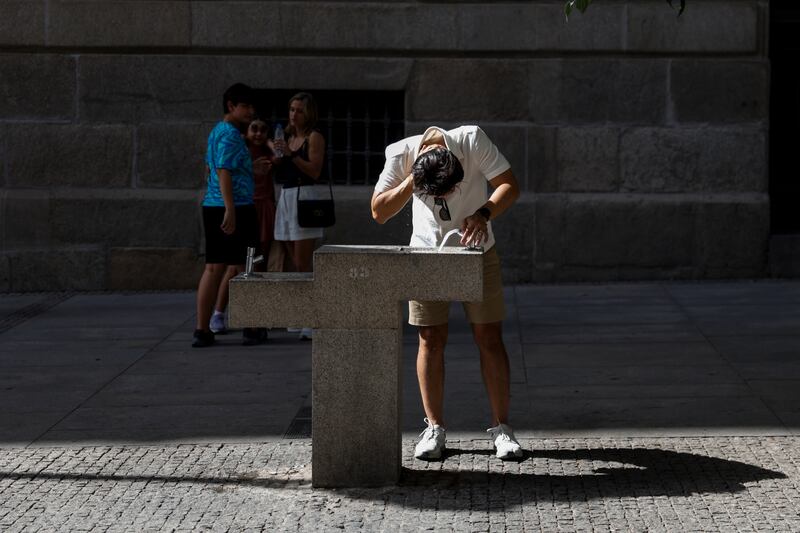
Here are some photos from around Europe during the heatwave:


Heatwave reduces France’s nuclear power output
A heatwave sweeping western Europe reduced France’s nuclear output on Wednesday as high temperatures across the country reduced access to water needed to cool reactors, Reuters reported.
Output was reduced by 4.1 gigawatts, or 7 per cent, of total power demand at midday, data from French utility EDF showed.
Rise in children experiencing sunburn, UK expert says
Ken Dunn, consultant burns and plastic surgeon (retired) and vice chair at the Children’s Burn Trust (CB), told PA: “We are seeing a worrying rise in children experiencing sunburn, which is painful, distressing and entirely preventable.
“Simple steps like keeping children out of direct sun, covering up exposed skin and reapplying sunscreen regularly can make a real difference.”
Time to look at mitigation measures, Maynooth University academic warns
It is now time to look at measures to cope with warmer temperatures which will continue because of global emissions, Claire Bergin of the Irish Climate Analysis Research Units (ICARUS) at Maynooth University has warned.
Bergin told RTÉ Radio’s Morning Ireland that summers were definitely getting warmer and there was a need to slow down the increase in “human-caused climate change”.
It was time now to look at mitigation measures “to put health practices in place, to look at your homes and evaluate them, how can you make them cooler in these warm temperatures? It’s all together very important,” she said.
What we were experiencing now was “basically a stacking of high-pressure systems through our atmosphere, from the lower levels to the upper levels, that just sit on top of each other and create this really hot, warm area underneath”.
Bergin also said: “These temperatures are increasing because of human-caused climate change. There’s more heat in these systems because of our emissions of fossil fuels and we’re adding to these global temperatures.”
Research at ICARUS and internationally was showing that these high-intensity heat episodes were being made more likely because of climate change, she said.
More than 90 million people in Europe face temperatures of about 35 degrees today
At least 94 million people in Europe are expected to experience temperatures above 35 degrees today, most of them in France and Spain, according to AFP estimates.
More than 350 million people will experience temperatures above 30 degrees. That’s two-thirds of the continent’s population.


Electricity prices rise in Europe due to heatwave
Electricity prices have risen sharply across European markets in recent days, as the heatwave has gripped much of the continent. Millions are turning to air conditioners and electric fans to battle the record temperatures, pushing demand higher and causing power plant outages.
The Irish Times would like to hear from people from Ireland living or travelling in parts of Europe impacted by extreme heat. How are you coping? Are transport networks impacted? Has your work or holiday been affected or have you changed your plans as a consequence of the heat?
What is day-to-day life like living in these conditions? You can share your experiences of hot weather in Europe by using the form here.
Europe heatwave ‘putting people’s health at risk,’ WHO chief warns
The head of the World Health Organisation, Tedros Adhanom Ghebreyesus, warned that Europe’s heatwave was “putting people’s health at risk.”
“Europe’s heatwave is closing schools and putting people’s health at risk. The data are clear: temperatures across Europe are rising at roughly twice the global average rate, increasing the likelihood and severity of extreme heat in the future,” he said.
Ireland ‘at edge’ of European heat dome, Met Éireann issues hot-weather warnings
With temperatures in Ireland bouncing around the mid-20s, Met Éireann has issued a status yellow advisory from midday Tuesday until Friday morning, warning of “exceptionally warm weather” that could lead to water safety issues, uncomfortable sleeping conditions and heat stress.
This is the second time this summer a prolonged heatwave has seized the Continent. But behind this spike in temperatures is a “heat dome” hovering above the land mass.
The phrase “heat dome” has only come into use relatively recently and “isn’t a traditional meteorological term”, said Matthew Martin, a forecasting meteorologist at Met Éireann. He said it was commonly used “to refer to a slow moving area of high pressure” that “usually develops above large, continental areas”.
Read our full explainer here.
Here is the weather forecast for today, with temperatures for some of the key European cities:
Paris: 41 degrees
Bordeaux: 39 degrees
Madrid: 38 degrees
Frankfurt: 37 degrees
Brussels: 36 degrees
Rome: 35 degrees
Bologna: 35 degrees
London: 34 degrees
Amsterdam: 34 degrees
Zurich: 32 degrees
Prague: 32 degrees
Berlin: 31 degrees
Barcelona: 31 degrees
Essentially, if you are anywhere between Lisbon (24) and Warsaw (27), it will be super hot.
Europe is facing another day of an unprecedented heatwave, with temperatures breaking records in several countries.
A Met Éireann high-temperature alert kicked in at noon on Tuesday, and runs until Friday, with a daily high of 28.3 degrees recorded at the Phoenix Park in Dublin.
The UK is braced for record-breaking temperatures, with schools to close and people urged not to travel, as temperatures are set to potentially reach 40 degrees on Wednesday and Thursday in some parts of England and Wales. A red weather warning for extreme heat is in place for areas stretching from London to Swansea and Somerset to Birmingham.
On Tuesday, France registered its hottest day on record as 40 people across the country were confirmed to have drowned while swimming in unsupervised areas over the last few days. More than 90 per cent of the French population is exposed to extreme heat, government data shows.
Rome, Milan, Florence, Turin, Venice and 10 other Italian cities were subject to the state’s highest level of alert, meaning the heat is deemed to pose a risk to the general population.
In the coming days, the heatwave is expected to extend into eastern Europe.
“Around the world climate disasters are becoming more frequent, more destructive and more costly,” United Nations secretary general António Guterres told a climate conference in London, while that city was gripped by suffocating heat. “London isn’t just calling, it’s cooking,” he said.
We’ll have live updates here throughout the day on the situation across Europe.
How to sleep in hot weather
Irish homes are designed to retain heat in colder months, which can quickly make them feel stuffy and warm as temperatures rise, leaving us searching for ways to cool down to sleep more comfortably.
The Irish Times published a piece on this last week, advising on simple ways to adapt your home to help it feel cooler.
These include:
Keeping blinds and curtains closed during the hottest part of the day to keep the room cooler. If you are renovating or extending your home, it is worth thinking carefully about glazing and shading too.
Cooking outdoors where possible or using smaller appliances such as air fryers, instead of ovens or hobs, and keeping extraction fans running after cooking.
Rethinking bedding and switching to a lighter 4.5 tog duvet, as well as using breathable natural fabrics such as cotton and linen.
Read the full piece here.
Lower temperatures could come to parts of Europe later today
Some relief from the heatwave could start to come from the west of Europe later today. Spain’s national weather service said temperatures would drop in most of the country.
By the afternoon, only parts of the Basque country in the north will still be marked red, and on Thursday no part of Spain will be rated either red or orange.
Power cuts in France
About 68,000 households were without electricity in western France on Wednesday, authorities said – the country’s first major power outage of the latest bout of extreme weather.
The outage, which involved a transformer on the electricity grid, was related to extreme temperatures, the prefecture in the coastal department of Finistere said in a statement.
Tuesday was the hottest day recorded in France, with an average temperature of 29.8C across the country. Similar conditions are expected until the weekend, with highs between 40 and 42 degrees.


