
Where did your love of the natural world come from?
Luck, nature, nurture and trauma. Losing a twin brother at birth predisposed me to search for something I knew was missing and as soon as I could venture into the wild woods and meadows near my home, I found wildlife. Dad had a huge collection of field guides on nature, and encouraged me to use them to identify everything from species of tiny insects to types of clouds and trees. As a neurodivergent child, nature wasn’t just my grounding obsession but a refuge from the bewildering social codes of school.
Both your parents were journalists – the photojournalist Alisdair Macdonald and news journalist Barbara Macdonald. How did that influence how you approached writing?
Both journalism and photography once seemed hugely uncool to me because they were my parents’ careers. Now I know better. In terms of my own writing, their influence has been huge. Both of them taught me that you can’t wait around and rely on the muse to inspire you. You have to do the work, however you’re feeling about it, and if things don’t work out, don’t dwell. Move on. You’ll have learned something from the experience.
RM Block


What is one of your strongest memories from your time studying English at Cambridge and how did that experience lead to your research work with falcons?
I remember being quite miserable a lot of the time. I wasn’t posh and came from a state school. Cambridge was still super-privileged back then. My strongest happy memories involve learning to navigate the complicated reference systems of the university library and realising whole worlds of new thoughts and facts were suddenly available to me. Properly sublime.
As a writer of books and a maker of documentaries on nature, in which medium do you find it easier to communicate with your audience?
Documentaries are always a collaborative effort because you’re working with a talented team of camera people, sound people, directors and so on. It’s never just you communicating with the audience. Books let me do that; there’s a quiet, wonderful intimacy to writing that isn’t a feature of TV.
In H Is for Hawk, you write about how you became absorbed in training a goshawk as a way of coping with your grief following your father’s death. Was it difficult for you when your book was made into a film more than 10 years later and did you liaise with Irish author Emma Donoghue on the screenplay?
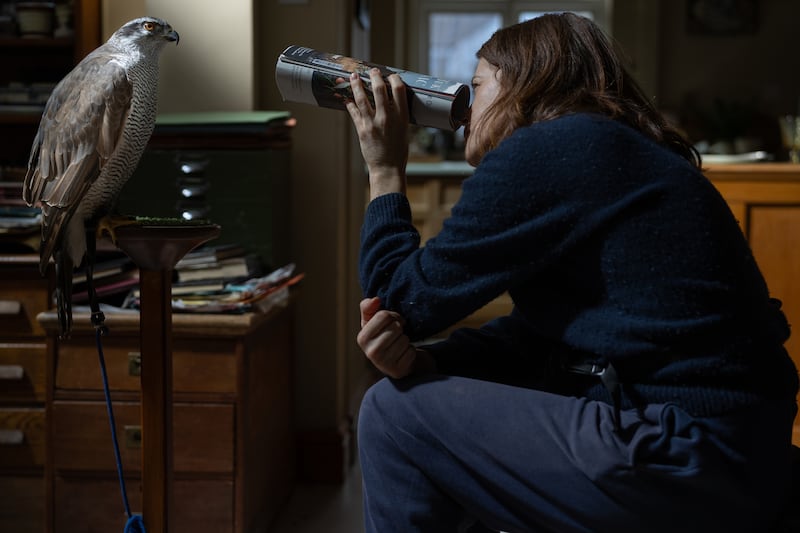
It has not been at all difficult, just very, very weird. When I visited the set and saw Claire Foy walking through the cloisters of my old college with a hawk on her fist I felt so much like a ghost watching myself I felt faint. Her performance is so like me it’s haunting – and she’s an incredible natural falconer. I feel strongly that stories live in their retelling, so I didn’t feel possessive over the script. I did meet with Emma early on, but my input was very much towards the end of development, just tweaking the script for accuracy and tone.
What are the best and worst things about where you now live?
The best thing: my Suffolk village on a summer evening just after harvest with the sun low in the sky and swifts scything above the treetops. The worst thing: Britain’s increasingly reactionary politics, particularly how it treats trans people. Awful.
Which projects are you currently working on?
A big book on Midway Atoll, a remote island in the Pacific Ocean that’s full of albatrosses and the ruins of an American naval base.
What is the most remarkable place you have visited?
Midway Atoll. Utterly surreal and astonishing in every way.
What is the best writing advice?
Don’t wait for inspiration or you’ll never get anything done. It’s great advice. I wish I could follow it.
What is the most beautiful book you own?
It’s a special cased facsimile of a Japanese falconry book from 1863 called Ehon Taka Kagami (An Illustrated Mirror of Hawking) by the artist Kawanabe Kyōsai. Absolutely exquisite, and the bookbinding is on another level.
You are supreme ruler for a day. Which law do you pass or abolish?
I’d begin by banning private equity.
Which current book, film and podcast would you recommend?
Book: The End of Everything by M. John Harrison. It’s one of the finest novels I’ve read for years. He’s described it as a Brexit novel and a road movie. It’s horrifying and beautiful and captures the sense of epistemological collapse that increasingly seems a feature of our times. I’m not a huge podcast listener but if I’m feeling glum, Mike and Vittorio’s Guide to Parenting invariably makes me laugh uncontrollably. Film: I just got back from seeing The Odyssey and it was immense.
Which public event affected you most?
Many years ago I witnessed a skydiving accident at a country fair. A vicious crosswind turned a parachute inside-out and the man hit the grassy arena with a terrible crack. It happened very close to me. I remember the face of an ambulance man wet with tears, and somehow the taste of the thick hush of the crowds. An appalling event that I still replay in dreams.
What is your most treasured possession?
At this point in my life, parrots have gleefully chewed, damaged or destroyed most of my treasured possessions. But I’m reaching the age where possessions feel increasingly less important, so that’s good. I do have a vase full of moulted wing feathers from my much-missed goshawk Mabel, from H Is for Hawk. I’m deeply sentimental about them.
Which writers, living or dead, would you invite to your dream dinner party?
I adore a lot of living writers and would feel obliged to invite them all, which would make the party huge, raucous and uncontrollable. Police would definitely be called. So, keeping it very small: Frank O’Hara, Mary Shelley, Coleridge, Flann O’Brien, Ursula Le Guin, Margaret St Clair. Irreverent, spiky, large-hearted, brilliant people all.
Who is your favourite fictional character?
John le Carré’s spy, George Smiley. A complicated figure in possession of great humanity who works for an institution marked by betrayal and brutality, Smiley’s moral compass fascinates me and he feels so impossibly alive and human on the page.
What are your expectations of reading and speaking at the Shaking Bog art and nature festival in Co Wicklow in August?
I’ll be speaking with the wonderful writer Hilary Adam White, which is guaranteed to bring me joy. I know I’m going to adore Shaking Bog not only for the people appearing – I’m particularly excited to see the brilliant poet Anthony Vahni Capildeo – but because it’s so wholeheartedly a celebration of place and nature, and as much about how to read a hedgerow or bog as it is to parse a phrase of music or get lost in a poem. Wicklow is a glorious place and it’s always, always wonderful to be back in Ireland.
Where Art & Nature Meet at The Shaking Bog Festival in Co Wicklow, August 21st–23rd


