Across the world, we are “in danger of becoming a people who cannot communicate with one another”, Booker Prize winning author Salman Rushdie has warned.
During a public interview in Dublin, the Indian-born British and American novelist said: “Even if people speak the same language, we don’t understand each other and we use the same words to mean different things”.
“When [US vice president] JD Vance uses the word freedom, he doesn’t mean what I mean, but he thinks he knows that word too.”
Language “can be so warped” by what is happening within cultures, said Rushdie. “As the gulfs between us widen and deepen, we literally cannot talk to each other. We are quite close to being there.”
“What happens when language does not work any more?” he asked. “How do we function?”
This, said Rushdie, is the meaning of his short story. The Old Man in the Piazza, included in his latest collection, The Eleventh Hour, published last year.
The story is “a kind of warning”, he said. “Writers have no power, we don’t have armies, most of us do not have any money but what we do is tell the future what the past is like, and so the history of the human race is in our hands.”
The future “will be what survives of us in words, in stories, in histories”, he said.
His message at the end of The Eleventh House collection – which contains three novellas and two shorter stories, set in India, England, and the US – is: “Things ain’t getting better folks. And look out.”
In another story in the collection, Rushdie said he was “having a go” at the many billionaires in his “hometown” of Bombay [renamed Mumbai] who are “even more garish and grotesque” than US billionaires.
The city has more billionaires than the rest of India and, he believes, more billionaires than the rest of Asia “so the concentration of wealth is colossal”. The city also has the largest population of people living in slums below poverty line, the contrast between wealth and poverty “is nowhere more acute than in Bombay”.
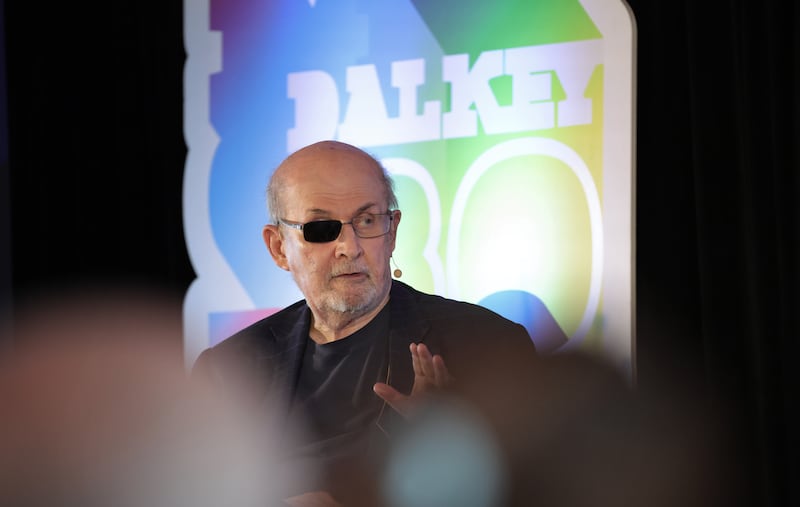
Rushdie, who turned 79 on June 19th, was interviewed by Merve Emre, a Turkish writer and academic before a large audience on Sunday evening in Dalkey as part of the Dalkey Book Festival.
After his fourth novel, The Satanic Verses, was published in 1988, he became the subject of several assassination attempts and a fatwa calling for his death was issued in 1989 by the then supreme leader of Iran, Ruhollah Khomeini.
In 2022, he survived a stabbing at the Chautauqua Institution in New York but lost his right eye and suffered injuries to his hands and liver.
Asked about his reaction, he said: “I don’t suffer from revengitis, unlike the president of the United States who can think of nothing else except money.”
He said he had been asked after the New York attack how he felt towards the attacker. “If you get trapped in the rhetoric of anger and revenge, it’s a cage, it makes it difficult to go past it and go on.”

When writing his memoir Knife in the aftermath of that attack, he had in mind a triangle shape involving himself, his wife and the attacker. It was drawn on his own experience of the event and the observations of others who were there.
The triangle represented “love and death, hate and love, ugliness and beauty” and the book turned out to be a love story, he said.
In his own memory of the attack, he was just standing there and the attacker is running at him but that was not how it happened, he was moving and trying to get away.
“One of the things about memory is that it makes mistakes, even when we know it is a mistake, we still trust it more than the facts.” His earlier novel, the Booker-prize winning Midnight’s Children, is about memory “as a fallible thing”, he said.
Towards the end of the interview, Rushdie was asked by an audience member to name his favourite book. Saying he did not know how to answer that, he said James Joyce’s Ulysses would be in his top five.
“There was a time when I would read it fairly regularly every few years in order to depress myself,” he said to laughter. “‘What do I do, he has done everything’, and then I had to find little corners of literature Joyce didn’t touch.”