
Kamil Pustkowski (17) from Limerick, one of five teenagers killed in the M9 wrong-way crash in Co Kildare last weekend, was recently diagnosed with autism.
He was described by a source as “impulsive and easily led”.
One person who had dealings with him said he appeared to be “doing better recently”. But another insisted his offending was rapidly escalating.
“He was the kind of young lad who was only going to stop if he killed somebody or was killed himself,” that person said.
RM Block


The same source said Pustkowski had rapidly attained a degree of notoriety among his peers because he so frequently posted content of himself in stolen cars. This included being pursued by gardaí and also engaging in wrong-way driving on motorways, involving near misses with oncoming traffic.
“He’d almost always show his face in the car,” said one source of Pustkowski. He later shared that footage on the online video sharing platform TikTok, where he had multiple accounts.
Gardaí were so concerned at the frequency and brazenness of his offending that his name was even cropping up in policing conversations about tackling joyriding nationally.
Pustkowski was on bail at the time of his death last Sunday at about 3am near Moone, Co Kildare, having been charged with joyriding-related offences.
[ M9 crash: What happened when? From attempted break-ins to the fatal collisionOpens in new window ]
A ban on leaving Limerick was one of the conditions imposed on him before his next scheduled court appearance in September.
Despite being restricted to Limerick, he often travelled to places such as Carlow, Kildare and Dublin – and as far as Monaghan – to “go on the tear in cars” with others, as one source put it.
“Like them all, he knew [gardaí] wouldn’t follow him the wrong way down a motorway,” said one garda.
As a result, once he was being pursued by gardaí, there followed a “frantic, crazy” dash to what he saw as the safety of the nearest motorway.
Despite the reputation Pustkowski had gained, especially since the start of this year, he was also the victim of violent bullying.
A video, seen by The Irish Times, apparently recorded recently, shows him being kicked and punched by a group of similarly-aged boys.
He tries to move away from them before collapsing on the ground. He is crying and pleading for the beating to stop.
Due to his engagement with the criminal justice system, he was receiving support from Extern, an organisation specialising in “positive change through youth justice” and was engaged in a full-time manufacturing course.
The four others killed on the M9 at Moone, Co Kildare, in the black BMW last weekend were: Jack Kennedy (17) from Athy, Co Kildare; Jeremy O’Brien (18) from Carlow; Joe “Joey” Carthy (15) from Athy; and Alex McCarthy (17) from Carlow.
The BMW they were in was not registered to any of the teenagers or their families, but it was not stolen. It is believed to have been purchased for just over €1,000 early last week.
Pustkowski and Kennedy, from the Green Hills area of Athy, were regarded as the most dominant of the five young males killed last weekend.
Kennedy is described as having had “an awful life” and “pushed from pillar to post in care”. He attended Ardscoil na Tríonóide in Athy and was in a residential placement in the care of child and family care agency Tusla.
In July, Kennedy was among a group of young males in a Ford Ranger that was driven over a motorcyclist in Graiguecullen, Co Carlow, after it had been stolen in Rathcoole, Co Dublin, hours earlier.
The Ford Ranger, a large 4x4 utility vehicle costing up to €72,000 new and weighing about two tonnes, was driven on to the narrow roads of Graiguecullen just after 7.30am on Wednesday, July 8th, with a patrol car in pursuit.
When the Ranger ran into traffic, the Garda car pulled alongside, only to be rammed from the side.
The Ranger was then driven up on to the pavement, to undertake the line of traffic ahead, hitting the car in front. It knocked over the motorcyclist, driving over him and his motorbike.
The vehicle sped away over traffic calming ramps, with footage of the incident going viral on social media. It was soon abandoned, with four suspects, including Kennedy, arrested on foot a short distance away.
The motorcyclist suffered serious head injuries and, as a result, went blind for a time. Sources said he suffered a severe skull injury, causing a swollen brain and gravely endangering his life.
Gardaí were waiting the results of forensic tests on the Ranger before they could link Kennedy and the other suspects to the vehicle for the purposes of charging them with a crime.
[ Kathy Sheridan: Grown-ups had a role to play in dangerous actions by childrenOpens in new window ]
Alex McCarthy (16) was also questioned by gardaí about the incident last month in Carlow. It was strongly suspected he was one of the four males in the Ford Ranger.
He was from a settled Traveller family. He attended St Joseph’s National School in Carlow town where one teacher remembers him as a “fine boy – no trouble at all”.
He went on to Tyndall College secondary school, but left before completing his Junior Cycle exams. He is understood to have loved horses and enjoyed sulky racing – a common pastime among some Travellers.
Joe ‘Joey’ Carthy (15) was from a settled Traveller family in Athy. He lived in the Clonmullion estate, a working class area in the northeast of the town, with his siblings and parents.
He was a member of St Michael’s Boxing Club from the age of 10, where his father is a long-time volunteer. His mother is understood to have taken in foster children.
In a statement the Athy boxing club said: “All of us here at St Michael’s were deeply saddened to learn of the death of Joe Carthy.
“We want to offer our sincere condolences to Joe’s family and friends, and especially to his father Willie, a valued volunteer and member of the club.”
Jeremy O’Brien’s death notice said he will be “sadly missed by his heartbroken mother Margaret, his loving brothers Jamie, Felix, Myles and Vincent” and other family members.
The response to the death of the five teenagers, whose car seriously injured three women and a child “travelling innocently”, as Garda Commissioner Justin Kelly put it, has been unforgiving in some quarters.
[ ‘Frightening time’ for family injured in M9 crash, friend saysOpens in new window ]
Indeed, a large volume of public comment online became so vitriolic that when the death notice for Carthy was published on RIP.ie, it had to be removed due to the nature of messages left in the section usually used for condolences.
And when notices for O’Brien and McCarthy were published, the condolences sections were disabled.
The crash that claimed the lives of the five teenagers, and left four members of the Kinsella family with major injuries, has dominated the news agenda for the week.
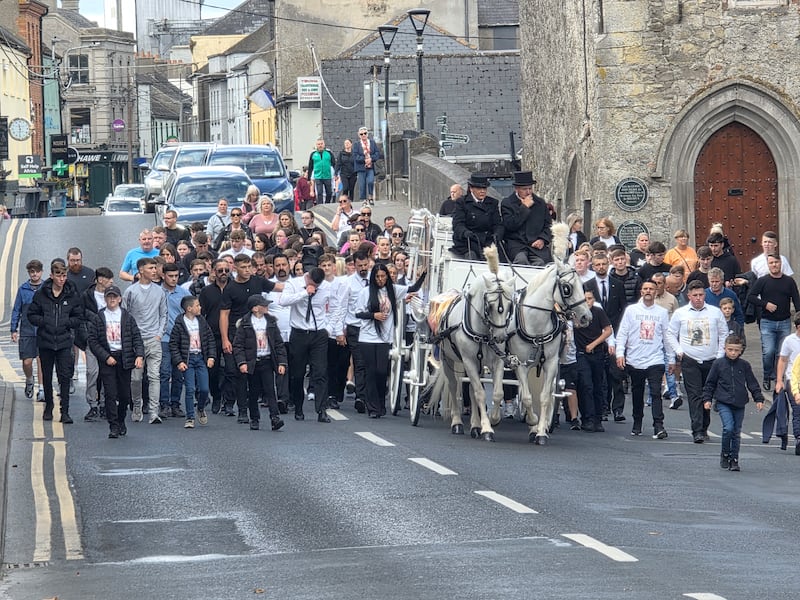
The funerals of Carthy, McCarthy and Pustkowski took place on Friday. O’Brien’s will be held on Monday. Kennedy’s funeral will take place in Athy on Tuesday.

Social media platforms came under fire through the week for allegedly helping glorify risk-to-life joyriding because of their failure to ban those who share videos of the incidents.
The first to raise this point was Det Mark Ferris, based in Blanchardstown, Dublin, and a member of the central executive of the Garda Representative Association, which represents more than 11,000 rank and file gardaí in a force of 14,700.
Many teenage joyriders were motivated to engage in their crimes, he said, because it gave them the opportunity to record what they were doing, for sharing on social media to gain kudos from their peers.
“Social media companies facilitate this and must also be held to account,” Ferris said.
Kelly, the Garda Commissioner, also pointed to the role of social media platforms, saying some of the joyriding and wrong-way motorway driving was “being done for social media likes” regardless of the life-threatening risk.
In a reflection of growing frustration and public anger at the extreme joyriding incidents – and though five young people had just lost their lives – the Garda Commissioner said the M9 collision underlined “how irresponsible and dangerous driving on the wrong side of the motorway is”.
While clips shared on social media platforms depict “threat to life” crimes, and gardaí seek their removal from public circulation and preserved for investigation, this rarely happens.
After the M9 crash, platforms such as Snapchat and TikTok said they had removed videos of the crash and related to it, and blocked some users.
Despite mounting political pressure, TikTok turned down an invitation to the Oireachtas media committee, issued in the wake of a fatal incident.
The committee’s chairman, Labour TD Alan Kelly, described the refusal as “a slap on the face”.
TikTok’s head of public affairs Susan Moss claimed Kelly made it clear the hearing would centre on questions about last Sunday’s crash.
The collision and the sharing of related videos are now subject of investigations by the Garda and media regulator Coimisiún na Meán.
Moss added it would be not be “appropriate to be the sole representative of the video-sharing industry” at the committee.
[ M9 crash exposes limits of rules on social media giantsOpens in new window ]
Garda sources said the joyriders’ appetite for capturing footage of their illegal driving was encouraging them in their crimes; one garda said he believed this was a motivating factor to a “colossal” extent.
Gardaí say joyriding has worsened due to the surge in the number of used Japanese cars being imported into the Republic since Brexit made buying used cars from Britain much less attractive.
Japanese used imports are usually not fitted with immobiliser devices, unlike cars made for the European market. Immobilisers are an antitheft device, compulsory for new vehicles in Europe, that prevent cars being hot-wired, or started without the key.
“Before Covid we had less than 3,000 Japanese cars [imported into the Republic] in a year and now we’ve more than 30,000 a year,” said one source.
“The Revenue Commissioners could increase the VRT [vehicle registration tax] on Japanese imports and put a real dent in this. But you need the co-operation of the social media companies too, and not just after the event.”
Warnings in the wake of the M9 crash also came from the Government. Minister for Justice Jim O’Callaghan warned young drivers “you’ll end up in jail, or you’ll end up in a grave” if they didn’t stop.
In reality, few young gang members driving recklessly on roads, often in stolen cars, are being killed.
Even when pursued by gardaí – though not the wrong way down motorways – they are escaping. Those who are caught – and later convicted – aren’t always sanctioned with a period in detention.
And, even if they are, Ireland’s youth prison – Oberstown Children Detention Campus in north Co Dublin – faces capacity constraints that mean it is, at times, unable to accept new committals.
Last Christmas, a group of joyriders took a car to Oberstown, posing outside for photographs, which they shared on social media to taunt gardaí.
Much was made this week, including by O’Callaghan, of plans to finally start training gardaí in vehicle pursuits. Garda driving instructors are already being trained by personnel from Devon and Cornwall Police in Britain, which has a pursuit training centre of excellence.
Once the Garda’s instructors are accredited, they will roll out the pursuit training by year end, in a first for Irish policing.
[ Gardaí start specialist training in UK for high-risk vehicle pursuitsOpens in new window ]
But Garda members in patrol cars will still be required to offer a live running commentary on pursuits, as they unfold, to their commanders at control and command centres.
When conditions are deemed by managers as too dangerous to continue a pursuit, they will be instructed to withdraw and let the joyriders speed off, in the hope they can be caught somewhere else.
So, will the new pursuit training change things on the roads? Will it help to bring wrong-way motorway driving to an end?
“Gardaí won’t be chasing people the wrong way down motorways, ever,” said one source, pointing out police in Britain also don’t engage in such chases as they were far too high risk.
“We’ve never done wrong-way motorway pursuits and we never will do it, and I think everybody knows that.
“The guys in the [stolen] cars definitely know it. And that’s why they’re rallying to the motorways when they see us. This isn’t going away any time soon.”


