
Gardaí not wearing identification badges and lacking an awareness of human rights standards have been flagged as emerging issues around the policing of Irish protests.
The first report from the Irish Network of Legal Observers has found that the vast majority of protests attended by its members during 2025 were policed “largely within the parameters” of relevant human rights legislation.
Emily Williams, policing and justice policy officer at the Irish Council for Civil Liberties (ICCL), says the network has not “identified any discriminatory practices per se” but has spotted trends.
The ICCL established the network alongside Dr Illan Wall of the Irish Centre for Human Rights at the University of Galway in late 2024. It has been monitoring the policing of protests since its establishment in 1976, including the presence of gardaí at evictions.
RM Block


It says it has been aware of wider concerns about protest policing, while internationally it cites similar legal observer projects in the UK, Scotland, Australia and the US.
During its first active year in 2025, legal observers attended demonstrations relating to the genocide in Gaza, the housing crisis, trans rights, antiracism and the climate crisis.
One example of an identified “trend”, Williams says, is the “more heavy-handed approaches and more use of force in Dublin and also in Shannon Airport ... whereas we’ve had observers present frequently at protests in Galway and in Cork city, and gardaí there seem to take a very hands-off approach”.
The network’s findings suggest more forceful policing can occur “near sites of infrastructural significance”.
One of the guiding principles of the network is that they “do not send legal observers to protests which are advocating for the infringement on rights of others”, Williams says.
“What this means is we are only sending legal observers to protests that are seeking collective liberation for all disadvantaged or marginalised groups,” she says. The network does not send observers to the kind of anti-immigration demonstrations that have been prominent in recent times.
Regarding allegations of gardaí not wearing badge numbers, the report notes that in certain instances “gardaí who were unidentifiable seemed to be the ones who are quick to use violence, raising the spectre that gardaí may be unofficially using ‘designated hitter’ tactics”. A “designated hitter” is an officer encouraged to “rough up” protesters and who endeavours to remain anonymous while doing so.
In a response, An Garda Síochána described this as a serious allegation.

“Any person or organisation that has any information or has evidence that substantiates such a serious allegation, that An Garda Síochána is in anyway involved in such activity as suggested, should immediately bring that information to the Office of the Police Ombudsman, Fiosrú the office with the statutory responsibility to investigate complaints about the Gardaí,” it said in a statement.
Wall says there is a wider issue around transparency and that gardaí are “really secretive about a lot of their procedures and policies”. He estimates that, at any given protest with a high Garda presence, roughly 10-30 per cent of officers do not wear badges.
[ Who were the Dublin rioters? What 82 prosecutions tell us about the unrestOpens in new window ]
“We can’t really speculate as to why the guards might not be wearing badges,” he says. “We do know that in certain [international] jurisdictions, there is a practice – not something which is official policy – but a practice of a ‘designated hitter’.”
Legal observers also claim that gardaí sometimes misuse Section 8 of the Criminal Justice (Public Order) Act 1994, which allows them to direct a protester to cease their behaviour and exit the vicinity immediately in a peaceful manner.
Observers documented gardaí “giving a Section 8 directive and then very rapidly escalating the situation” failing to allow a protester time and space to comply with the order.
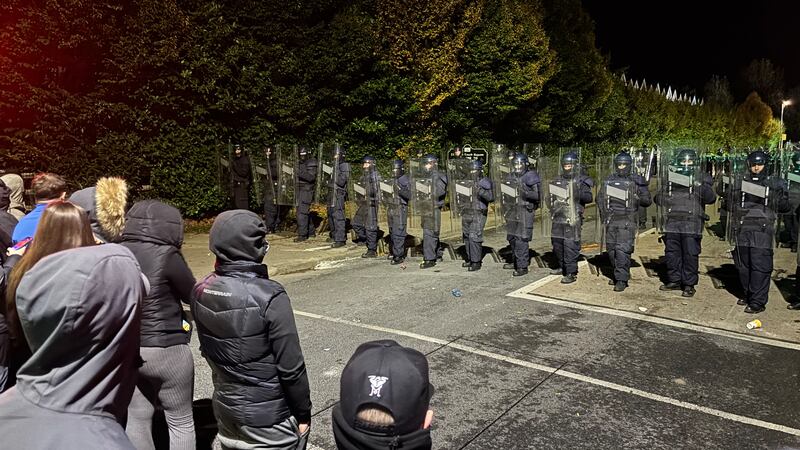
Of the 70 protests attended by the network in 2025, only one was considered non-compliant with human rights-based policing guidelines – a Palestinian solidarity event in Dublin on October 4th. On the day, Wall says, a smaller group of about 150 people broke away from a large demonstration in the city centre and rerouted to Dublin Port. There, they were stopped by a line of gardaí. Wall says the group linked arms and tried to push through Garda lines, and that officers responded by using pepper spray and drawing batons. Protesters withdrew and gardaí followed them, Wall says, continuing to use pepper spray.
A standoff ensued and, according to the claims, the protesters marched back around the block attempting to get to Dublin Port from a different direction. This time they were greeted by members of the Garda National Public Order Unit (GNPOU), who used pepper spray and batons “from the outset” as protesters again attempted to break through the lines.
“They beat a number of people [and] pepper-sprayed a number of people,” Wall says.
In a statement issued on October 4th An Garda Síochána said its members “attempted to engage with the protest group over the course of the afternoon to disperse the protest in a voluntary manner”.
“Despite this engagement there was a co-ordinated and concerted effort to physically breach the Garda cordon. In accordance with procedures An Garda Síochána deployed an escalation of response.”
The statement said members of the GNPOU and frontline uniformed gardaí “intervened to prevent a breach of the Garda cordon, which included the use of incapacitant spray on protesters”.
Wall says the network’s findings on October 4th were that “gardaí, in the first instance, had not given any direction to the protesters not to keep coming. The protesters were pushing and shoving, and the guards, in response to that, pepper-sprayed them and beat them”.
“There is perhaps a discussion about whether or not that initial interaction was legitimate,” he says. “What was not legitimate was for the guards to continue after they had started trying to get away.”
A guiding document for Williams and Wall is general comment 37 from the United Nations’s (UN) Human Rights Committee.
It establishes the human right to peaceful assembly, setting a threshold for what is considered violence, and noting that there should be a presumption in favour of peaceful protest.
It defines violence in the context of protest as “physical force against others that is likely to result in injury or death, or serious damage to property. Mere pushing and shoving or disruption of vehicular or pedestrian movement or daily activities do not amount to ‘violence’ ”.
Williams calls to mind demonstrations such as the Citywest riots last October, and the Dublin riots of November 2023, as events that clearly meet that threshold and fall outside the scope of peaceful protest.
Based on the network’s interactions with gardaí, Williams says members of An Garda Síochána do not seem to have “an understanding of what violence means within the context of peaceful protest” as determined by the UN.
Nobody in An Garda Síochána was available for interview, but in a statement it noted the constitutional right for citizens to express their views and opinions freely and to assemble peaceably, subject to statutory provisions.
“Any Garda response in relation to evolving events is in keeping with a community policing model and graduated policing response, taking into account relevant legislation and public safety.”
It says it policed more than 1,300 demonstrations last year, a broad categorisation that includes marches, rallies and meetings “where large public gatherings occur”. It says “the nature” of certain protests has changed in recent times. “While the vast majority of protests are peaceful, there has also been an increase in public disorder at some protests.”
Legal observers within the newly formed network are volunteers, and the majority do not have any legal background. In 2025 the ICCL ran about a dozen training events around the country, developing a base of more than 300 trained observers, 150 of whom are active with the network at any given moment.
It says its observers are drawn from various backgrounds and that the network is overseen by a steering committee of international experts in protest, policing and criminal justice, including the UN Special Rapporteur on freedom of assembly and association.
This year the network is on track to match the 70 protests it attended in 2025.
“There’s no suggestion that [Garda] policies should change,” says Wall. “The suggestion is simply that they should be upheld. Just holding the guards to account on their own policies is a really important thing to do.”


