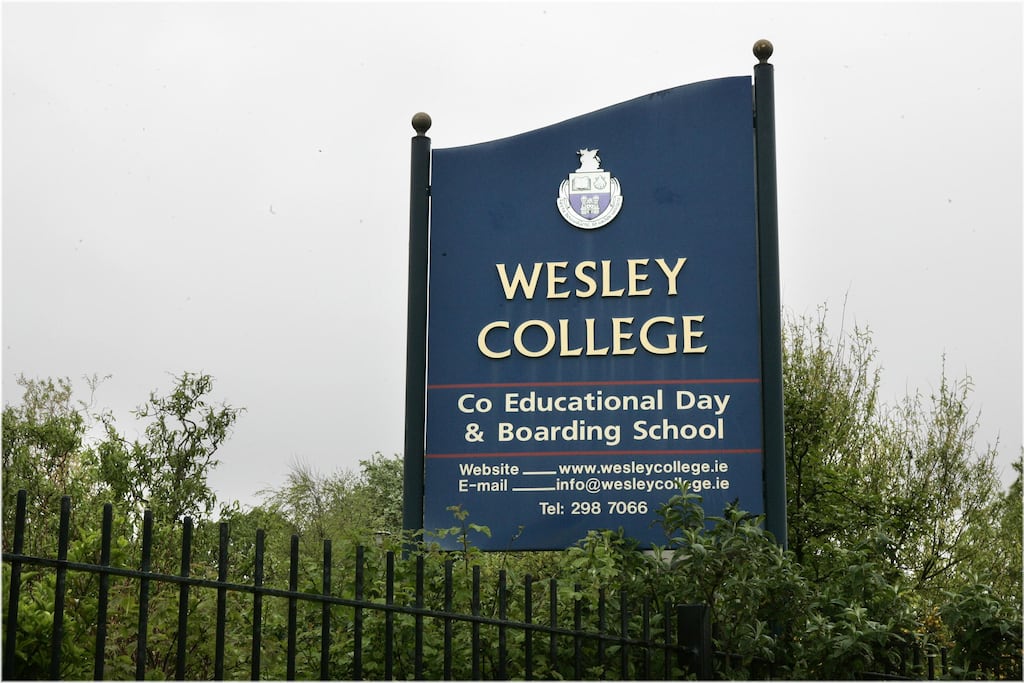
A “Trojan horse” development of all-weather rugby and hockey pitches on the grounds of Wesley College, a private school in south county Dublin, is to go ahead despite more than 10 neighbours raising concerns that its “possible consequences are not known, or even hinted at” by the school.
While multiple local residents described the school as a good neighbour and said they would not want to impede the sports facilities on offer to pupils, they objected to the proposal over its scale and potential noise disturbances, among other issues.
Wesley College’s board of governors was granted planning permission by Dún Laoghaire Rathdown County Council in early November for the project, comprising the construction of an all-weather rugby pitch and the refurbishment of an existing hockey pitch to upgrade it to an all-weather multi-sport surface with an eight metre high ball-stop fence and net.
These are to be located on the eastern side of Wesley College’s grounds, “part of the college’s established sports facilities” including grass fields, hockey pitches and tennis courts, according to a planning report supporting the school’s application.
RM Block



A proposal for six LED floodlights on the rugby pitch was included in the initial planning application, however the council mandated in its decision that these be subject to an additional application.
The Methodist-ethos school, which charges €8,125 for a day pupil to attend this academic year, has come under criticism by local residents for the “gradual erosion” the development may cause to their residential amenity. They all have a Dublin 16 address on Clonard Drive, which runs along the school’s eastern boundary.
“While we recognise the importance of providing sporting facilities for students and the wider community, we have significant concerns regarding the nature, scale and impact” of the proposal, a pair of residents wrote in a letter to the council’s planning office.
“Increased noise from sporting activities, coaching sessions and spectators” will lend itself to “disturbances to nearby residents”, they continued, as well as the “gradual erosion of residential amenity”.
Another couple, four doors down, took issue with the ball-stop fence and net blocking their and their neighbour’s views of the Dublin Wicklow Mountains.
“Such a setting warrants great sensitivity and condensation”, they wrote, and “this unique environment and open outlook is enjoyed by the occupants of around 60 houses on [the road] and has been an established feature of these houses for over 50 years.”
They questioned the need for such a tall fence, too. “While we confess to knowing little about hockey, we would question why it is necessary to have a combination of rigid ball-stop fence and nets at each end of the pitch”.
“Surely, a principal rule of field hockey is to keep the ball at a safe, low level,” they added.
Their next-door neighbour furthered that argument in his letter to the council: “I don’t understand the need for such a high fence, both rigid and netting, if it is only for hockey, which I thought was played close to ground level, except for the odd miscue,” he wrote.
“I hope the size of the fence is not in anticipation of the introduction of other sports, eg Padel. Padel courts are currently in vogue and highly lucrative. Reading the printed word, the impact of a Padel court is very disruptive and, with floodlights, could continue late into the evening,” he continued.
He and his family have lived behind Wesley College for more than 40 years, according to his letter, and the school has been an “excellent” neighbour throughout this time. However, the noise coming from its current hockey pitch, on the western half of campus, “is quite loud, even with the windows closed”.
“It is possible to hear [an] individual shouting instruction and occasionally foul language,” he wrote. “I dread to think what it would be like if the pitch was adjacent to the back of my garden.”
Wesley College Dublin declined to comment on the construction of the new rugby pitch and the refurbishment of the existing hockey pitch. It did not respond to a request for comment on objections to the development.